Saugata Saha wanted to fly airplanes. Growing up in India, he watched a father who was an engineer move into senior management and imagined a different destination for himself. The cockpit appealed. Engineering and business leadership did not. Years later, he would become a business leader whose opening statement at Qlik described artificial intelligence as a jet stream. Childhood ambitions have a way of finding a seat on the flight, even when somebody else is doing the flying.
On July 31, 2026, Saha became president and chief executive of Qlik, based in New York. He arrived from S&P Global, where his responsibilities had included both running Market Intelligence and serving as the company's first chief enterprise data officer. His new assignment brings that experience to software used to connect, prepare and analyze other organizations' data. The question running through his career has become particularly pressing: how does information become something a business can actually use?
His answer begins well before the arrival of a conversational interface. It involves customers, definitions, operating decisions and the awkward business of getting separate systems to cooperate. That makes for a less theatrical account of AI than a machine composing a sonnet. It also puts Saha's collection of previous jobs in a rather interesting light.
A first job worth reconsidering
Before consulting or financial information, there was Godrej. Saha spent seven years at the Mumbai-based group, with responsibilities spanning sales, supply-chain re-engineering and the Office of the Group Chairman. The range matters. Selling something, changing how it reaches a customer and working on corporate strategy offer different views of the same business. A spreadsheet can make those views look comfortably compatible. A customer can be rather less accommodating.
His education took him through economics at St. Xavier's College in Kolkata, a postgraduate management diploma at the Xavier Institute in Bhubaneswar and an MBA at Harvard Business School. At Harvard he graduated as a George F. Baker Scholar. The sequence moved from economics to management and then to another country, giving his later work across finance and operations a substantial academic foundation.
He subsequently spent seven years at McKinsey's New York office. His consulting work covered strategy, mergers and acquisitions, corporate finance and operational improvement, particularly for financial-services clients. Consulting expanded the range of businesses in view; his next move would give him a sustained role inside one of them.
In 2014, he joined McGraw-Hill Financial, the business later renamed S&P Global. Over the following decade he worked across corporate strategy, financial planning, technology operations and acquisition integration. He also led strategy within Ratings. This was a career assembled across departments rather than within one narrow specialty. Each function posed its own version of a practical question: what needs to happen for a plan to survive contact with the organization?
When the finance executive takes the controls
Before he ran Platts, Saha was chief financial officer of both Platts and Market Intelligence. He became Platts president on January 1, 2021, taking over a business supplying information and benchmarks to commodity markets. Here the usefulness of data is unusually concrete. Prices, shipping, energy and agricultural markets are places where information has consequences beyond the screen on which it appears.
His first year included the launch of the Platts Dimensions Pro integrated platform, expanded energy-transition coverage and broader capabilities in Asia, agriculture, shipping and petrochemicals. For 2021, Platts recorded $950 million in incentive-plan adjusted revenue, up 6.7%, with an adjusted EBITA margin of 54.4%. Those are division measures, with specified accounting definitions. They give the story a firmer footing than the usual executive biography's procession of flattering adjectives.
There was also the task of combining businesses after S&P Global's merger with IHS Markit. By 2024, Saha was leading Commodity Insights. That year's work included exceeding integration revenue-synergy targets and launching 13 products and services. Generative AI was entering the division through employee adoption programs and products including AI-Ready Data and Chat AI for Clean Energy Technology.
These details place him in the middle of the unglamorous part of transformation: integration, product releases and people learning to use new tools. An acquisition announcement occupies a day. Making the resulting organization work occupies considerably longer. Saha's roles repeatedly put him on the latter side of that calendar.
Two jobs, one stubborn problem
On November 1, 2024, Saha took on the presidency of Market Intelligence and the new chief enterprise data officer role. One responsibility concerned a division serving clients. The other crossed the wider company's data estate. The combination brought a commercial view and an enterprise view into the same office, with an explicit brief to expand and connect the information S&P Global held.
In January 2025, he announced the official launch of the Enterprise Data Organization. He described an estate exceeding one trillion data points, having grown a hundredfold in five years. The proposed work included AI-assisted sourcing, extraction, linking and distribution, supported by patterns that could be repeated at scale. Even a trillion data points still need introductions to one another.
His interest in AI also predates the generative boom. He was involved in S&P Global's 2018 acquisition of Kensho Technologies, which brought natural-language processing and machine-learning capabilities into the business. Those technologies subsequently appeared across its platforms. His later emphasis on interoperability followed an existing investment in using machines to make information more usable.
The ambition was becoming visible beyond internal infrastructure. At Davos in January 2026, his conversation with Business Today's Siddharth Zarabi covered enterprise AI adoption, metadata, legacy silos and the balance between human judgment and machine-generated insights. These are connected problems. A model can produce an answer quickly while the organization remains unsure which definition, dataset or permission made that answer possible.
“There is no shortage of data.”Saugata Saha, in his first external Qlik interview
The next assignment comes with existing customers
S&P Global announced his planned departure on May 26, 2026, with a transition through July 30. Qlik's appointment followed the same timetable: Saha would start the next day, succeeding Mike Capone after an eight-year tenure. S&P Global chief executive Martina Cheung described him as a valued member of the leadership team who was leaving Market Intelligence and the Enterprise Data Organization with momentum.
Qlik offered a different place to apply the experience. Its appointment announcement described more than 30,000 customers globally and use by more than three quarters of the Fortune 500. A new chief executive arriving at that scale inherits relationships as well as products. Customers have systems already installed, contracts already signed and work that needs to continue while the vocabulary of enterprise technology changes around them.
At the start of his tenure, Saha emphasized trusted context, depth within business workflows and operating judgment. Qlik set out priorities around higher-value workflows, customer choice across changing AI architectures and measurable outcomes. Those outcomes included decision quality, operating speed, cost and risk. It is a list on which the finance executive and the technology operator can both find familiar territory.
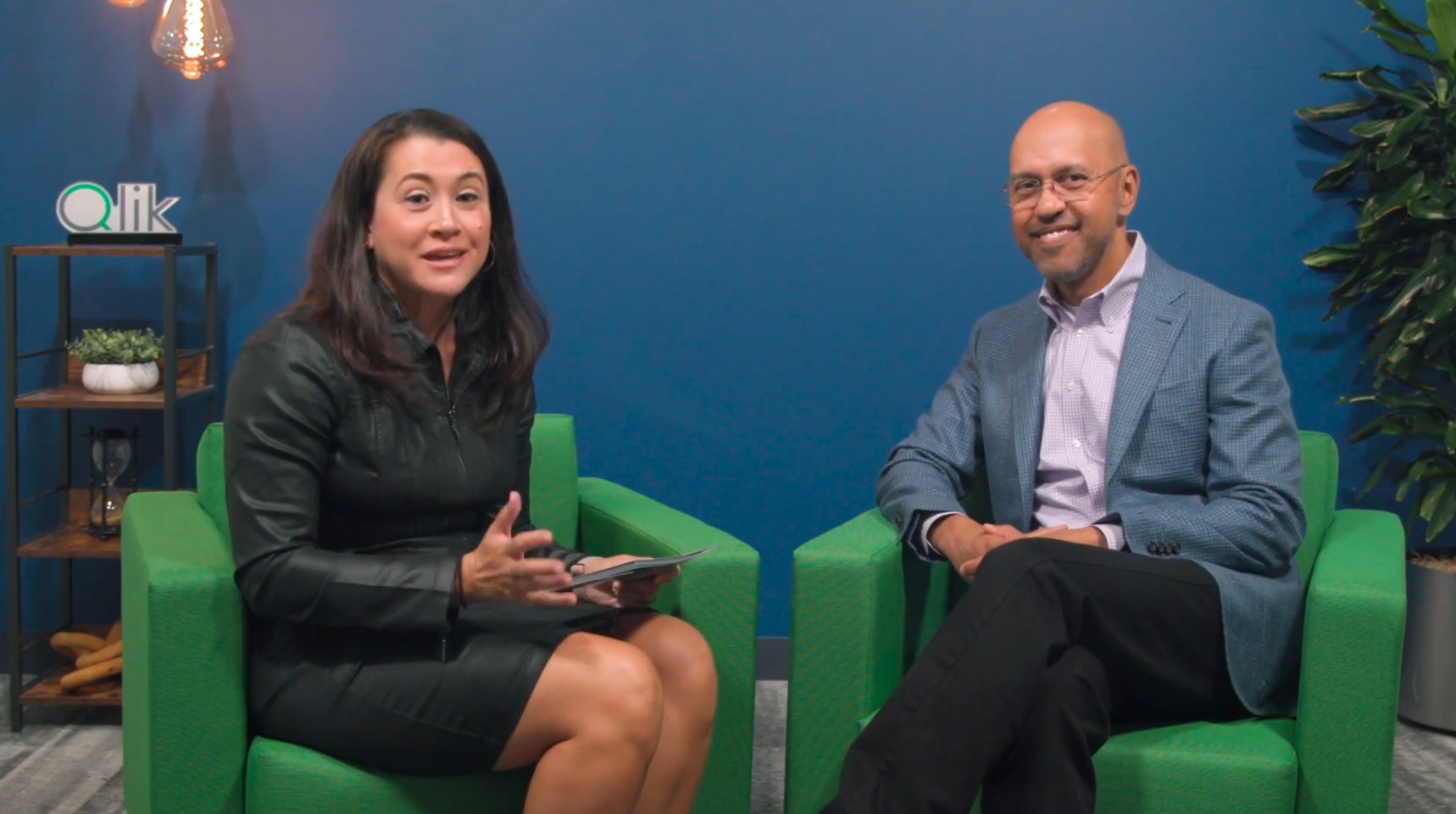
In his first external interview at Qlik, with Jessica Dubois, Saha outlined an initial 90-to-100-day period of travel and listening. He wanted to meet colleagues, customers, partners and distributors, then develop a vision and an executable strategy. His stated leadership expectations included candor, transparency and creating value together. The listening tour gives those intentions an early, observable test: whose understanding of the business makes it into the plan?
Where decisions happen→Choice
Across existing systems→Outcomes
Results customers can measure
A game that resists the spreadsheet
There is another side to the executive who talks about data estates. In a November 2025 conversation with Barclays chief executive C. S. Venkatakrishnan and podcast host Joseph Cass, Saha discussed his longstanding affection for cricket. Living in the United States, he explained, makes following live matches harder. Time zones are an effective reminder that a global career does not automatically produce a convenient viewing schedule.
He recalled a business trip to India when a T20 team happened to be staying at his hotel, with fans gathering outside each day. It is a modest personal detail, but a useful one: amid conversations about financial markets and AI, the sport still supplied a shared language. The executive interested in connecting information also had something quite ordinary in common with the other guest.
The childhood pilot ambition supplies a similar glimpse. It belongs to a person whose eventual career took several turns: economics, sales, consulting, finance, commodities, enterprise data and now software leadership. Read together, those turns suggest why the operating details get so much attention in his public account of AI. His work has repeatedly involved the distance between an appealing idea and a functioning business.
At Qlik, that distance is the assignment. Saha has articulated the importance of trusted data and outcomes customers can measure. The next chapters will be written in product choices, working relationships and execution. For a former would-be pilot, the destination is now fairly explicit. The work is getting a very large organization and its customers there.