An old steel mill is an unusual place to look for the future of computing. Peter B. Ritz found a practical attraction there: electricity. At the former U.S. Steel Fairless Works in Pennsylvania, the machinery of an earlier economy had left behind something a new one could use. The furnaces had needed serious power. Servers would, too. For a technology entrepreneur, it was a useful reminder that the cloud still needs somewhere to plug in.
In 2014, Ritz was explaining the proposition behind Keystone NAP, the data center business he helped found. Large technology companies could spend enormous sums building efficient computing facilities. Ordinary enterprises needed some of those capabilities without undertaking an Amazon-sized construction project. An industrial site in Bucks County offered a way to close the distance.
Years later, as co-founder and CEO of FatBrain AI, he would make a related argument about artificial intelligence. Large businesses had specialists, data and budgets. Smaller ones had decisions to make before lunch. Ritz wanted to put useful analysis within their reach. The equipment changed; the question of who could afford access remained.
A second career for the steel mill
The Fairless site had geography as well as electrical muscle. It sat between Philadelphia and New York, with nearby generation and fiber connections. Ritz could talk about the power plants around it and the network routes serving it. These were the details that made the location interesting, well before a customer installed a server.
Keystone's backers included Philadelphia investors led by Ira Lubert, with additional investors arranged by DH Capital. Schneider Electric supplied engineering and manufacturing expertise. The proposition needed that combination: property, financing, electrical infrastructure and customers who would entrust the place with their computing. A good address alone would not do the work.
Then came the boxes. Keystone and Schneider developed KeyBlocks, private modular data center vaults that could be configured for individual customers. Their power profiles ranged from 100 to 400 kilowatts. Capacity could arrive when needed, instead of requiring every tenant to pay for a vast, speculative room on the first day. Even the physical packaging reflected the business argument: buy enough for the work in front of you.
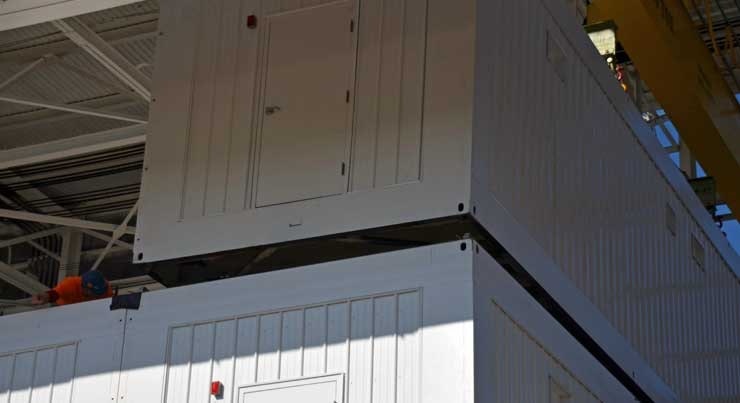
One leftover from the mill was particularly handy: its overhead crane could hoist the modules into stacks. Ritz and his colleagues were fitting a new use into an existing industrial structure, rather than treating the site's past as an inconvenience. The steel industry had already paid for some formidable engineering. Computing could inherit part of the benefit.
“We're standing on the shoulders of giants that used to be here,” Ritz said in 2014. The giants, in this instance, had left substations. It is a less ethereal origin story than technology usually gives itself, and a more useful one.
“We're standing on the shoulders of giants that used to be here.”
Peter B. Ritz, on the former steel site, 2014
The colleagues before the company
Keystone also grew out of working relationships. Ritz and Shawn Carey had worked together at Xtium, a cloud services business that used other operators' facilities. They saw an opportunity to operate infrastructure themselves. John Parker, who had done legal work on an earlier data center proposal at the site, and technology executive Philip Lanctot completed the founding team.
By April 2016, Keystone had secured a $15 million senior debt facility from White Oak Global Advisors. The financing was intended to complete its property purchase from U.S. Steel and support expansion. Xtium had chosen Keystone as its third data center location. A relationship that began on the service side now connected to the building beneath it.
Ritz's Xtium chapter had its own chronology. Tim and Andrea Vogel founded the business and brought Ritz and Carey aboard in 2007 as it moved into virtual hosting and disaster recovery. Evolve IP acquired Xtium in October 2016. Across those ventures, the recurring work involved making computing services available to business customers and finding a commercial structure that supported them.
He had already worked on the connection between physical things and online information. At AirClic, which he co-founded, Ritz was among the inventors named on a U.S. patent granted in February 2004 for directing an end user to a provider's network location using user-provided codes. The title sounds forbidding; the underlying concern is familiar to anyone who has used a code to reach something online.
His education crossed disciplines, too: a B.S. in computer science and a B.A. in biochemistry and molecular biology from the University of Maryland. His career has included an adjunct lectureship at the University of Pennsylvania Law School and service on VMware's provider advisory board. Software, intellectual property and the business of delivering technology have all had a place in the same résumé.
Learning what ordinary looks like
Another chapter put observation at the center of the product. From February 2014 to July 2017, Ritz chaired Observable Networks, with responsibility for corporate development. Cisco completed its acquisition of the company on July 31, 2017.
Observable's software modeled the behavior of devices on a network. Understanding ordinary activity could help identify activity that deserved attention. Cisco wanted that capability for security across data centers and cloud environments. Ritz's role was on the board and business side; the technology belonged to a team. That distinction matters in a career containing both inventions and investments.
FatBrain would apply comparison to another set of decisions. Its promise was to combine information from a business with signals from peers and markets. A company might know its own figures very well and still lack a useful view of its position. The numbers in your ledger cannot, by themselves, tell you what is happening down the road.
Applications + records+Outside context
Peers + markets
Conceptual illustration. No performance results implied.
Directions for the middle of the pyramid
Ritz dates FatBrain's business beginnings to 2015. Its early work included large corporate customers. By his 2023 account, the ambition had shifted toward businesses with 500 employees or fewer, a group he called the “middle of the pyramid.” He described a market for capabilities that wealthy organizations could already commission for themselves.
His preferred explanation was Waze. Drivers contribute information that helps other drivers choose a route. In the business version, relevant comparisons help an owner understand where a company stands and what might improve its position. The metaphor makes his commercial instinct easy to grasp: a useful answer can depend on what others are experiencing.
FatBrain packaged its offer as software, market information and expert service delivered by subscription. The company emphasized connecting to applications businesses already used. That approach placed a familiar practical demand on the technology: fit into the customer's working day. A tool that requires an owner to become a systems integrator has given that owner another occupation.
As CEO, Ritz's listed responsibilities included sales and corporate development. Alongside him were co-founder and chief scientific officer Rajarshi Das and colleagues working in architecture, financial analysis, insurance and regional operations. The breadth of the team reflected the breadth of the proposed applications. Selling a general idea about intelligence still required people who understood particular business problems.
Across borders, then into a dispute
In July 2022, FatBrain's expansion reached Prime Source in Kazakhstan. At a press briefing, which Ritz joined remotely, he said FatBrain would retain the local company's management structure and help the business grow. Prime Source chief Evgeny Chsherbinin emphasized access to expertise, technology and resources. The pitch joined an existing local team to a wider commercial network.
That autumn, Ritz appeared on a Digital Bridge panel about protecting venture portfolios during financial turbulence. Fellow panelists included Michael Moe, James Tan, Arslan Kudiar and Gleb Davidyuk. The subject was an apt companion to his operating career: building technology businesses also means managing the conditions under which capital is available.
The next large transaction became contentious. In March 2024, Genius Group announced a deal involving FatBrain. Its March 18 clarification described a purchase of selected assets and liabilities through a subsidiary, rather than a merger into Genius itself. Ritz joined the Genius board and became chief revenue officer. In September, Genius announced it had terminated his employment amid governance and transaction allegations.
The conflict continued into 2026. On April 20, Genius announced an ICC arbitration award against LZG International entitling it to roughly 7.4 million shares and $7.97 million. Separately, Ritz sued Genius and two executives over his firing. A July 17 federal court order denied Genius's motion to strike certain defenses asserted by Ritz and Moe. That ruling concerned the pleadings; it did not decide the underlying employment dispute.
Those developments belong alongside the companies and acquisitions in his career. The ambitions behind a transaction and the obligations created by it can lead to very different conversations. Ritz's current public LinkedIn profile lists a stealth AI startup in New York. FatBrain's website continues to list him as CEO responsible for sales and corporate development.
The business behind the business
A more personal note appears in his public posts. Ritz celebrated his son Owen's 2:17 Philadelphia Marathon finish and shared his pride in Owen and co-founder Reed starting a business. In 2026, he also shared his wife's commencement address at Germantown Academy. The language of pride is rather less complicated than the language of asset purchases.
There is a recognizable question running from the steel site to the AI pitch: what useful capability is out of reach, and how can a business deliver it? At Keystone, the answer involved power, fiber and modular rooms. At FatBrain, it involved data, comparison and subscriptions. Each demanded a connection between something technically possible and something a customer could actually use.
The crane at Fairless offers a fitting image for that work. New equipment came into a building made for another purpose, carried by machinery that was already there. Progress sometimes looks like a fresh invention. Sometimes it looks like noticing what the neighbors, the previous tenants or the previous generation have left within reach.