A bank asked Sunny Pokala to build something before he had much of a company to build it with. His employer, JPMorgan, became an early customer of the venture he registered in 1997. For an aspiring entrepreneur, that is a useful form of encouragement. The person who knows your work also has a problem for you to solve.
Pokala’s subsequent career has wandered well beyond banking: restaurants, an analytics investment, a social platform built around the human voice. Yet that opening arrangement remains a helpful way into his story. He began close to a user. The more his ventures moved into public life, the more complicated the relationship with that user became.
An office across the street
His first setup was small: a Manhattan office near JPMorgan, two computers and $60,000 of savings. He had studied computer science at Madras University before moving to New York for further study. By 1995, he was working in equity derivatives. He also fitted business school into his evenings.
“New York city was my inspiration.”
Sunny Pokala · 2007
New York mattered to his view of the industry. He saw a distinction between the technology products associated with the American West Coast and businesses that grew around solving clients’ problems in New York. His own company belonged to the latter tradition. Wall Street supplied an education in what a customer needed, as well as an address.
By 2006, he was describing how that experience had shaped Amtex’s business model. Financial-services consulting came first; other sectors followed. His earlier career included both JPMorgan and Salomon Smith Barney. The move into entrepreneurship carried knowledge of an industry with it. He could approach a conversation about technology with some understanding of the work on the other side of the desk.
Amtex Systems begins in New York, serving the technology needs of financial businesses.
The second address was India
As the company expanded, India became part of its delivery model. In November 2006, Pokala described offshore development centers in Delhi and Chennai. Amtex had earmarked ₹100 crore over three years for its Indian expansion, with a quarter already invested in land and hiring. The plan connected physical space, people and the ability to serve customers across borders.
He also announced a target to increase the Indian workforce from 350 to 1,500 over two years. Those were plans stated at the time, with all the obligations a hiring target implies. Behind the phrase “end-to-end solutions” stood the less glamorous business of finding offices, recruiting colleagues and deciding where work would happen. A global company needs rather a lot of local arrangements.
Amtex’s present service menu shows how far the enterprise brief has spread. It includes software engineering, reporting systems, cloud infrastructure, automation and talent services. The company describes fragmented data and disconnected workflows as recurring customer problems. Its pitch begins with the operational foundations needed to make newer technology useful.
There is continuity here with Pokala’s early financial-services work. The machinery changes; the practical question persists. Can the person using a system complete the job? Today, Amtex advertises a presence in ten cities and more than 1,500 professionals. Those are company figures, describing an organization whose work requires coordination as much as invention.
A taste for a different business
Hospitality added a more personal explanation for diversification. By 2007, Pokala had restaurant interests in New York and a partnership in Chennai’s Harrisons Hotel. Dosa Hut answered a particular appetite. “I missed south Indian food,” he explained. Some business ideas require an elaborate presentation. This one could be understood before lunch.
The restaurant chapter gives his career a useful change of texture. A software founder can discuss requirements at length; a diner’s requirements tend to arrive with an appetite and a clock. In either setting, the customer has an opinion. The ventures belonged to different industries, but both put a founder’s proposal in front of people who could decide whether they liked it.
A microphone changes the customer
In 2021, Pokala’s next public-facing venture began with someone else’s family conversation. Soundarya Rajinikanth had noticed the effect of hearing a voice message from her father, the actor Rajinikanth, amid a stream of text. The sound carried something the written exchange had missed. She and Pokala began working together that February.
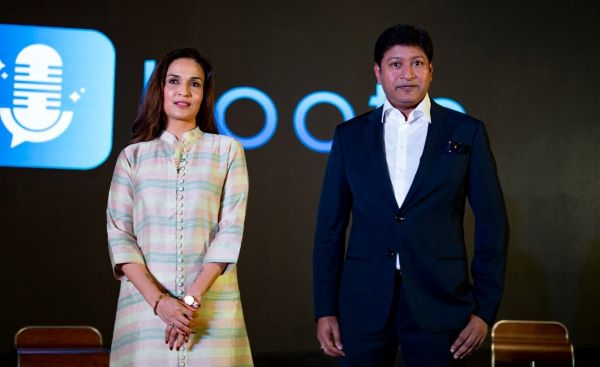
The result was Hoote, launched in October. Soundarya brought a creative background and the original observation; Pokala brought technology-building experience. At the Chennai launch, he described a multilingual platform intended to make expression possible across languages. He also discussed moderation, verification and the need to address impersonation. Once the product carries people’s voices, technical decisions acquire a social life.
Hoote’s launch proposition was easy to grasp: record a message, keep it short and let other people listen. Its announcement described support for 15 Indian and ten international languages. Users could add a picture or background music. The promise was expression in a familiar voice and language, with a little room for theatrical accompaniment.
That combination explains the venture’s appeal within Pokala’s broader career. An enterprise product helps an employee carry out a task. Here, the person supplied the content as well as the reason for someone else to open the app. The software had to support an exchange that neither founder could manufacture on every user’s behalf.
A short voice message, with optional music and an image. The waveform is an illustration, not a recording.
By November 2021, familiar social features surrounded the audio: a feed, accounts to follow, likes, comments and sharing. Posting involved recording or uploading an audio file, listening back and then adding the optional extras. Private and group conversations were still described as forthcoming, distinct from the features already available.
The sequence was revealing. Listening back gave the speaker a moment to consider how the message sounded. Background music could alter its mood. A photograph could supply context. Hoote was asking users to compose something with their voices, while borrowing enough conventions from existing social networks to make the process recognizable.
Celebrity participation helped introduce the idea. When comedian Kapil Sharma joined in November, Pokala emphasized how quickly public figures could share thoughts on the platform. Sharma, whose profession depends on delivery, spoke about the difference voice modulation can make. For an audio product, a comedian was a particularly apt recruit: a pause can do work that punctuation merely applies for.
Rajinikanth’s launch message also gave Hoote an immediately recognizable voice. The public opening drew attention to the collaboration between his filmmaker daughter and Amtex’s founder. It was a different sort of introduction from the one Pokala had received in banking, where an employer’s request supplied the first business problem.
The audience has to come back
The later chapter requires the same attention as the launch. By July 2024, Hoote had been renamed Huut. That month, it was described as inoperative: new users could not register and existing users could not log in. No official announcement about the app’s status had accompanied those observations.
The account recorded around 100,000 Play Store downloads despite a roster of prominent participants and advisers. Those historical figures describe the venture at that moment. They also sharpen the contrast within Pokala’s career. A social platform needs people to return, contribute and find one another. A famous opening can introduce that possibility; the next ordinary Tuesday still has to offer a reason to visit.
The work after the launch
Alongside his operating roles, Pokala is listed as an investor in Trendalyze, a company focused on finding useful patterns in time-series data. Its investor biography describes his enthusiasm for business intelligence and analytics. It also supplies a detail outside the meeting room: he is an avid golfer. The public record offers rather more about his technology interests than his scorecard.
His writing provides another view of those interests. In a May 2023 column, he treated innovation as broader than a dramatic new invention, including services and business models that create value. An April 2024 article on no-code AI considered the tension between adopting new methods and keeping existing systems stable. For someone selling technology services, that balance has obvious practical consequences.
His August 2024 essay on digital trust was more specific about the relationship with users. He organized the argument around security, privacy, reliability, compliance and transparency. Trust, in that account, belongs throughout a business’s operations. The everyday details include explaining how information is used and ensuring that a service behaves consistently.
Those concerns sit comfortably beside his publicly stated ambition to build products with social impact. They also invite a demanding standard of judgment: the experience of the person using them. In February 2025, his AI writing turned to applications including cybersecurity, finance and agents that can undertake business tasks. Even as the tools acquire more autonomy, someone remains responsible for whether the result is useful.
Pokala’s career keeps returning to that encounter. A bank employee needs better tools. A diner wants a familiar meal. A speaker wants to be understood. Each gives a business a possible beginning. What follows depends on the work of serving them again.