In November 2016, Bank of Ceylon’s banking analytics announcement contained a revealing little sequence. Reports had to be prepared, verified and sent. Somewhere beyond those three verbs sat a manager, waiting. The bank already possessed the raw material: information in its core banking and peripheral systems, reaching down to individual transactions. The difficulty was getting a useful view of it into the right hands.
- Infosense turns banking data into management dashboards.
- Bank of Ceylon signed for an iPad-enabled solution in 2016.
- Its practical appeal: banking-specific questions, mobile access and deeper web analysis.
01 / 626 branches. One reporting problem.
Consider the scale described at the time: 626 branches, spread across Sri Lanka. A bank-wide figure could tell senior management how the institution was doing. A provincial manager needed something closer to home. Which branches needed attention? Which products were performing? Where was credit risk gathering? The distance between those questions and a usable report was the opening for Infosense.
IronOne Technologies supplied the solution. Infosense is its banking business intelligence offering, designed to make performance information available to executives and managers through dashboards. The Bank of Ceylon agreement covered an iPad-enabled system for senior decision-makers, with analysis spanning troubled assets, deposits, inward remittances and risk. The tablet mattered because it changed where that information could be consulted.
“Simplicity is the key to success.”
D. M. Gunasekera
Bank of Ceylon general manager, 2016 announcement
Gunasekera’s accompanying explanation was wonderfully practical. Provincial managers would receive daily updates on their iPads instead of waiting for information and reports to arrive. That makes the proposition easier to understand than a catalogue of analytical terminology. A review meeting could begin with the numbers already available to the person responsible for discussing them.

02 / The next question lives underneath
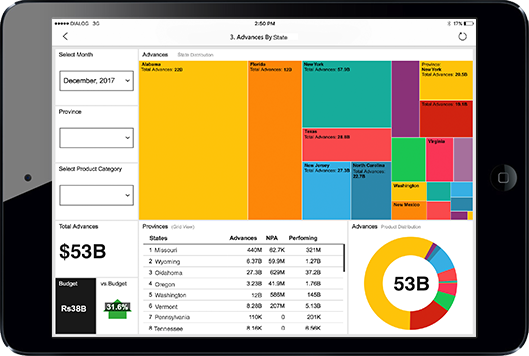
Infosense’s product list follows the working vocabulary of a bank. There are modules for deposits, loans and advances, and non-performing assets. Deposits can be examined by product, region and business line against performance indicators. Advances can be examined by product, region and interest-rate bucket. These are specific ways of dividing a financial institution into pieces that a manager can investigate.
The distinction matters. Suppose a banking team sees an unexpected change in advances. That observation is only the beginning. A useful investigation might compare regions, then products, then customers. Infosense’s web edition advertises customer analysis, drill-down, drill-through and report exports. Its mobile versions, listed for iPad, Android and Windows, provide bank overviews, trends, performance ratings and regional or product views.
Those capabilities serve several audiences. Senior managers can examine performance across the bank. Regional and branch managers can inspect their own operations and identify customers requiring attention. Product and marketing managers can compare offerings and geographic opportunities. The same underlying information has different jobs depending on who is looking at it. The product’s specificity comes from acknowledging those differences.
03 / An engine with banking instructions
Under the interface sits an established technology foundation. Infosense describes integration with Microsoft Business Intelligence technologies and advertises a plug-and-play connection to the Fiserv Signature banking solution. In the Bank of Ceylon announcement, IronOne described a customised Microsoft BI stack. Its role was to apply banking knowledge and implementation work to technology with a broader range of uses.
That places Infosense in the enterprise analytics market, close to a bank’s existing operational systems. A bank could also commission its own reports or build an analytical application using general-purpose tools. Infosense’s proposition is the banking layer: modules, views and access patterns already organised around the institution’s work. The buying question becomes how well that starting point fits the bank’s actual systems and reporting needs.
Infosense says its templates can get corporations running within a week. Treat that as a vendor setup claim, conditional on the implementation.
The commercial route is a direct enterprise conversation. The website asks prospective customers to request a demonstration and describe their business. For a bank evaluating the software, a sensible demo would use a real reporting problem: one data connection, one agreed metric and one manager who must use the result. That would make the fit easier to assess than a tour of attractive charts.
04 / A screen is only half the job
The people behind Infosense bring an enterprise software background. Its leadership page lists Lakmini Wijesundera as co-founder and chief executive for global operations, and Rajitha Kuruppumulle as chief operating officer. Wijesundera’s biography connects her leadership to IronOne and BoardPAC. The surrounding organisation builds software for institutional customers; Infosense applies that experience to banking information.
There is a useful clue to its thinking in Wijesundera’s account of digital transformation at a 2018 EY event. She emphasised human adoption, the interface and how people interact with technology. Applied to banking analytics, that suggests a demanding test. A dashboard needs understandable numbers, a place in the working day and someone able to follow through when a problem appears.
The Bank of Ceylon announcement identified accurate information as a challenge. That remains the practical constraint to examine in any evaluation. A polished screen cannot settle inconsistent definitions or repair an unreliable feed by appearance alone. Equally, identifying a concentration of troubled loans leaves a human task: investigate the accounts and decide what action is appropriate. Visibility creates an opportunity for action.
05 / Borrow the sequence
The useful lesson for another organisation starts with the waiting manager. Identify the decision being delayed. Establish which information it needs. Give the responsible person an overview and a route into the detail. Then test whether the information arrives in a form they can actually use. Infosense’s banking proposition gives that sequence a concrete shape: a bank, its branches, its customers, and a screen close enough to reach.