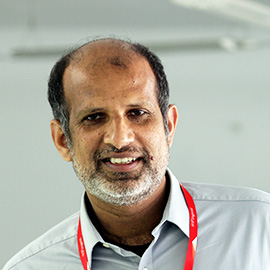
Something new arrives with a promise. Somewhere nearby, something old is still doing the work. For Varghese Samuel, the founder of Fingent, that awkward coexistence has become a business proposition. His current argument about artificial intelligence begins with the systems a company already has: the software holding its records, routing its approvals and organizing its working day. The future, in this account, has to learn its way around the office.
There is a pleasing lack of theatre in that starting point. Technology announcements tend to enjoy a clean sheet of paper. Businesses bring a filing cabinet. Samuel is interested in the contents of the cabinet, the people who use it, and whether the proposed improvement will actually help them. His term for the AI version of this work is Intelligence Integration. The name is recent; the concern with making technology useful runs through earlier chapters of his career.
A business built between systems
Samuel founded Fingent in White Plains, New York, in 2003. He had earned a master’s degree in engineering at the Indian Institute of Technology Bombay and worked as Vice President of Technology at Ascent Computing Group. The combination puts an engineering education and an operating role before the founder’s title. His subsequent business would deal with the practical demands of software inside other organizations.
His public LinkedIn profile places him in White Plains and supplies a small, useful detail: he goes by Sam. The abbreviated name sits beside a career whose central institution has endured for more than two decades. A company founded in 2003 has had to work through several generations of tools. Survival alone cannot explain a founder’s decisions, but it gives the current conversation about AI a longer frame.
Fingent’s work includes custom applications, system integration and enterprise consulting. Samuel once described its intended relationship with customers as our client’s extended technology wing
. It is a compact description of a demanding arrangement. A wing belongs to the building. It has to connect to the rest of it. The metaphor leaves little room for a supplier to admire its own addition while the staircase goes nowhere.
“our client’s extended technology wing”
Varghese Samuel, on Fingent’s relationship with customers
That wording also locates responsibility. Software can be delivered as a finished object, yet its consequences continue through daily use. Calling a company an extension of a client raises the expectation of continuity: somebody should understand the business well enough to remain useful after installation. For a founder selling technical expertise, that is a consequential promise to make.
Samuel founds Fingent
White Plains, New York
Fingent launches Infince
A cloud workplace product
Intelligence Integration
AI within existing systems
The owner has other things to do
Another chapter arrived with Infince, launched in 2018 as a Fingent product. Its name expands to Infinite Cloud for Enterprise. By April 2021, when Samuel discussed it publicly as CEO and Managing Director, his explanation concentrated on a recognizable customer: a business owner with work to do and limited time to become an expert in workplace IT.
He described a platform bringing together cloud infrastructure, applications and collaboration, with centralized administration and a single sign-on. The intended convenience was straightforward. Fewer separate places to manage meant less time spent tending the technology. The product proposition treated an owner’s attention as a limited resource. A subscription might have a price on an invoice; the interruption required to understand it has a price, too.
That distinction gives this part of Samuel’s story its human scale. The customer in his account has no obligation to find the software industry fascinating. A business owner may be perfectly competent and still prefer to spend the afternoon running the business. Technology that requires its own small court of administrators has a way of confusing purchase with progress. Infince was an attempt to gather those responsibilities into a more manageable arrangement.
Products and services pose different tests for a founder. Custom work begins with a particular organization’s requirements. A product has to make enough shared assumptions to serve multiple users. Samuel’s involvement in both gives the profile a useful pair of lenses. One asks how closely software can fit an individual business. The other asks which burdens can be handled in common. Both require attention to the person expected to use the result.
The company is a user, too
Fingent also uses Infince. In describing that relationship, Samuel credited the platform with helping its geographically dispersed teams communicate and collaborate remotely. A company that builds workplace software gets an unusually immediate form of feedback when its own staff depend on it. The people who can report the problem may be colleagues, rather than a distant account represented by a support ticket.
Infince’s account of the deployment also records Fingent’s sixth-place ranking among India’s Great Mid-size Workplaces in 2022. That is a recognition of the company, rather than a personal award for Samuel. It belongs in his story because the organization he leads has made the workplace part of its stated ambition. The distinction matters: a founder can set an intention; a working culture requires many people to carry it.
His leadership team spans operations, finance, sales and technology. Fingent lists Dileep Jacob in global operations, Anija Susan in finance and administration, Stephen Cummings in sales and marketing, and Deepu Prakash in process and technology. These are the functions that must make an enterprise promise hold together. The founder’s argument reaches customers through people responsible for delivery, resources, communication and technical decisions.
There is a social counterpart to that organizational chart. In December 2022, Fingent brought leaders, managers and employees from its international locations together in India for its nineteenth anniversary. The company’s account mixed achievements and plans with a party. An anniversary celebration makes a modest but welcome correction to the software vocabulary: an organization also consists of people gathering in a room, with subjects to discuss beyond the next release.
The past gets a vote
By February 2026, Samuel was explaining Intelligence Integration as a way to embed AI in existing enterprise systems and workflows. His concern was fragmentation: separate experiments drawing on different data and accumulating their own rules. In that account, the speed of adoption can conceal a growing burden of coordination. Every department may have acquired something useful while the organization has acquired a new set of connections to maintain.
“When decisions are fragmented, complexity scales faster than intelligence”
Varghese Samuel, February 2026
The sentence supplies a reason to pause before the shopping begins. A tool can look efficient when considered alone. Its real place in a business depends on what it must exchange with other tools, what its users need to understand and who will remain responsible for it. Samuel’s integration proposal gives the existing organization a say in the architecture of the next addition.
The preservation argument has a practical appeal. Older software can hold years of investment and accumulated decisions. Replacing it means reckoning with those decisions as well as the code. Samuel’s approach seeks to add intelligence while retaining useful systems and established workflows. That makes the existing business an input to the design. The product has to enter a place with habits, permissions and obligations already in residence.
In his more recent LinkedIn writing, Samuel has returned to operational efficiency, productivity and new business opportunities as the reasons to apply intelligence. Those are ambitions with consequences that can be examined. They invite a discussion about the work being done and the outcome being sought. They also leave a sensible question hanging over the proposal: how will the organization know that its working day has improved?
There is also a limit built into this argument. Integration is a proposal to evaluate, and a business still needs evidence from its own operation. A diagram can explain the intended relationship between systems; it cannot supply the result. Keeping that distinction visible gives Samuel’s proposition a fair test. The ambition becomes more useful when the buyer can name an improvement, identify the work affected and judge what happens after deployment.
An ordinary working day
The continuity across Samuel’s career is the interesting part. Custom enterprise software asks for an understanding of a particular business. A cloud workplace product asks which daily burdens can be gathered together. AI integration asks how a new capability can enter an existing operation. Each chapter brings the technical conversation back to the organization that must live with the answer.
It is an undramatic place to locate ambition, which may be part of its appeal. An ordinary working day is a demanding critic. It contains people trying to finish tasks, information needed at inconvenient moments and decisions that cannot wait for a presentation to be revised. Software earns its place there through repeated use. A founder concerned with that setting has to keep returning to details that a launch announcement can comfortably skip.
Samuel’s next chapter remains tied to that setting. The business already exists. Its people already know something. Its systems already contain value. He is proposing that the next layer of technology take those facts seriously. After more than two decades at Fingent, the question running through his public work remains agreeably concrete: what will this let the business do better when everybody gets back to work?