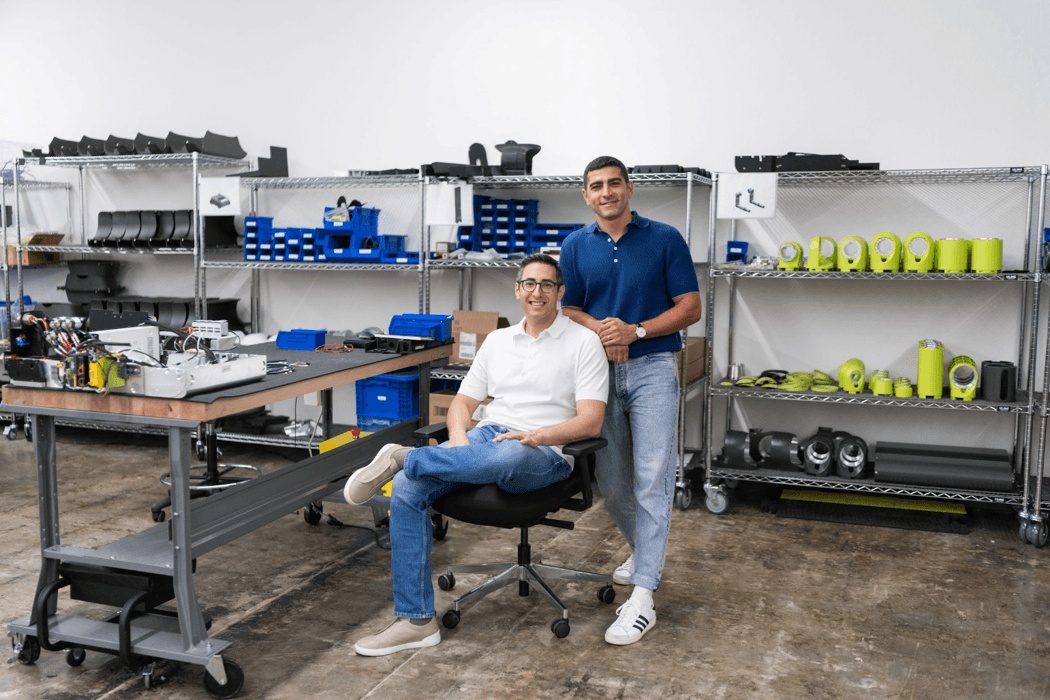
A warehouse is an awkward place to bring a fixed idea. Doors have widths. Shelves have depths. A box that has to leave today is unimpressed by tomorrow’s technological promise. Hamza Derbas has made those inconveniences part of his brief. Before deciding what his company’s robot should look like, he wanted to understand the work it would inherit.
Derbas co-founded Maven Robotics with his brother Khalid in 2024. The company began by studying industrial operations with customers, looking for tasks it could take on and repeat. Mixed-case palletizing and tote handling became its first applications. There is little glamour in either phrase. There is, however, a customer who needs the job finished.
That starting point helps explain the engineer now running Maven. His career has passed through electrical machinery, automotive controls, business school, and Apple’s autonomous systems organization. Along the way, the object under development has changed considerably. The central problem remains recognizable: how do you make complicated physical equipment behave as intended, in the place where someone actually needs it?
The customer has the first word
At Maven, visiting customers meant watching people work in factories and warehouses. Derbas wanted the operations themselves to inform the design. How high must something reach? How heavy is the load? Where does a movement slow down the next operation? These questions can sound modest beside an ambition to build general-purpose robots. They also have the advantage of producing usable answers.
His emphasis gives the customer an unusually early role in the engineering conversation. The facility already exists. So does its work. A designer can propose a different mechanism; persuading a warehouse to rearrange its entire working life is a larger request. Derbas’s approach takes those existing conditions seriously enough to let them shape the machine.
It is a useful way into his story because it avoids treating Maven as an inevitable next chapter after Apple. A senior engineering title does not choose a customer, design a business model, or settle the shape of a robot. Founding the company required decisions about which work to attempt first. Derbas and his team chose a starting point narrow enough to investigate on an actual floor.
Before the warehouse, the circuit
Derbas’s technical education began at the American University of Beirut, where he completed his undergraduate electrical engineering studies in 2005. At Purdue University, he pursued a master’s in electrical engineering, with control systems among his interests. His research also touched electric machinery and linear algebra. These are subjects concerned with making behavior intelligible: describing a system well enough to predict and influence what it does.
He co-authored a paper comparing nodal and mesh approaches to magnetic equivalent circuit models. The title is unlikely to be mistaken for light holiday reading. It does locate an early part of his work in the mathematical representation of electrical machines, well before a warehouse robot became his principal concern.
His subsequent roles took him into automotive engineering at FEV, software and controls at A123 Systems, and research at Ford. Batteries, electric drives, and vehicle control systems belonged to that professional world. From 2013 to 2015, he attended Harvard Business School. His training now spanned the electrical system and the organization paying to develop it.
The sequence matters without requiring a grand theory of his character. A controls problem, a battery system, and a new company are different undertakings. They do share an inconvenient property: improving one part can create work elsewhere. The appeal of thinking about the whole arrangement is apparent in the career, and explicit in the company he later built.
American University of Beirut
Apple autonomous systems
Maven Robotics
When the team follows you
From 2015 through 2023, Derbas served as a director of engineering in Apple’s Autonomous Systems, Special Projects Group. He has spoken sparingly about the work itself. The consequence for Maven is easier to see: he had worked with experienced engineers who could choose where to go next.
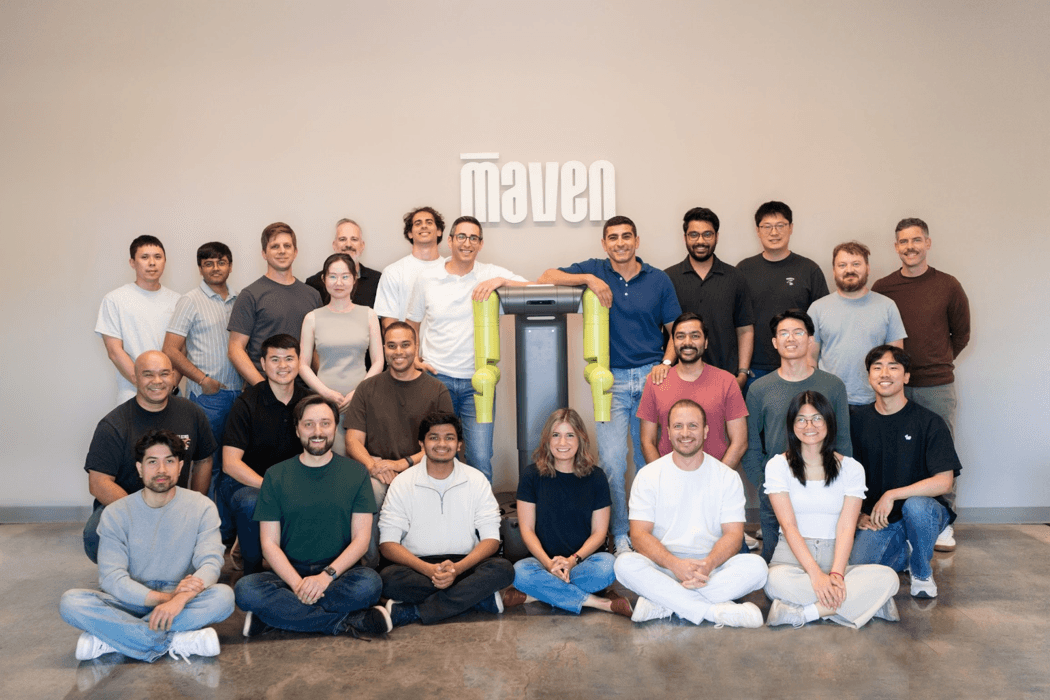
Some chose his startup. Derbas has described their interest as humbling. He has also been direct about the obligation it created. People who were established in senior positions had decided to take a risk on the new enterprise. A founder receives their expertise, but also becomes responsible for the place where they have chosen to put it.
“You can’t let these people down.”
Hamza Derbas, on colleagues joining Maven
That is a more personal account of leadership than a headcount or a list of previous employers. It connects the company’s future to decisions made by people Derbas knew. Their arrival could accelerate development; it could also make each decision feel heavier. The confidence of colleagues is useful precisely because it comes from people whose judgment you respect.
Khalid, meanwhile, brought a career in private equity to his role as CFO. The brothers’ partnership combines different professional experience rather than two copies of the same résumé. Engineering and finance meet early in a hardware company: each design eventually needs components, suppliers, production capacity, and a customer prepared to pay for the result.
A robot need not dress for the part
Maven’s industrial machine has two arms and a wheeled base. Derbas’s argument for its form begins with the application. A machine intended to move goods through a facility has to fit that facility and handle the relevant loads. Resembling a person supplies no automatic answer to either requirement. The warehouse has already issued its dress code: fit through the door.
The hands provide a smaller example of the same reasoning. Maven explored different gripper configurations, including arrangements with several fingers. It developed tooling for its tasks rather than assuming a familiar hand shape would settle the problem. Vacuum suction and a two-finger parallel gripper became part of the approach.
Derbas has explained that movement available in the arms can reduce the complexity required in the gripper. That is an engineering choice with a pleasing economy: consider what the whole machine can do before adding another mechanism at its fingertips. Complexity has to earn its place, especially when the equipment will be manufactured and maintained.
One of Maven’s adopted mottos is “Strong convictions, loosely held.” Applied to hardware, the phrase has a practical edge. A drawing becomes a prototype; a prototype encounters a job; the job supplies reasons to revise the drawing. A conviction remains useful while it directs the next experiment. Keeping it after the experiment argues otherwise is an expensive hobby.
The box has somewhere to go
Mixed-case palletizing means assembling a pallet containing different products. The significance lies in the mix. A load prepared for one destination can require a selection of goods rather than an identical stack repeated without variation. Picking up a box is one operation inside a larger sequence that begins with a requirement and ends with the right goods ready to move.
Derbas’s description of Maven therefore extends beyond the robot. He talks about the robot, the fleet, the factory, and a shared network. The company’s September 2026 launch presented these as connected parts of its system. A customer’s infrastructure supplies information; machines must turn that information into completed physical work.
- 01Customer requirementWhat needs to move?
- 02Robot + fleetCoordinate the physical work.
- 03Completed loadThe goods are ready to go.
Editorial schematic of the workflow Derbas describes.
This is also how he frames learning. In his public launch message, Derbas described experience from working robots feeding improvement across the system. The larger ambition is cumulative: a machine acquires useful experience in a task, and that experience helps the system take on more. Its value depends on what improves in the customer’s operation.
The distinction between a capability and a completed job is consequential for a chief executive. It affects what the company promises, what it measures, and where it puts engineering effort. Derbas’s vocabulary keeps returning to the task because the task gives the organization a common destination. An elegant component is easier to judge when everyone knows what it must help finish.
The next shift
On September 10, 2026, Maven announced its public launch and a $100 million Series A. Investors included RoboStrategy, LocalGlobe, Vine Ventures, and XTX Ventures. The announcement also described autonomous fleets working multiple daily shifts for a Fortune 250 consumer packaged goods company. Those are company-reported deployments, distinct from its targets for future operating hours.
Capital for the next phase of Maven’s industrial robotics work.
Later that month, Shorooq and Presight announced their participation. Derbas spoke about access to compute, data, and enterprise relationships, and about the Gulf region as a potential route to international customers. His ambition reaches beyond a single facility, although each new site brings the practical work of putting machines into operation.
By early October, he was discussing plans for longer operating schedules, larger fleets, and mass production. He identified manufacturing priorities including mechanical components, actuator costs, and simpler electronics. These are plans to execute, rather than results already banked. They bring the company back to questions that will be familiar from his earlier career: how the parts behave, what they cost, and whether they work together.
Derbas’s story currently rests at that transition. The engineer has become the founder responsible for turning a team’s confidence into a durable operation. His broad aspiration is greater industrial capacity through autonomous work. The next useful proof will arrive in a less expansive form: a customer’s job completed, another shift finished, and a machine ready to do it again.