At fourteen, Wahid Nawabi had three younger sisters to travel with and a country to leave. The journey took two months, from Kabul through Pakistan to New Delhi, where the children rejoined their parents. At fifteen, he arrived in the United States. Long before he was responsible for machines that could fly without a pilot, he had been responsible for getting somewhere himself.
In June 2023, addressing a congressional subcommittee, he recounted the essentials without much decoration: learning English, finishing school, attending college, becoming an electrical engineer and an American citizen. He presented himself as an immigrant who had pursued the American dream. He connected that experience to a personal obligation to help defend his adopted country and its values.
By then, Nawabi was chairman, president and chief executive of AeroVironment, now branded AV. His business put him at the meeting point of engineering, public money and war. His childhood gives his arguments about that business a particular gravity. His route into it supplies a surprise. The future drone executive first made his career in electrical power.
The apprenticeship without wings
Nawabi earned his electrical engineering degree at the University of Maryland, College Park. He spent sixteen years at American Power Conversion, the power protection company known as APC. His responsibilities grew to encompass enterprise infrastructure and international business. Before aircraft became his public calling card, there were the less photogenic demands of keeping the equipment behind modern computing supplied and protected.
That background matters because an engineering business must do several things at once. A design has to work. A customer has to need it. A supplier has to produce the parts. An organization has to repeat the performance after the demonstration is over. Power equipment offers an education in the gap between a promising idea and a dependable product.
His next stops were C&D Technologies, where he held Americas and global sales roles, and fuel-cell company Altergy Systems. In December 2011 he joined AeroVironment to run Efficient Energy Systems. The division worked in a company whose portfolio then included electric-vehicle charging and testing equipment alongside unmanned aircraft. His entrance into the drone business came, quite literally, through the charging side.
The promotions followed the operational work. He became chief operating officer in April 2015, added the presidency in January 2016 and succeeded Tim Conver as CEO that May. Conver stayed on as chairman. Nawabi took that position in September 2021. The sequence describes an operator learning the institution before being asked to lead it.
energy systems
CEO role
board chairman
transaction closes
A childhood enters the argument
Russia’s invasion of Ukraine brought a personal dimension to Nawabi’s public explanations of AV’s work. In a 2022 interview, he recalled going onto a roof in Afghanistan and seeing Soviet aircraft. He also remembered the difference that American Stinger missiles made to the conflict. His interest in the relationship between a relatively small weapon and a much larger military power had a history.
AV’s Switchblade loitering munitions put that relationship at the center of his working life. The systems combine flight with a strike mission. Their purpose gives them a moral seriousness that cannot be tidied away by calling them robots. Nawabi has described an internal discussion about whether the company should make loitering munitions, and said the support for doing so was nearly unanimous.
His stated position is that people who enjoy freedom have a responsibility to help protect others facing invasion. It is an argument made by a weapons manufacturer, and a belief he ties to lived experience. Both facts belong in the picture. An account of his convictions is not a verdict on every application of the technology his company sells.
“I’m an example of a legal immigrant, who pursued the American dream.”
Wahid Nawabi · Congressional testimony, June 2023
The other destination was Mars
There is another aircraft in AV’s recent history that requires a different vocabulary. NASA’s Ingenuity made the first powered, controlled flight on Mars on April 19, 2021. The helicopter had arrived beneath the Perseverance rover. AV contributed the rotor system, landing gear and solar panel substrate; NASA’s Jet Propulsion Laboratory oversaw the vehicle’s architecture, design and development and integrated the complete machine.
That division of labor deserves to remain visible. Nawabi led a company that helped make the flight possible. The achievement belonged to a collaboration of engineers and institutions. Corporate storytelling has a habit of shrinking a crowded workshop until only the chief executive fits in the photograph. The hardware tells a more populated story.
Ingenuity also offers a useful view of the engineering demands beneath the romance. Four carbon-fiber blades formed two counter-rotating rotors. Getting an aircraft to operate on another planet required work on weight, structures and propulsion before anyone could enjoy the spectacle. A flight can look effortless precisely because so many people have spent years making it otherwise.
For a chief executive associated with military drones, that connection to exploration broadens the frame. The same organization can contain equipment built for conflict and hardware built to answer a scientific question. Understanding Nawabi’s working world means keeping both destinations in view, while giving each project its own purpose and its collaborators their due.
How much room for a wrong turn?
Listen to Nawabi explain management and, eventually, a car appears. In a 2025 podcast conversation with Vineet Gupta, he used the trip to Los Angeles International Airport to distinguish different kinds of engineering work. A driver can make a wrong turn, adjust the route and still arrive. An early experiment can allow that sort of correction. A Mars mission demands another level of assurance.
His point was about fitting the process to the assignment. The freedom to try something is valuable; so is knowing when failure has become prohibitively expensive. In the same conversation, he put people, culture and strategy among his priorities and described giving employees latitude to experiment. Those are connected ideas. Permission to explore needs judgment about where the boundaries sit.
He has also argued for understanding what customers need before accepting their proposed solution. That requires familiarity with their actual work. In an earlier interview, his examples stretched from farmers to soldiers. The practical question is what a person needs to accomplish and which combination of machines, software and connections will help them do it.
There is a useful impatience in that approach. A product specification can become an elaborate answer to the wrong question. Nawabi’s preference is to get closer to the task itself. The challenge for a growing organization is preserving those conversations as the number of products, customers and reporting lines increases.
The acquisition has an afterlife
On May 1, 2025, AV completed its BlueHalo transaction. The combined company brought autonomous systems together with additional capabilities in space, cyber and directed energy. At closing, AV described an organization with more than 3,750 employees operating across more than forty states. For Nawabi, the job now involved a substantially wider collection of technologies and teams.
An acquisition announcement makes a portfolio look neatly assembled. Integration is where the pieces acquire colleagues, budgets and interfaces. Two good systems do not automatically become a useful combined system. The attraction of broader capabilities has to survive the more ordinary work of making people collaborate and equipment communicate.
AV added another piece in March 2026, buying Empirical Systems Aerospace, or ESAero, in a transaction valued at approximately $200 million. The business brought expertise in electric and hybrid propulsion, rapid prototyping and manufacturing. Its facilities in San Luis Obispo gave the rationale a physical address: places where designs could become aircraft.
The financial picture supplies a necessary check on the expansion narrative. For the quarter ended August 1, 2026, AV recorded $480.5 million in revenue and a $10.9 million operating loss. It also disclosed an approximately $240 million goodwill impairment in its space business earlier in 2026 after a stop-work order on the SCAR program. Growth has brought a broader set of exposures as well as opportunities.
The size of the assignment
Poetry survives the org chart
A 2021 profile listed Nawabi’s interests as golf, poetry, music, soccer, cooking and mentoring. It is a pleasingly unruly collection beside the job title. None of it needs to become a business metaphor. Cooking can remain cooking. Poetry is entitled to a life beyond teaching executives to communicate.
Those details do, however, make room for a person in a story crowded with equipment. His public biography has become closely attached to his company’s mission. A list of ordinary interests restores some proportion. The teenager who left Afghanistan became an engineer and an executive; an executive can also have a soccer match to follow.
The current work remains resolutely practical. In October 2026, AV announced a partnership with Elsight to integrate connectivity technology into its Mayhem 10 system. The proposed arrangement combines communications links to reduce reliance on a single connection. Behind the language of autonomy sits an old engineering concern: what happens when a link stops working?
That question brings the career back toward its beginnings in dependable power and infrastructure. Nawabi’s professional life has moved through very different machines. The task of making them function outside the presentation room has followed him. His personal account of why the work matters reaches further back still, to four children traveling toward their parents and a future they had yet to meet.
Continue the conversation
Interviews, public remarks and places to follow the work.
- Wahid Nawabi at AV · Official biography
- Wahid Nawabi on LinkedIn · Personal profile
- Watch: The Titanium Economy conversation · YouTube interview
- His June 2023 congressional remarks · Written testimony
- The 2022 conversation about Ukraine · Interview
- AV’s quarter ended August 1, 2026 · Financial filing
- AV website · Company channels: X, Instagram, Facebook, YouTube
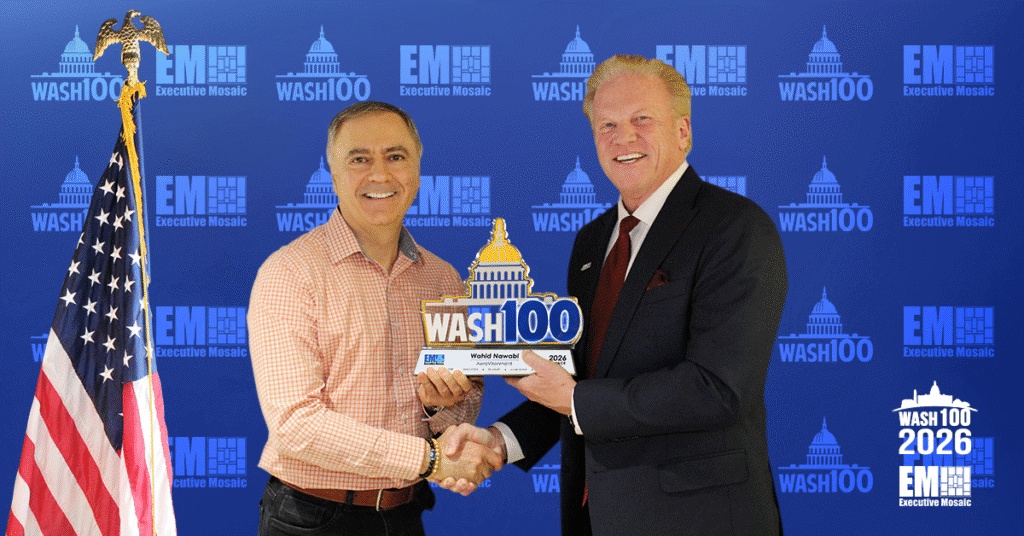
- The Wash100 award presentation · Event photograph and report