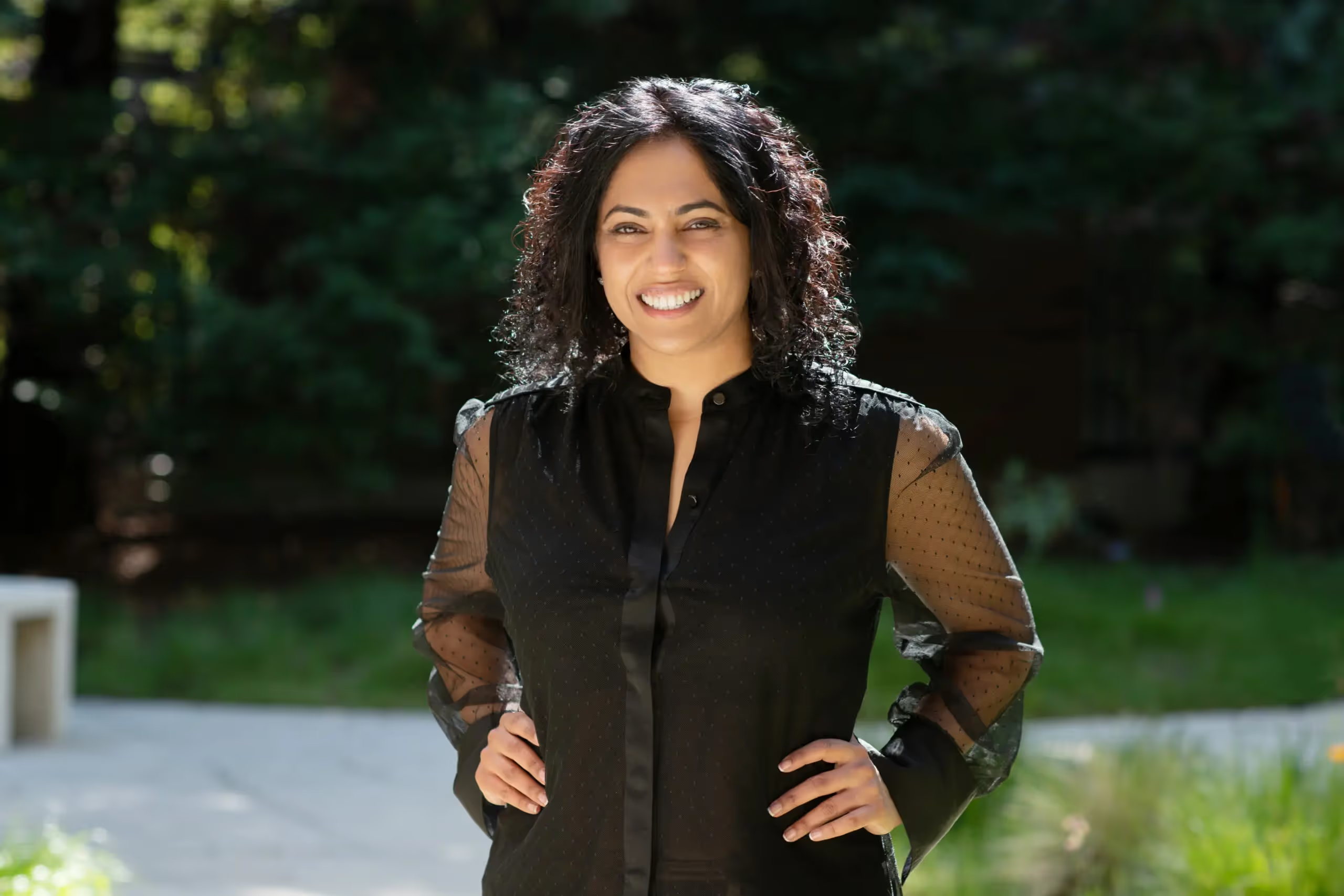
Most people don't cold-email venture capital firms. Even fewer turn that email into a summer internship. Almost nobody parlays that internship into a partnership at one of Silicon Valley's most respected firms. But Kanu Gulati isn't most people.
She's the kind of investor who can debug your FPGA architecture and your business model in the same breath. A partner at Khosla Ventures who doesn't just fund AI companies - she built the hardware acceleration technology that makes modern AI possible. Before she was writing checks for robotics unicorns, she was writing code for Intel's CAD lab and co-authoring textbooks on hardware-accelerated algorithms.
The cold email came in 2014, midway through her Harvard MBA. She'd already spent a decade in the trenches - research scientist at Intel and Cadence, founding engineer at three startups (all acquired, naturally). She knew deep tech the way most people know their commute. What she wanted was to find it, fund it, and help it scale. So she wrote to Khosla Ventures. They said yes.
The Mathematician Investor
Here's something you won't find on most VC bios: an Erdős number of 3. For the uninitiated, that's a measure of collaborative distance from Paul Erdős, the legendary mathematician who published more papers than almost anyone in history. Three degrees of separation. That's closer to Erdős than most mathematicians will ever get.
It's the kind of credential that makes sense when you meet Kanu's portfolio. She doesn't invest in "AI companies" - she invests in robotics foundation models, hardware-accelerated analytics, autonomous trucking systems, precision navigation for drones. The stuff that requires you to understand both the theory and the silicon.
Genesis AI. Waabi. PolyAI. Kognitos. Zendar. If you're building something that moves AI from software into the physical world, there's a good chance Kanu has either funded it, looked at it, or knows the three companies you're competing against.
From Delhi to Sand Hill Road
The journey started in India, where she earned her bachelor's in computer engineering from the University of Delhi. Then Texas A&M for a master's and PhD in electrical engineering. NVIDIA thought enough of her research to give her a graduate fellowship - the kind of thing that funds your dissertation and opens doors for the rest of your career.
Those doors led to Intel's research lab, where she didn't just write papers - she helped Intel Capital evaluate startup investments. Pattern recognition at its finest: see the cutting edge in the lab, then spot it in the wild before anyone else realizes it's the cutting edge.
But research scientist wasn't enough. She joined three early-stage companies as a founding or early engineer. Heavy.ai (hardware-accelerated analytics). Spyglass (predictive analytics for design, acquired by Synopsys). Nascentric (fast-circuit simulation, acquired by Cadence). All three built tools for problems most people didn't know existed. All three got acquired.
Education Arc
- Harvard Business School - MBA (2013-2015)
- Texas A&M - PhD, Electrical & Computer Engineering
- Texas A&M - MS, Electrical & Computer Engineering
- University of Delhi - BS, Computer Engineering
Portfolio Highlights
- Genesis AI - $105M seed for robotics AI
- Waabi - $200M Series B for autonomous trucking
- PolyAI - $50M Series C for conversational AI
- Kognitos - AI-powered automation
- Zendar - High-resolution radar
The Academic Pedigree
Three books. Not blog posts, not Medium essays - actual published books on hardware acceleration and EDA algorithms. Thirty-five peer-reviewed publications with over 650 citations. A U.S. patent. The kind of academic credentials that would make most people stay in academia forever, chasing tenure and grants.
Instead, Kanu went to Harvard Business School. Not to escape engineering, but to understand how it scales. She became co-president of the school's annual Venture Capital and Private Equity Conference - the biggest student-run conference of its kind. If you wanted to understand VC, you talked to everyone who showed up. And everyone showed up.
That's where the cold email makes sense. It wasn't naive ambition - it was pattern matching. She'd seen the technology roadmap from the inside. She knew what worked. She just needed the platform to back it at scale.
The Operator Turn Investor
There's a type of VC that founders love: the operator. Someone who's been in the room when the product won't ship, when the key engineer quits, when the customer calls at midnight because production is down. Kanu had been in all those rooms.
At Intel, she wasn't just researching algorithms - she was building tools that other engineers would use to design chips. At her startups, she was writing the code that had to work the first time because there was no budget for a second try. She knows the difference between a demo and a product, between a research paper and a production system.
That's the lens she brings to investments. When a founder pitches a robotics foundation model, she doesn't just ask about the business model - she asks about the training data, the inference latency, the edge cases where the model breaks. She's seen the gap between "works in the lab" and "works in production" destroy companies.
The Altitude Test
Somewhere between the PhD and the partnership, Kanu hiked to 19,341 feet. That's higher than any peak in the continental United States. Higher than most people will ever go without an airplane. The kind of altitude where every step requires intention, where you can't fake the conditioning, where turning back is always an option and pushing forward is always a choice.
It's the perfect metaphor for deep tech investing. You don't stumble into robotics foundation models or autonomous trucking systems. You don't accidentally build hardware-accelerated analytics platforms. You climb, deliberately, one step at a time, knowing that most people will think you're crazy for trying.
What She's Backing Now
The thesis is clear: AI is moving from software into the physical world. The next wave isn't chatbots or image generators - it's robots that can navigate warehouses, trucks that drive themselves, conversation systems that actually understand context, radar that sees through fog and rain.
In July 2025, Khosla Ventures co-led a $105 million seed round for Genesis AI, building foundation models for robotics. In 2024, portfolio company Waabi raised $200 million for autonomous trucking. PolyAI raised $50 million for conversational AI. These aren't incremental improvements - they're category-defining bets.
And Kanu isn't just writing checks. She's on the board of PolyAI. She's the first call when a portfolio company needs an intro to a chip designer or a reality check on their compute costs. She writes for TechCrunch about what VCs actually want from AI startups (hint: cut through the hype, show the enterprise value).
The Bridge Builder
There's a gap in Silicon Valley. On one side: brilliant researchers who can solve impossible problems but have never shipped a product. On the other: operators who can scale businesses but don't understand the underlying technology. Most VCs live on one side or the other.
Kanu lives in the gap. She can read your research paper and your P&L. She knows what good science looks like and what good business looks like, and - crucially - she knows they're not the same thing. The best technology doesn't always win. But the best technology with the right go-to-market strategy, the right team, and the right timing? That's what she's hunting for.
It's why founders in robotics and autonomous systems put her on their target list. It's why Khosla Ventures has her leading deals in the hardest, deepest, most technically complex parts of the AI landscape. And it's why that cold email from 2014 turned into one of the better decisions Harvard Business School has seen in a while.
The Pattern Continues
If you chart Kanu's career, you see the same pattern repeating: spot the frontier, go deep, build something, move to the next frontier. Computer engineering in Delhi. Hardware acceleration at Texas A&M. Research at Intel and Cadence. Founding engineer at three startups. Venture capital at Khosla.
Each step built on the last. Each role gave her a new lens. And now she's using all of them at once - the researcher's rigor, the engineer's pragmatism, the founder's urgency, the investor's patience.
The next frontier is already clear: AI systems that work in the real world, with all its messy physics and edge cases and unpredictable humans. Robots that don't just work in demos. Autonomous vehicles that handle construction zones and snow. Conversation systems that understand what you mean, not just what you say.
And somewhere in that frontier, there's a founder with a cold email, wondering if it's worth sending. Kanu knows the answer. She sent that email once. It worked. And now she's the one reading them.