Florian Seibel kept the tape. In April 2024, when a German vice chancellor came to open his company’s factory in Ukraine, there was no ceremonial ribbon. Someone found grey packing tape in the shipping area. Robert Habeck and Seibel cut it with scissors. A piece ended up in Seibel’s office, an unusually modest souvenir of a rather consequential opening.
The detail suits a business built around getting aircraft into use. There are more flattering things a founder could display than something borrowed from dispatch. Tape, however, has the advantage of having done a job. Seibel’s career keeps returning to that distinction: the satisfaction of making a thing work, followed by the less photogenic business of making it work again.
Today he shares the chief executive role at Quantum Systems, the drone company he helped establish in 2015. His remit covers technology, products and strategy. The journey there runs through military helicopters, an unfinished doctorate and a small aircraft that can leave the ground vertically before flying on wings. The turns are more revealing than the valuation.
A pilot with two kinds of aircraft in mind
Born in Freiburg im Breisgau, Seibel grew interested in flying early. He wanted to fly fighter jets when he joined the Bundeswehr after school; his military flying career instead took him into helicopters. He trained on the BO 105. There is a certain practical education in discovering that the aircraft you had imagined flying and the aircraft you actually fly need not be the same.
He studied aerospace engineering at the University of the Bundeswehr Munich. Military service, which ran from 1999 to 2016, gave him experience as an officer and helicopter pilot in Germany and abroad. In 2010 he returned to university as a research assistant, working on unmanned aircraft. The cockpit had given way to the laboratory, but the subject remained recognisably airborne.
A helicopter can take off without a runway. A fixed-wing aircraft offers efficient forward flight. Putting those attributes into one small unmanned system was the engineering proposition around which Quantum Systems formed. For someone who had flown helicopters and studied aircraft design, the appeal was specific: an aircraft that could get out of a confined launch area and then travel efficiently.
The doctorate that became a company
The founding team came together through research at the university’s Institute of Flight Systems. Michael Kriegel, Tobias Kloss and Armin Busse joined Seibel in the venture. Quantum-Systems GmbH was founded in January 2015. Seibel left his doctorate unfinished, choosing to build the business rather than complete the academic qualification.
His account of the beginning is refreshingly unceremonious. He thought other people were better suited to deep abstract research; his own strengths lay in gathering people around a technical idea. Smartphone development had also made small cameras, positioning receivers and communications components more accessible. Parts that once belonged in expensive systems were becoming useful ingredients for small aircraft.
An application for EXIST startup funding failed. He worked on the venture during evenings and weekends, and used military transition payments to support himself for two years, allowing money that might have paid his company salary to fund another employee. The early team numbered five or six. Before the funding announcements came the familiar arithmetic of one more person.
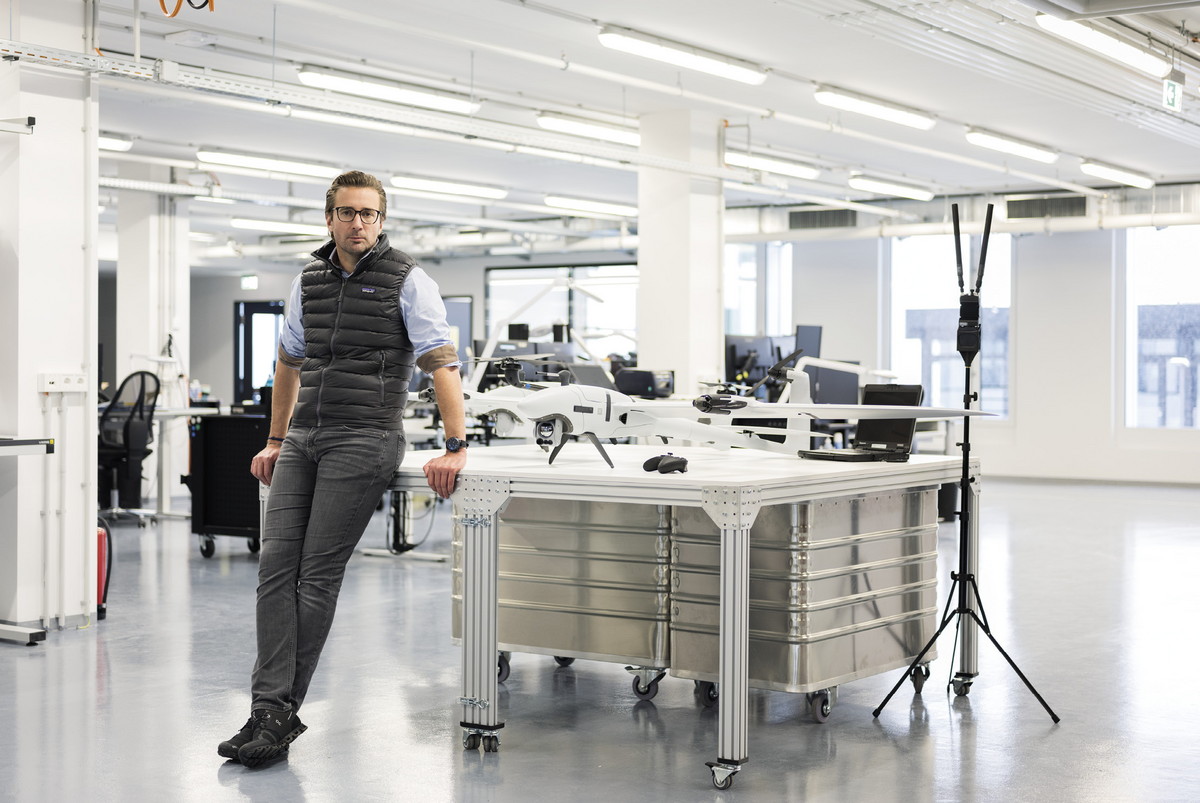
First, make the map
The early commercial proposition involved collecting useful information from above. Trinity, launched in 2017, served mapping and surveying work. Agriculture, construction and other land-based industries needed aerial data; a small aircraft offered a way to gather it without organising a conventional flight. The glamour, such as it was, involved returning with measurements someone could use.
By the launch of Trinity Pro in May 2023, the Trinity platform had accumulated more than 75,000 flight hours. The newer model brought an updated autopilot, onboard computing and terrain-following improvements. Those are revealing priorities. A customer collecting data needs dependable missions, manageable preparation and a clean result, even when the product photograph prefers to dwell on the wings.
That commercial inheritance matters to Seibel’s story. The company’s identity developed around aircraft carrying sensors and delivering information. A farmer, a surveyor and a military operator have very different purposes, but each needs an aircraft that can launch, navigate and bring back useful data. The shared engineering helps explain how a civilian mapping business could also become a supplier of reconnaissance systems.
The factory behind the ribbon
Russia’s full-scale invasion of Ukraine made that second use urgent. Quantum Systems’ Vector reconnaissance drones have been operating in Ukraine since May 2022. Seibel publicly committed himself to supporting the country. His military background and his company’s technology had acquired a common, immediate purpose.
In April 2024 the company opened the Ukrainian factory commemorated by the tape. It already operated a local service, support, training and logistics centre. The new plant added manufacturing to that presence, alongside an announced investment of up to €6 million over two years. It was a commitment involving premises, colleagues and continuing work inside the country.
“The future of drone technology is being written here,” Seibel said at the opening. The line describes his view of Ukraine as a place to learn and develop as well as a customer. By February 2025, the local factory employed 80 people and had achieved full unit production. Plans to expand staffing and output remained plans; the existing workforce was already a tangible measure of the undertaking.
“The future of drone technology is being written here.”
Florian Seibel · Ukrainian factory opening, April 2024
Quantum Systems was recognised among ten international business flagship projects at the 2024 Ukraine Recovery Conference. The company also described future civilian work for its drones: surveying, reconstruction and assessing damage. A machine built to gather information can remain useful when the question changes from where danger lies to what needs rebuilding.
Sharing the helm, keeping the product
Growth brought a different design problem: how to arrange the people at the top. Effective January 2025, Seibel became co-CEO alongside Sven Kruck, who had joined Quantum Systems in December 2022. Kruck took responsibility for operations, sales and finance. Seibel concentrated on products, technology and strategy.
“It’s all about the product,” Seibel said when the arrangement was announced. By then the organisation had more than 400 employees across five countries. Sharing authority gave the founding engineer a defined place in a business that required substantially more coordination than a research team. Someone still had to care about what the engineers were building next.
The arrangement also gives his story a useful complication. Founders are often described as if their chief accomplishment were holding every responsibility indefinitely. Here, the responsibilities were divided. Seibel remained at the helm while making room for another executive to run much of the machinery around the product. Even a company devoted to flight needs people attending to what happens on the ground.
- 2015Co-found a company around unmanned flight.
- 2024Open a production facility in Ukraine.
- 2025Share the CEO role; focus on technology and product.
A bigger cheque brings a bigger assignment
In July 2026, Quantum Systems announced the signing of a $1.2 billion Series D financing at an approximately $8 billion post-money valuation. Blackstone, Noteus, Airbus and Advent co-led the transaction. The company set out a programme of manufacturing expansion, stronger supply chains and investment in software and AI. Those are obligations measured in deliveries as much as money.
Its stated ambition had expanded beyond individual aircraft to connected autonomous systems across air, land and sea. MOSAIC UXS, its software ecosystem, sits within that plan. For Seibel, the product question now includes how different machines work together. The small aircraft’s transition from vertical lift to forward flight has become one part of a much larger coordination problem.
The manufacturing plans made the expanded assignment concrete. In July 2026, Quantum Systems described work to increase capacity in Germany, Ukraine, Australia and California, ramp up a facility in Huntsville, Alabama, and establish additional sites in Britain and eastern Europe. For a founder responsible for product strategy, that footprint adds a practical question to every new design: how will colleagues in different places build and sustain it? The distance between a promising prototype and a dependable production system becomes part of the engineering brief.
He has also moved into work that connects younger companies with established industry. In September 2025, Germany’s aerospace association, BDLI, elected him to its newly created startup representative role. His task includes strengthening links between the startup ecosystem and aerospace businesses. The founder who once struggled for support now has an institutional position from which to help make introductions.
The latest turn reaches into the components themselves. On 13 October 2026, semiconductor startup Ubitium named Seibel as a personal investor in its $14 million seed round. He explained the attraction through an operator’s constraints: autonomous machines need to process information and control themselves onboard when communications are unavailable, while keeping weight and power consumption down. Ubitium proposes a universal processor to handle those workloads.
Still a pilot
Flying remains part of Seibel’s life away from the company: gliding, paragliding, helicopter flying and flight instruction. He also walks and runs with his dog. His professional life concerns aircraft that can operate without a pilot onboard; his own enthusiasm still includes being the pilot. The pleasure of flight has survived the effort to automate it.
The packing tape is a useful place to leave him. A factory opening needed a ribbon, the shipping department had a substitute, and the ceremony proceeded. Seibel kept a piece. For all the capital and expanding ambition around Quantum Systems, that small object records a particular day when people found a practical answer and got on with the work.
Follow the flight path
Conversations, public profiles and further reading.