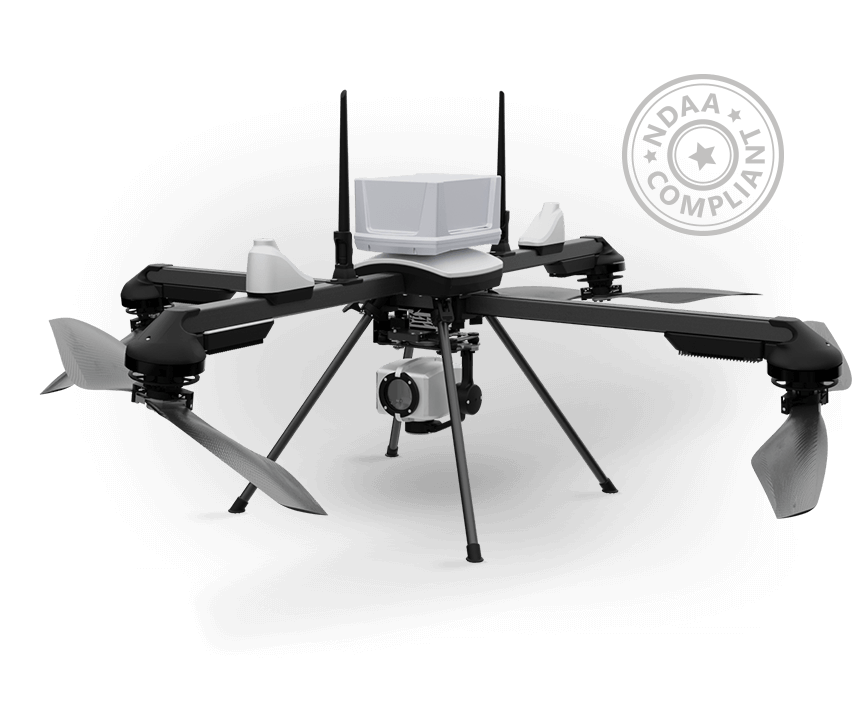
For four months in 2024, ten members of the Fort Wayne Police Department’s Air Support Unit tested an ideaForge drone. The aircraft was the NETRA V4 PRO. Their published assessment praised its endurance and quietness, then supplied the detail that makes the story interesting: the software took some learning. A machine can spend an hour and a half in the sky and still require patient work on the ground.
- The offer: surveillance and mapping aircraft, flight software, training, and support.
- The American foothold: operator trials and a cooperative purchasing contract.
- The lesson: test the whole mission, including the people and paperwork.
That small reservation is useful. Drone brochures have room for flight time, range, and cameras. An agency has to make room for shifts, training, equipment budgets, and somebody who can answer when an operator gets stuck. ideaForge Technology Inc., the group’s U.S. subsidiary, is working in the space between those two documents.
The most useful sentence in the demo
Fort Wayne’s trial ran from May to August. The department reported flights exceeding 90 minutes and described the aircraft as quieter than similar models. It also credited ideaForge’s support during the extended demonstration. These are observations from a company-published customer testimonial, rather than an independent benchmark. They describe a trial, without establishing a subsequent purchase.
“The NETRA V4 PRO was reliable, though its software required some learning.”
Fort Wayne Police Department · Air Support Unit
The U.S. early-adopter programme makes that kind of encounter part of the sales pitch. It advertises test flights without an initial investment, priority support, and discounts after the trial. The practical attraction is time to discover whether a capable aircraft belongs in a department’s routine. A buyer gets evidence before committing to equipment.
For other hardware businesses, there is something worth borrowing here: put the product in several users’ hands and let ordinary work expose the awkward bits. A demonstration rewards the person who already knows the controls. Repeated use asks whether everyone else can learn them. Software familiarity becomes part of the product’s value.
A long flight has a very earthly purpose
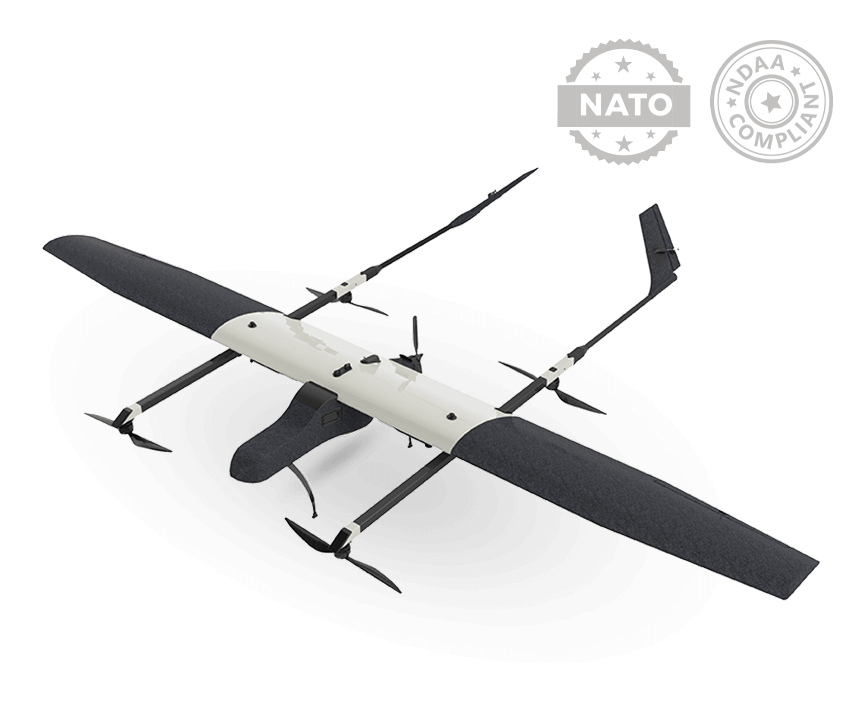
ideaForge’s catalogue separates missions by aircraft. NETRA V4 PRO is a portable quadcopter for surveillance. SWITCH combines vertical take-off and landing with fixed-wing flight, aimed at long-range observation and difficult terrain. Q6 V2 GEO serves mapping work. The choice begins with what the user needs to see, and where the aircraft must operate.
The U.S. product pages advertise more than 90 minutes for NETRA V4 PRO and more than 120 minutes for SWITCH. Those are manufacturer specifications, with field performance dependent on operating conditions. Their importance is straightforward: sustained observation can reduce the interruptions caused by landing and relaunching. Whether that matters depends on the mission.
Manufacturer specifications. Actual endurance depends on conditions.
The intended users include police, fire services, emergency managers, border-security teams, and enterprise surveyors. The jobs range from observing an incident to mapping terrain or monitoring a wildfire. Aerial imagery helps people inspect places that are hard to reach from the ground. The useful output is information someone can act upon.
BlueFire Touch handles ground control and mission management; BlueFire Live! shares live video and enables payload control. Together with training and support, these offerings show why ideaForge sells a system around the aircraft. Engineering expertise extends across avionics, autonomy, software, and manufacturing. For the buyer, each part has to cooperate during an actual operation.
Fifteen years before Texas
The subsidiary was formed in September 2022. Its parent’s story starts in India in 2007 with Ankit Mehta, Rahul Singh, Ashish Bhat, and Vipul Joshi. Keeping the dates separate matters: the American business inherits an established engineering programme, while building its own access to customers and institutions.
Qualcomm Ventures recounts that the 2008 Mumbai attacks pushed the founders toward products that could assist security forces. The team pursued hardware and software together, with manufacturing in India. That decision placed difficult operating environments at the centre of the business. The American expansion carries that mission-focused engineering proposition into another purchasing landscape.

The purchase order joins the aircraft
ideaForge’s business model combines institutional hardware sales with associated software and services. Its PCA contract, 00-430-25, adds a cooperative buying route for eligible member agencies. The company describes access across the United States, Canada, and Mexico, with renewals allowing up to five years. It offers direct access to the manufacturer under an already competed contract.
That route can spare an eligible agency a separate solicitation, subject to its own purchasing requirements. It is a commercial advantage with no propeller attached. A technically suitable drone still needs a permissible route into the equipment cupboard. Public-sector sales depend on addressing both questions early, rather than discovering the second after a successful flight.
- 01Fly the mission
- 02Train the crew
- 03Arrange the purchase
An editorial reading of the trial, support, and procurement approach.
Local production is still a project
In September 2025, ideaForge and First Breach announced a venture to manufacture and distribute selected UAVs in the U.S. A subsequent SEC filing describes the subsidiary contributing technical knowledge, equipment, software access, and intellectual-property licences. The purpose is localisation. The filing presents production, trials, and procurement as plans dependent on approvals and successful execution.
The company also announced a public-safety AI partnership with Skylark Labs in 2024. In June 2026, American Industrial Technologies announced a preliminary, non-binding letter of intent with the subsidiary, exploring drones, communications, and mobility. These arrangements occupy different stages of development. A proposal deserves attention, while completed products and deployments require their own evidence.
ideaForge competes in a market served by Skydio’s public-safety systems and DJI’s enterprise aircraft. Its pitch emphasises long endurance, portable designs, and a choice of quadcopter or hybrid fixed-wing platforms, backed by software and support. Buyers should judge endurance alongside payloads, operator effort, service, and purchasing eligibility. The Fort Wayne sentence supplies the right starting point. A useful trial lets the awkward detail remain in the story, where the next buyer can learn from it.