Electric flight has always attracted lovely pictures and brutal arithmetic. The pictures show quiet aircraft hopping over traffic, rotors placed wherever a designer pleases and cities relieved of another queue. The arithmetic begins with weight. Eric Bartsch has spent enough time around real electric airplanes to know which one wins the argument.
He is a mechanical engineer, a commercial and instrument-rated pilot, a glider pilot, an inventor on more than 20 U.S. patents and the co-founder and CEO of VerdeGo Aero. His company builds hybrid-electric powerplants in Daytona Beach, Florida. Its proposition contains a useful tension: aircraft can gain the design freedom of electric motors while retaining the range, endurance and shrinking weight of liquid fuel. A turbine or piston engine makes electricity; motors decide what to do with it.
Bartsch does not present this as a timid bridge to some purer future. He argues that hybrids belong in aviation for the long haul, especially where useful payload, regulatory reserves and hundreds of miles matter. The claim annoys a particularly modern instinct - the belief that technological progress should arrive as a clean replacement. Aviation, alas, has never been obliged to respect a keynote.
“The transformative technology that makes electric flight interesting isn’t batteries - it’s electric motors.”Eric Bartsch, on HangarX Studios
An aircraft company discovers the engine room
VerdeGo began in 2017 with Bartsch, electric-flight advocate Erik Lindbergh and Embry-Riddle professor Pat Anderson. Their first plan was a hybrid-electric vertical-takeoff aircraft. The founding logic was not frivolous. Bartsch had arranged Lindbergh’s first flight in an electric airplane. Anderson had flown an early hybrid aircraft. The three had worked around electric and hybrid programs for years, and a rewrite of U.S. small-aircraft certification rules had created room for unfamiliar designs. Money and attention were pouring into short-range VTOL.
Then the market supplied a better question. Dozens, eventually hundreds, of teams were proposing electric aircraft and drones. Each had a shape, a mission and a rendering. Many faced the same missing piece: a power system that could deliver electricity without assigning a ruinous share of the aircraft’s weight to batteries.
VerdeGo stopped developing its own airframe and moved upstream. Instead of competing to sell one aircraft, it could supply the common constraint to many aircraft makers. In startup language, this was a pivot. In workshop language, it was walking to the end of the bench where everybody had left the same unsolved problem.
The distinction is the heart of Bartsch’s thesis. Electrification is not synonymous with a battery. Motors and energy storage solve different problems. Small, responsive electric motors can distribute thrust across a wing or around a VTOL airframe, opening design choices that mechanical shafts make awkward. The electricity feeding those motors can come from batteries on short missions, or from an onboard generator when range and reserves become less forgiving.
A product apprenticeship in miniature
Bartsch arrived at full-scale aircraft by a route that included products much smaller than a cockpit. Early in his engineering career, he developed consumer products and led engineering teams. In 2008 he became a vice president in Horizon Hobby’s product division, where the output included electric radio-controlled aircraft, helicopters, cars and boats produced by the million.
That experience matters because aerospace prototypes are good at seduction. One exquisite machine can conceal a business that cannot repeat itself. Consumer products enforce another rhythm: supply chains, costs, customers, iteration and volume. Bartsch later brought that product sensibility to GreenWing International, an offshoot of drone maker Yuneec, where he served as acting general manager in 2013 as the company worked to sell single- and two-seat electric aircraft kits.
The same year, he led development and flight testing around a fleet of piloted electric research aircraft and organized an electric-aircraft formation demonstration at EAA AirVenture. Formation flying is an apt metaphor for the business he would later build. The machines need not be identical. They do need power, control and timing that behave as promised.
Physics keeps the minutes
Bartsch’s public explanations return to a stubborn comparison. Fuel stores far more energy per unit of weight than today’s batteries, and an aircraft gets lighter as it burns fuel. A battery lands at almost the same weight with which it took off. Aircraft also need reserves. An optimistic range number loses its charm when the vehicle must divert, hold, climb again or preserve predictable performance as its battery pack ages.
This does not make batteries pointless. Trainers, gliders and short, efficient missions can suit them. It does make mission selection decisive. Bartsch’s habit is to begin with what the aircraft must actually do, then choose the energy architecture. It is the engineering version of refusing to order the hat before measuring the head.
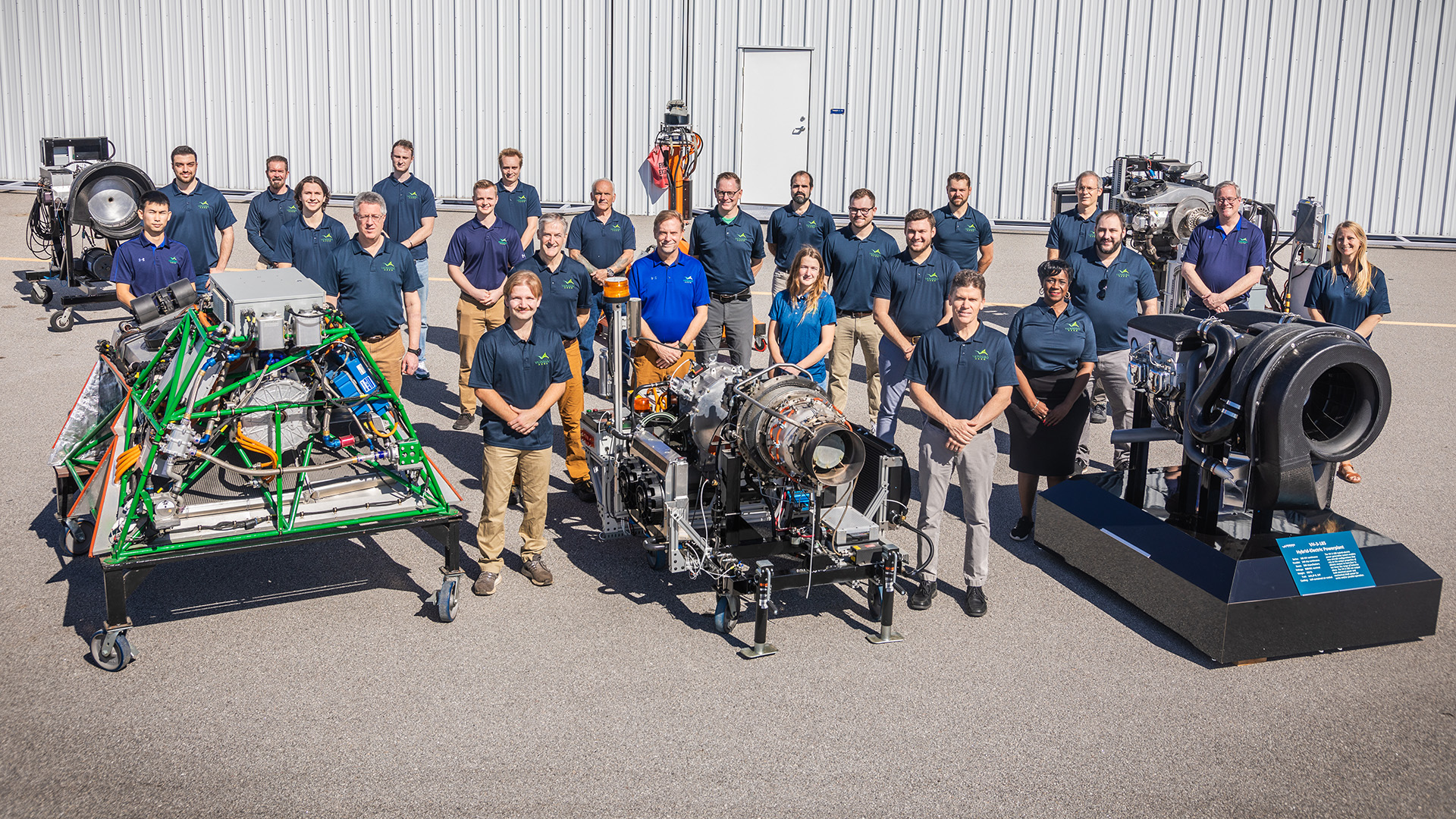
VerdeGo has arranged its products accordingly. The VH-3 sits at 185 kilowatts. The turbine-based VH-4T delivers roughly 400 kilowatts for larger VTOL, rotorcraft, cargo-drone and regional-aircraft applications. The VH-5 concept reaches the 1.5-megawatt class. The ladder lets one thesis travel across aircraft sizes without pretending every mission is the same mission in a different coat.
Hybridization creates its own hard work. Engines, generators, power electronics and motors produce heat. High electrical power can produce electromagnetic interference. Controls must coordinate the ensemble in ways that remain simple enough to certify. The system must fit into an airframe whose designer would quite like every kilogram back. Bartsch speaks readily about these chores. His optimism has wiring diagrams.
From the test stand to somebody else’s aircraft
The company’s commercial story has gradually caught up with its technical thesis. A $12 million Series A in 2022 brought backing from strategic and financial investors, including RTX Ventures, DiamondStream Partners, Seyer Industries and Avfuel’s technology initiative. A later Series A-1 added capital as full-scale prototypes moved through testing.
Government programs have become another route from experiment to hardware. U.S. Air Force awards supported the VH-3 and VH-4T. In August 2025, VerdeGo announced a $9.7 million Phase III Small Business Innovation Research contract to mature the VH-4T into a production-intent configuration and build the first VH-4T-415 prototype. NASA work has examined how VerdeGo powerplants could improve the missions of electrified rotorcraft.
By 2026, Bartsch was describing the industry’s shift from research programs to products and reporting that early VH-4T systems were shipping for customer ground and flight tests. This is a less cinematic milestone than a new aircraft lifting into the air. For a component company, it may be the more revealing one. The powerplant leaves the sympathetic environment of its maker and enters another team’s schedule, wiring, weight budget and reputation.
Bartsch’s circle reflects the bridge VerdeGo is attempting to build. Anderson brings academic research, flight test and certification experience. Lindbergh brings decades of advocacy around cleaner and quieter flight. Strategic investors connect the company to established aerospace and fuel infrastructure. Airframers bring missions. Regulators bring the questions that remain after the renderings have gone home.
- Separate the glamorous technology from the enabling technology.
- Find the constraint shared by a crowded field of competitors.
- Build a product ladder that serves several missions without flattening their differences.
The practical future has moving parts
There is a temptation to treat compromise as a temporary embarrassment. Bartsch treats it as architecture. Sustainable aviation fuel can work through existing liquid-fuel systems while electric motors change the design and control of aircraft. Batteries can contribute where their strengths fit. Hybrid power can handle the missions that would otherwise wait for a dramatic change in cell chemistry.
That leaves VerdeGo with a difficult but legible ambition: make electric propulsion useful before every part of the ideal future arrives. The company still has the ordinary aerospace distance to travel between prototypes, flight tests, certification, production and durable customer programs. Bartsch’s career suggests he understands that the noun “aircraft” is glamorous while the verb “commercialize” eats the calendar.
His bet is not that physics will surrender. It is that good engineering can negotiate better terms. Put the motors where they improve the aircraft. Carry energy in the form the mission can afford. Design the controls, cooling and certification path as parts of the product, not footnotes. Then ship the machine to someone who intends to fly it.