A rocket launch makes a persuasive ending. Flames, a rising vehicle, a dot disappearing into the sky: the machinery supplies its own punctuation. Ignacio Belieres Montero has built his working life around the awkward question that follows. Where, exactly, has the passenger arrived? A satellite can reach space and still have another journey ahead of it. That gap is where his company, Epic Aerospace, wants to work.
Montero’s title is CEO and founder. His company develops orbital transfer vehicles, usually called space tugs. The name suggests a harbor, which is a useful place to begin. Large ships and smaller working vessels have different jobs. Epic’s proposition gives the launch vehicle one leg of the trip and a separate spacecraft the next. Its founder’s story follows a similar change in perspective, from the pleasure of building rockets to the practical business of moving their cargo. ↗
01A terrace with upward ambitions
He began building rockets at 15, starting on his mother’s terrace. It is a wonderfully domestic address for an interest in leaving the planet. By January 2023, he was watching from Florida as a spacecraft built by his company launched aboard a Falcon 9. The distance between those two settings is part of the story. The more revealing connection is that he kept returning to the same subject: how to make a machine travel through space. ↗
The early experiments developed into engineering studies at Stanford. He subsequently left university to concentrate on aerospace work. An interview-based study of Argentina’s space sector describes independent rocket development as part of the experience from which he shaped Epic. The direction was established before a first orbital demonstration could give it a public date. ↗
There is a temptation to make the terrace do too much explanatory work. A childhood hobby does not contain a finished business plan. What makes the episode useful is its modest specificity. This began as something he did, with actual rockets, in an actual place. Years later, there would be investors and formal partnerships. First came the experiment.
02A seat in the summer of 2019
By Summer 2019, Epic was in Y Combinator. Its directory description is wonderfully economical: satellite delivery after launch. The Argentine corporate record already contained an Epic Aerospace entity incorporated in October 2017, with Montero named its founding administrator. The paperwork and the accelerator milestone mark different stages in the process of turning aerospace work into a company. ↗
In 2020, he was named a Thiel Fellow. The class included 24 people; the two-year program provided $100,000 and access to a network of founders, investors and scientists. The announcement paired Montero’s name with Buenos Aires and identified Epic’s transportation work. It put a particular person, place and business proposition beside the fellowship badge. ↗
Those affiliations helped place his work in entrepreneurial circles. They also create an interesting double audience for the founder. An engineer needs a vehicle to meet its requirements. An investor needs a business that can keep meeting them for customers. The same hardware has to withstand both kinds of examination, though only one involves lighting the engine.
03The paperwork before the propulsion
During the 2019 fundraising period, Montero needed a provisional patent application prepared before discussions with potential partners and investors. He was also trying to meet technical milestones before a seed round following YC Demo Day. He worked with Cognition IP, which turned his invention disclosure into an application in less than two weeks. The firm’s account describes the central constraint: protecting the work without consuming the founder’s time. ↗
This is the less cinematic portion of a space biography. Nobody assembles a cheering crowd around a provisional patent application. Yet a company built around its own technology has to decide what it can discuss, with whom, and under what protection. Montero’s problem was practical. He needed to keep development moving while making the company ready for other people’s scrutiny.
04The engine has an audience
His public posts supply a less bureaucratic pleasure. “Few things are cooler than testing a rocket engine at night...” he wrote alongside footage of Epic’s Tromen engine. The accompanying company update described more than 180 seconds of accumulated run time over two weeks. The enthusiasm is easy to understand even before the engineering vocabulary arrives. A machine that existed as a set of decisions now produces a visible result. ↗
“Few things are cooler than testing a rocket engine at night...”
Ignacio Belieres Montero · public post
For the first CHIMERA demonstration, Epic built its own propulsion system, an aluminum-alloy structure and control avionics. The company lists a 900-newton engine for CHIMERA LEO-1. Its mission description emphasizes building, qualifying and flying the structure as well as the propulsion. That sequence gives the excitement a discipline. An engine firing is an event; qualification asks whether the hardware is ready for the job ahead. ↗
Montero shared the footage and his delight in it. His post dwells on the engine doing its work, giving a direct glimpse of the pleasure he takes in testing. Around that engine, however, a vehicle must take shape. Structures, tanks and controls bring separate engineering tasks together, each needed for the machine that will eventually fly.
05January 3: the trip changes scale
CHIMERA LEO-1 launched on January 3, 2023, aboard SpaceX’s Transporter-6 mission. It was Epic’s first orbital transfer vehicle demonstration. Montero watched the launch from Florida. The vehicle was intended to mature the technologies needed for later commercial missions, bringing the company’s structure and propulsion work into orbit. ↗
The job Epic describes starts with a shared arrival point. A large launch vehicle carries small satellites together. Their intended destinations can differ. A transfer vehicle supplies another leg, allowing a payload to continue toward the orbit it needs. Luca Estebenet, Epic’s finance and operations lead, has used the familiar trip from airport to home to explain the arrangement. ↗
The analogy is useful because it makes the customer’s problem visible. Getting everyone onto the same large vehicle is efficient, but it leaves the destination question to be solved. For Montero, that second leg is substantial enough to build a company around. The first demonstration made the proposition physical. It also began the harder task of establishing a flight record.
06Earth has its own connections to make
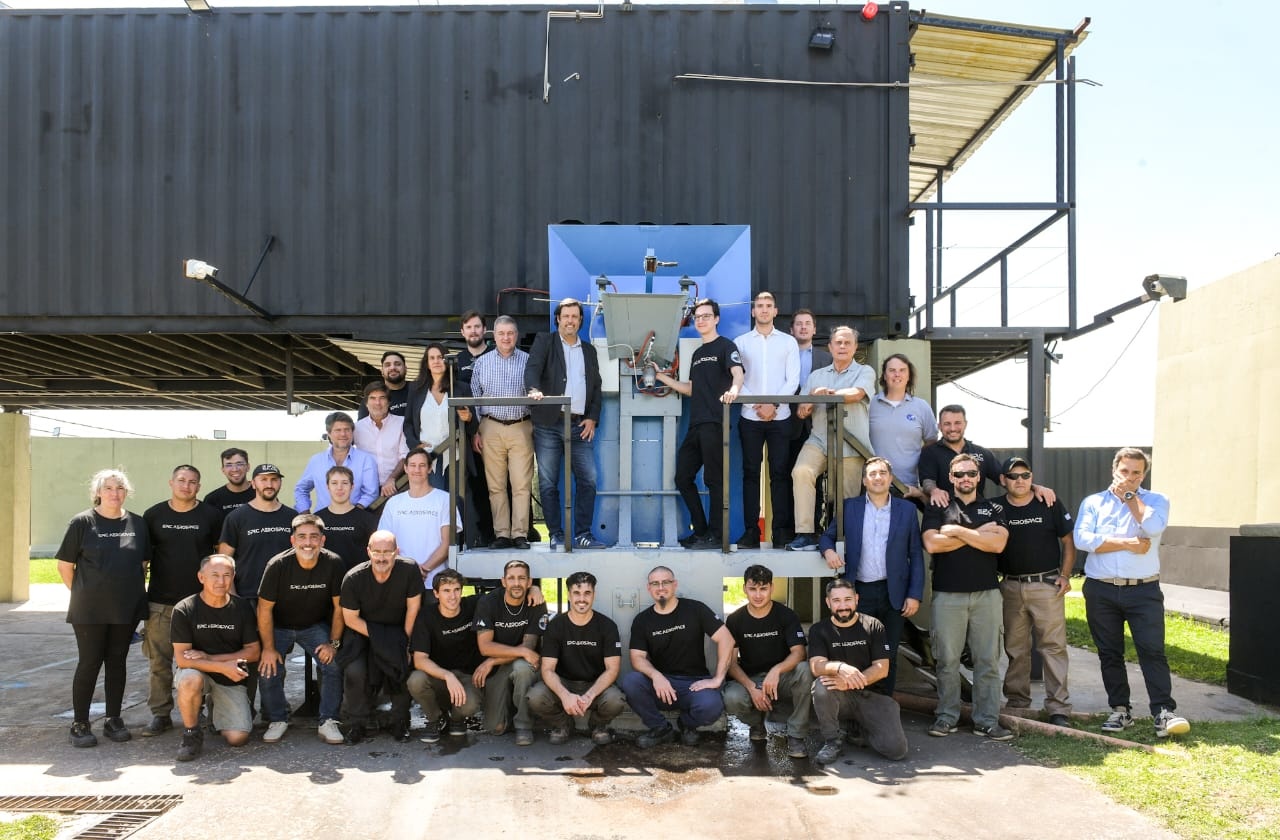
Epic’s ground operations have crossed borders. Estebenet described a 400-square-meter manufacturing facility in Uruguay’s Zonamerica, with office and warehouse space. In Argentina, the company has a testing facility in Ezeiza. The arrangement gives Montero’s orbital ambitions a distinctly terrestrial geography: hardware needs somewhere to be assembled, stored and tested before it can go anywhere else. ↗
The supply chain extends farther. In September 2023, Epic ordered €318,000 in products and subsystems from GomSpace for its space-tug control system. It was a purchase by Epic. Alongside the systems built inside the company, there are components sourced from other specialists. The founder’s transport project depends on that combination of making and buying. ↗
For CHIMERA GEO-1, specialists at CenTec Rafaela and INTI helped manufacture propulsion-system parts through metal additive manufacturing. Iterative work reduced weight and combined components. These are small-sounding changes with real consequences for the assembled machine. The useful unit of progress can be a component that meets the requirement, rather than a sentence about the future. ↗
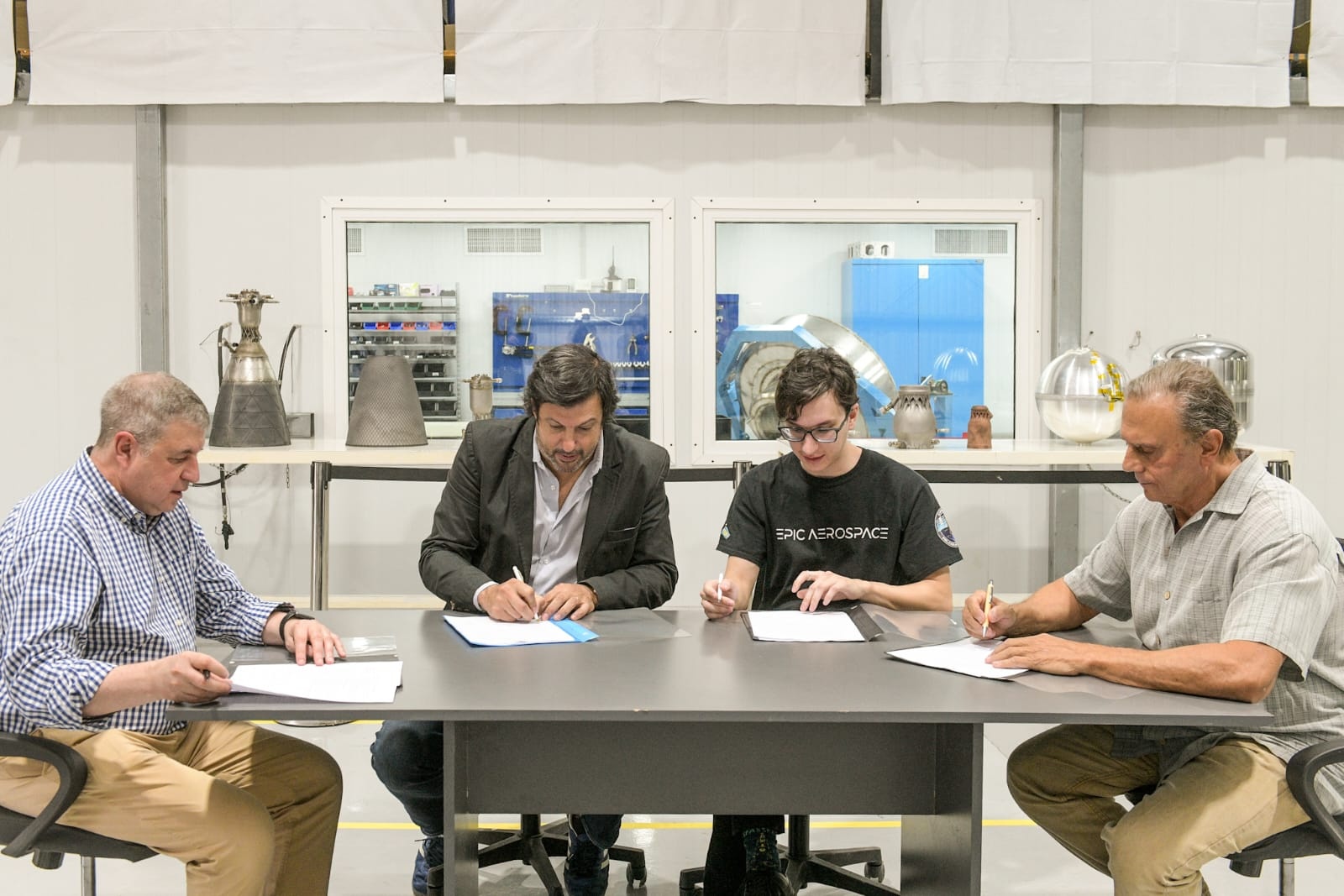
On February 19, 2025, Argentina’s innovation secretary Darío Genua visited the Ezeiza facility. A cooperation framework involved Epic, the secretariat, CONAE and VENG. Import procedures for essential parts were also on the agenda. Montero’s work placed him beside officials at a signing table, with engine hardware visible behind them. Even the paperwork had acquired an aerospace backdrop. ↗
07The call that had to reach farther
CHIMERA GEO-1 launched on February 27, 2025, UTC. The intended route used a lunar fly-by before delivery of its CubeSat payload into geostationary orbit. Communications problems disrupted that plan, and the spacecraft continued deeper into space. On March 2, Goonhilly was called in to provide emergency support. Its operators established a solid connection and supported rescue efforts for several weeks, at distances reaching 33 million kilometers from Earth. ↗
That episode adds an operational complication to a career already full of engineering milestones. A vehicle needs to launch and function. It also needs a continuing connection to the people commanding it. In this case, communications became part of the rescue effort. The long distance and the interrupted delivery plan belong together in the account of the flight.
For a founder proposing transportation as a service, that is a consequential pairing. A customer has a destination, rather than an interest in distance for its own sake. The mission brought Epic into an unplanned deep-space situation while exposing how much the journey depends on its ground links. It is a difficult chapter, with more to explain than a launch photograph alone can carry.
08A fleet, rather than a single trip
Montero’s stated ambition reaches beyond individual transfers. In a public post at the start of 2020, he described reusable tugs remaining in orbit and serving different satellites headed to different destinations. The point was to help smaller satellite operators position their spacecraft without each having to develop its own propulsion. A continuing logistics network was the goal. ↗
Epic’s mission language draws on railways, airport hubs and computer networks. They are systems whose usefulness comes from connections and repeated use. That comparison explains the scale of the founder’s proposal. Refueling and repeated trips remain part of the long-term vision. The flight milestones are the concrete steps against which that vision can be examined. ↗
The terrace makes a good opening scene because the setting is so ordinary. The later story becomes interesting for the opposite reason: an apparently familiar service, transportation, has to be made to work in an unfamiliar place. Montero has pursued that problem through studies, tests, components, partnerships and two launch milestones. The satellite still needs to reach its address. His work is in the intervening journey.