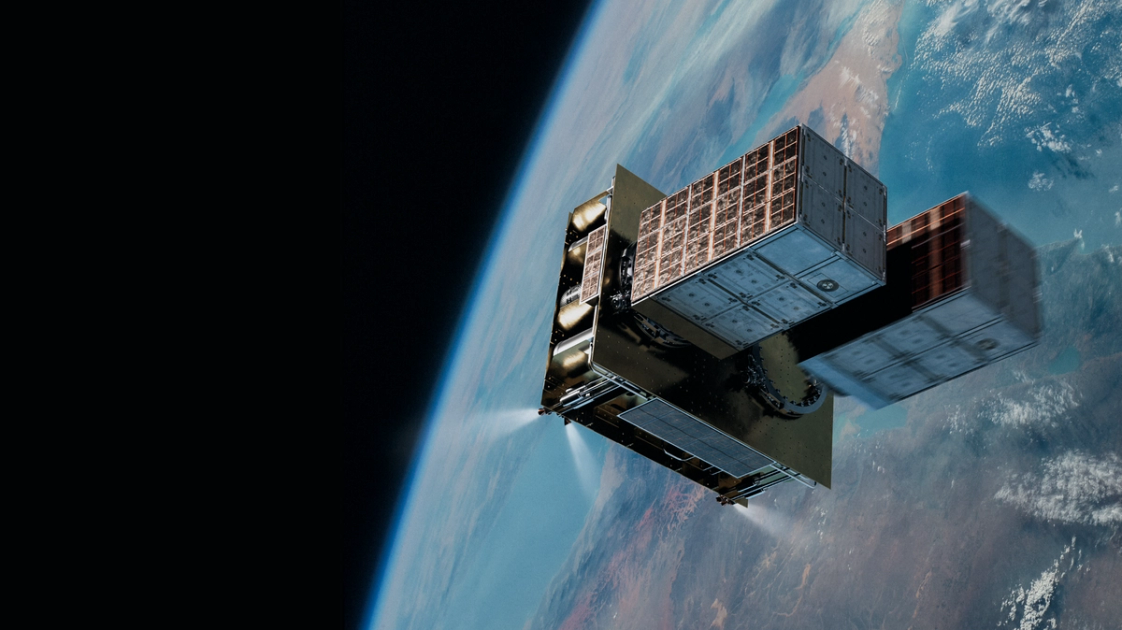
Somewhere above the Pacific, a Falcon 9 second stage opens up and a swarm of small satellites slips out into a parking orbit nobody actually wanted. The launch was cheap. The orbit is wrong. And then a refrigerator-sized vehicle wakes up, lights two propellants that ignite on contact, and starts the slow arc toward the orbit the customer paid for. That refrigerator has a name. It is called CHIMERA, and it belongs to Epic Aerospace.
This is what Epic Aerospace does, in one sentence: it finishes the trip. Rideshare rockets - the SpaceX Transporters, the upcoming Bandwagons - sell cheap tickets to a generic neighborhood. Epic sells the taxi from the bus stop to your front door, where your front door is 36,000 kilometers up and going eleven thousand kilometers an hour.
Epic Aerospace was founded in 2018 by Ignacio Belieres Montero, an engineer who looked at the booming smallsat market and noticed something most investors had missed. The rockets were getting cheaper. The satellites were getting smaller. But the gap between where the rocket dropped you and where you actually needed to be was getting wider. Somebody had to bridge it.
The company's first vehicle, CHIMERA LEO 1, hitched a ride on SpaceX Transporter-6 in January 2023 as a maturation flight - the engineering equivalent of a learner's permit. Two years later, in February 2025, CHIMERA GEO 1 launched on the Intuitive Machines IM-2 mission, carrying more than 1.7 km/s of delta-v - enough push to sling a payload from low Earth orbit toward the geostationary belt where television satellites live.
Headquartered in California, engineered in Argentina, the team is 33 people. They machine their own parts. They run their own test site. They graduated Y Combinator's summer 2019 batch with a deck and a dream and now they have a spacecraft with a tail number.
Approximate values · for illustration of the in-space mobility problem.
Three vehicles, one idea: separate the rocket from the orbit. Customers buy a cheap rideshare ticket, hand their payload to Epic, and Epic flies it the rest of the way.
The proof. A low-Earth-orbit transfer vehicle flown on SpaceX Transporter-6 to mature Epic's propulsion, avionics, and structures stack.
The big one. Over 1.7 km/s of delta-v - enough to start the climb from LEO toward geostationary orbit. Launched February 2025.
Spacecraft design, integration, launch coordination, orbital deployment, and on-orbit ops. The whole journey, one vendor.
Drop ten satellites from one launch, then have CHIMERA walk each to a different argument of latitude. One rocket, an entire orbital plane filled.
Skip the expensive direct-to-GEO launch. Pay for a rideshare to a transfer orbit, then let Epic burn the rest. The math is brutal in your favor.
Government and commercial demos that need to maneuver - inspection, proximity ops, repositioning - get a propulsion bus without designing one.
Founder and CEO Ignacio Belieres Montero runs the company. Around him is a team of structures engineers, propulsion engineers, AOCS engineers, machinists, welders, and a chemist - because hypergolic propellants are, in the end, chemistry. The shop floor is the road map. The road map is the shop floor.
The company runs lean. Reported revenue crossed roughly $4M annualized by late 2024, on a team you could fit in a small restaurant. That ratio - dollars raised to milestones flown - is the quietly interesting number on Epic's spreadsheet.
Mission footage, founder interviews, and outside coverage of Epic Aerospace's path from a YC pitch to a geostationary tug.
Look up again at that Falcon 9 second stage somewhere above the Pacific. The satellites are out. The parking orbit is the parking orbit it always was. But the cargo that mattered, the one a customer paid for, is no longer hanging around. CHIMERA has lit its engines and is doing the quiet, expensive, mathematically gorgeous work of moving from where the rocket dropped it to where the business actually needed it to be.
That is the whole company in one image. A handful of engineers in Buenos Aires, a small headquarters in California, two flown vehicles, a backlog of customers who would rather buy mobility than build it, and a propellant chemistry that ignites the second the valves open. The rockets get the headlines. Epic Aerospace gets the satellites to work.