A founder admitting that his company had six figures in annual recurring revenue is customary. Announcing, in the next breath, that he has decided to leave that business is less so. In July 2026, Grégoire Chomette wrote both sentences. AICE Power had paying customers, sensors installed on commercial sites, AI agents flagging anomalies and digital models of buildings. Its alerts, he said, were saving clients tens of thousands each month. Then he and co-founder Rémi Bouteiller chose to turn the company toward underwater defense.
The surprise was the success. A dying product gives a founder permission to change course; a working one demands an argument. Chomette’s was about urgency. Energy savings kept arriving in a queue behind dozens of other demands on a building operator’s attention. AICE wanted a problem that pulled harder. The founders began speaking with submariners, naval operators, former commandos and defense engineers. Soon their public question had moved from how a supermarket wastes electricity to what the “drone moment” underwater might look like.
The nouns changed quickly: electrical panels became naval assets; sensors became modular vehicles; commercial sites became coastal infrastructure. The verbs remained oddly stable. Model. Instrument. Test. Learn from the operator. Chomette had spent much of his adult life teaching computers to represent physical things that behave badly when simplified too far. The sea was a new address for an old habit.
A life in models that eventually meet matter
At the Massachusetts Institute of Technology, Chomette studied aeronautics and astronautics. His 2021 master’s work had a title that politely refuses small talk: “A Computational Framework for the Large Scale Simulation of the Dynamics of Highly Flexible Filaments in a Viscous Flow.” It concerned assemblies of long, thin fibers moving through fluid, where contact, deformation and hydrodynamic interaction all have to be calculated together. The later journal paper lists MIT’s AeroAstro department, the Institute for Soldier Nanotechnologies and the US Army’s DEVCOM Armaments Center among its affiliations.
This was not abstract mathematics wearing an aerospace badge. The work was about making difficult physical behavior computable. In parallel, research supported by the MIT-IBM Watson AI Lab explored how physical constraints could help neural networks interpret high-frequency signals from structures such as jet-engine shafts. The practical hope was to locate stress and failure without dismantling an entire machine to find the offended part.
One method, four physical worlds
There is a pleasing continuity here. A flexible filament is not an asteroid, and an asteroid is certainly not an underwater vehicle. Yet each asks the engineer to compress a stubborn physical world into a model useful enough for decisions. Reality supplies the final exam. It neither reads the pitch nor rounds the grade.
Planetary defense without the cinema
After MIT, Chomette worked through Science and Technology Corporation with the Asteroid Threat Assessment Project at NASA Ames. Planetary defense sounds cinematic until one sees the paperwork: distributions of possible entry conditions, probabilities, blast areas, thermal effects and emergency-response regions. An incoming object carries uncertainty in its trajectory and physical properties. Risk teams may need to evaluate tens of millions of scenarios quickly enough to inform a response.
Traditional engineering models could take days to run those scenario sets on local machines. Chomette’s research with Lorien Wheeler and Donovan Mathias proposed machine-learning models to predict damaged areas from entry parameters. He presented the work at the 2023 IAA Planetary Defense Conference in Vienna, and it appeared in Acta Astronautica in 2024. NASA’s public AI inventory also listed the work and linked to his open-source code.
He contributed to broader asteroid-risk scenario research and later coordinated work between his former MIT group and the NASA Ames team on how asteroids fragment during atmospheric entry. That study found that the stresses driving brittle fracture can be far lower than the ram pressure often used as a shortcut. The lesson was technical, but its temperament travels well: convenient assumptions deserve to be tested, especially when everyone has grown comfortable with them.
“We had six figures in ARR. And we decided to pivot.”Grégoire Chomette, July 2026
Coffee, sensors and the 6:42 departure
Chomette did not go directly from asteroids to submarines. In between came energy, and a revealing early-morning errand. In one public field note, he described setting out at 6:42 with coffee in hand and sensors under his arm. A partner store had installed a building-management system, yet its consumption had risen. Partial submetering could not explain where the waste lived.
AICE Power’s answer was a set of clip-on sensors and software meant to turn electrical behavior into actionable alerts. Chomette and Bouteiller spent time in equipment rooms, plant rooms and main switchboard spaces. They spoke with site directors, building-control installers and electricians. Chomette argued that energy algorithms were pointless without command of both the data feeding them and the operating constraints surrounding them.
The product found customers. On one store, Chomette described an alert that changed behavior and reduced consumption by 2.5 megawatt-hours per day, worth more than €10,000 a month. Another analysis explored shifting a hypermarket’s heating by a few hours to avoid expensive periods. By March 2026, AICE Power had joined Y Combinator’s spring batch. Chomette called it a return to learning five years after his final MIT semester.
What AICE learned was not that energy waste was imaginary. The savings and customers made the opposite case. The problem was its rank on the customer’s list. A founder can demonstrate value and still discover that a buyer does not feel compelled to move today. Revenue records willingness to pay. It does not always record the velocity of need.
The expensive decision to leave traction
This makes the pivot more useful than the usual origin myth. Chomette and Bouteiller were not saved by a flash of inspiration after failure. They had to decide whether a functioning company matched their ambition for speed. Chomette’s announcement was direct about the tension: real product, real customers, real recurring revenue, insufficient urgency.
It was also careful about the people on the other side of the decision. He said AICE was arranging a smooth transition for current clients and partners and would contact them personally. Strategy can change in an afternoon; trust keeps the longer calendar. The sentence suggested that the founders understood both clocks.
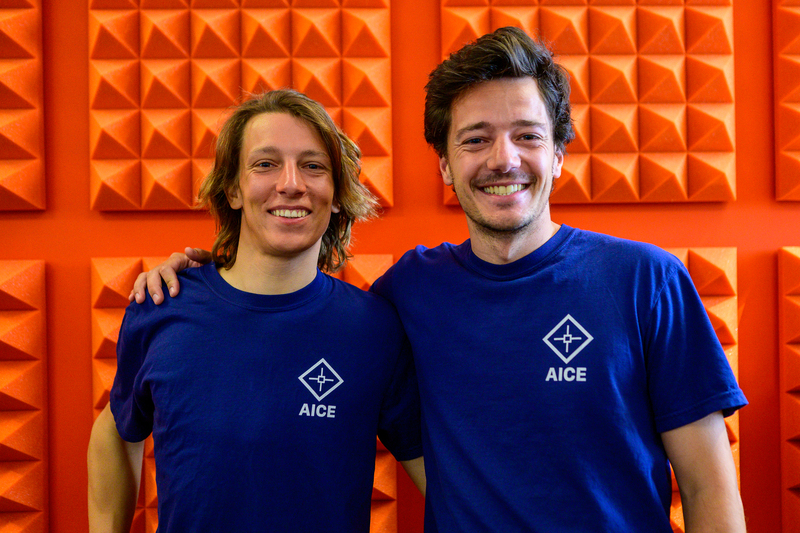
The new thesis is about economics as much as engineering. AICE argues that expensive naval platforms increasingly face smaller, cheaper systems produced at scale, as aerial drones have demonstrated in Ukraine. Underwater, the company sees demand for vehicles that are cost-conscious, modular and able to act in coordinated groups. Different missions might require different speed, range, sonar or payload configurations. Rather than make one exquisite answer to every question, the aim is an adaptable family of machines.
One week to the water
AICE says the founders built their first modular underwater prototype within a week of deciding to pivot. It integrated the main subsystems and was designed to change as operator feedback arrived. The website now records a simple milestone: “Prototype tested in water.” The restraint of that line is useful. Underwater hardware offers endless opportunities for a confident noun to become a wet collection of components.
Chomette brings simulation, machine learning and system validation. Bouteiller, an embedded-systems engineer trained at ENS Paris-Saclay, brings hardware and AI engineering plus experience taking products from prototype to production. Their public division of labor resembles the product itself: models must meet electronics, software must meet pressure, and autonomy must meet a machine that can actually be manufactured.
AICE is early. The company says it launched its naval-systems program in 2026, joined YC’s P26 batch, tested a prototype and opened engineering roles in Paris. Its stated audience includes naval operators, defense procurement teams, system integrators and, where appropriate, critical-infrastructure operators. Its ambition is to make subsea fleet and infrastructure defense more distributed, faster to field and economically sustainable.
For now, AICE’s disclosed milestones are a prototype test, a product direction and hiring in Paris. Deployed capability is a later chapter.
The portable habit
The temptation is to tell Chomette’s story vertically: he looked up at asteroids, down at buildings, then farther down beneath the sea. Geography makes a neat headline. Method makes the better biography. Across each chapter, he has worked where software must answer to matter. Models are valuable because physical experiments can be slow, expensive or dangerous. They are dangerous when their elegance encourages people to stop checking.
His public posts repeatedly return to the field: equipment rooms, customers, operators, prototypes. Even the choice to leave energy was based on observed priority rather than the technical satisfaction of the product. The company’s new language does not promise that a slide deck has solved maritime defense. It points to a prototype, water testing and conversations with people who understand the environment.
There is an entrepreneurial lesson hidden inside the engineering one. A model is a provisional account of reality. A startup is one too. Both deserve revision when observations disagree, even when the old version is functional and its author has grown attached to it. Chomette’s 2026 pivot was a costly revision. Its merit will be determined below the surface, where the conditions are less forgiving and the feedback is beautifully impolite.