The first joke writes itself. Geourg Kivijian is building a robot bird, and the internet has already spent years insisting birds are robots. He knows. Ornadyne even tried to put the gag on a billboard before, according to Kivijian, legal counsel objected. Good comedy survives contact with counsel; good aerospace must survive contact with air.
Kivijian's work begins where the joke ends. Most small drones advertise their arrival. Propellers buzz. Familiar geometries draw the eye. Electronic and acoustic signatures give detection systems something neat to classify. A bird is messier. It belongs in the sky, flaps instead of spins, and often lands in the bucket that counter-drone software calls clutter. Ornadyne's O1 is an attempt to build inside that ambiguity: a flapping-wing reconnaissance aircraft with the silhouette and motion of a crow.
The company is young. The obsession is not. Before he had a startup, a Y Combinator batch, or a Demo Day pitch, Kivijian spent more than two years at California Polytechnic State University, San Luis Obispo, working on the mechanics of flapping flight. His master's thesis did not merely ask whether an ornithopter could flap. It asked whether the machine could change the amplitude and frequency of its stroke as a bird does across takeoff, cruise, loiter, and landing.
First, teach the wing some manners
The thesis machine was called K1. Its drive paired a brushless motor under field-oriented control with a pull-pull cable mechanism modeled on avian muscle structure. The arrangement allowed precise control of wing angle and frequency rather than forcing the aircraft into one monotonous flap. Static wind testing showed variable amplitudes; flight tests reached six hertz at 90 degrees peak to peak. In the sober grammar of an engineering abstract, the results were “promising.” In ordinary language, a machine had learned more than one way to beat its wings.
This was careful, public work. Kivijian and adviser Nandeesh Hiremath published aerodynamic force characterization at the 2025 AIAA Region VI student conference, where it won first place in the graduate category for paper and presentation. A second paper on the cable-driven robot earned a Best Presenter award at AIRC 2025. An earlier project described a modular open-jet wind wall: a four-by-four array of computer fans, individually controlled through a Python interface, built to generate dynamic wind profiles for Cal Poly's low-speed tunnel.
A home-built wind wall is a small biography in hardware. It says the experiment matters enough to invent the instrument, too. Kivijian's portfolio is full of that temperament: a forward-swept tri-rotor VTOL stabilized with custom electronics; a precision diffuser for a solar-thermal rocket engine; an optical beam-profiling prototype; a sensor package weighed on a kitchen-scale display. When the proper apparatus does not exist, he seems inclined to make an apparatus-shaped argument with screws in it.
Mars, the Moon, and unforgiving machines
His education ran alongside systems work with considerably longer travel plans. At NASA's Jet Propulsion Laboratory in 2023, he developed behavior coordination for the tube-transfer phase of the Mars Sample Return Lander. His responsibilities included operating concepts, nominal and off-nominal scenarios, hardware descriptions, verification, and coordination meetings across helicopter, transfer, and flight-system teams. Later, at Astrolab, he worked on lunar-rover systems.
The connection to a bird-shaped aircraft is less eccentric than it appears. Planetary robotics punishes waste. Mass, power, autonomy, and reliability are not abstract virtues when service calls are impossible. Ornadyne applies those habits closer to Earth, in an aircraft whose small payload and low signature leave little room for ornamental engineering. The O1 shown publicly in mid-2026 had a one-meter wingspan and carried a 50-to-100-gram payload range, presently centered on a camera for visual reconnaissance.
A flight path measured in test rigs
There is another line through his résumé, one that points east. In summer 2024, Kivijian volunteered at Bazoomq Space Research Lab in Yerevan. He worked on early proposal material for Hayasat-2, envisioned as Armenia's second national satellite, and collaborated with domestic suppliers on optical and electronic hardware. His own portfolio greets visitors in English, Armenian, and French. His CV lists English and Armenian as native languages and French at professional proficiency. Aerospace, in his version, is both global and oddly intimate: celestial ambition written in the languages of home.
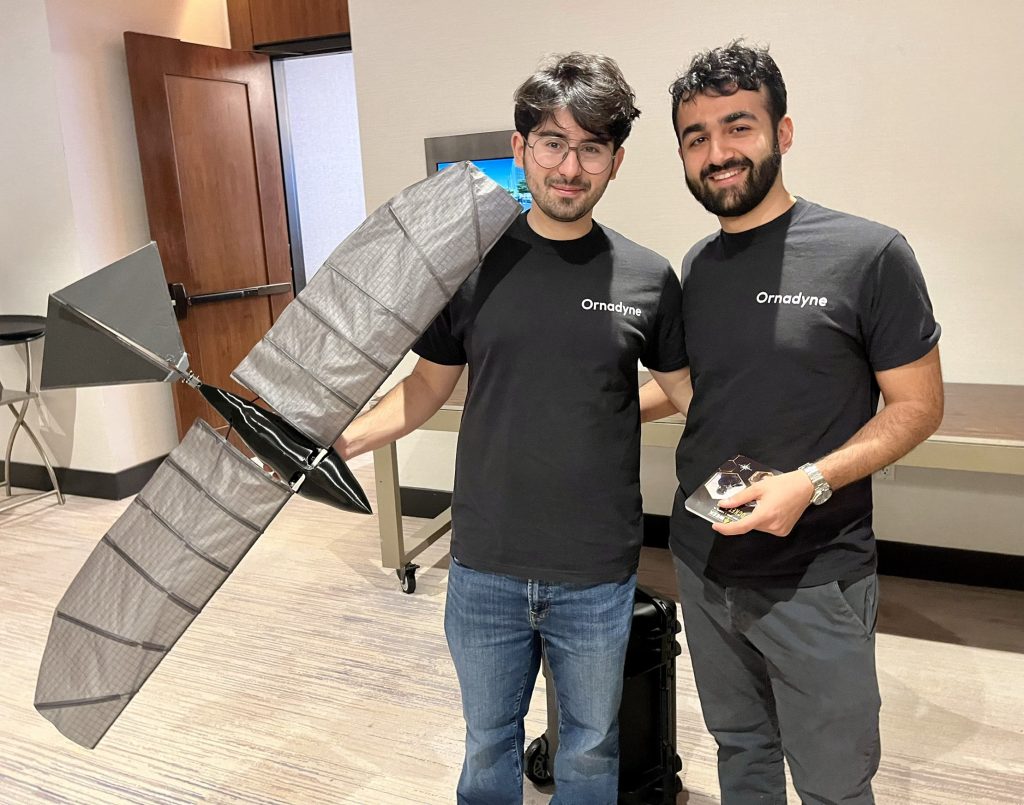
The middle-school co-founder call
Ornadyne is also a friendship story with unusually elaborate props. Kivijian and Armen Arakelyan have been best friends since middle school. Arakelyan studied astronautics at USC, led machining at its Rocket Propulsion Laboratory, and later engineered Starship components at SpaceX. Kivijian, watching European and Chinese researchers extend ornithopter endurance and seeing Chinese military interest in the technology, decided the work should become a company.
He called his old friend. In one interview, Kivijian described the recruiting strategy with the cheerful candor of someone confessing to a successful heist: he reached out to his friend at SpaceX and “basically stole him.” The phrase reveals something a polished founder origin story usually sands away. Companies are built from conviction, certainly, but also from the person who will answer your strange call because they remember who you were before the pitch deck.
Ornadyne's first prototype took roughly two months. The judgment behind it accumulated across years of research, machining, controls, test work, and friendship. Speed has a prehistory.
The pair founded Ornadyne in Los Angeles and entered Y Combinator's Spring 2026 batch. They took the O1 to SOF Week not tucked into a foam case but carried openly through the halls, seeking conversations with operators, program offices, and defense companies. By their May interview, the aircraft was assessed around technology-readiness level four to five, with a working flying model. The team said it wanted a high-fidelity system with operators within six to twelve months.
At Demo Day, Kivijian compressed the argument. Today's drones are easy to detect acoustically, visually, and electronically. Ornadyne's machines aim to look, fly, and sound like birds, giving soldiers another way to gather close-range data. He said the team had invitations connected with Marine special operations, an Army initiative, and the Michigan National Guard, plus a letter of intent in agriculture. Those statements mark opportunities, not deployments. The company is still doing the unfashionable work between prototype and reliable product.
A crow is not a costume
Biomimicry is often sold as visual poetry: a train nose inspired by a kingfisher, a surface borrowed from sharkskin. Ornadyne's proposition is more adversarial. A crow shape matters only if it changes how a human observer or a detection stack interprets the aircraft. Flapping matters only if it reduces the telltale buzz and supports useful endurance. The bird is not decoration. It is a bundle of constraints that has already passed millions of years of flight testing, albeit with an unfairly good manufacturing process.
That makes Kivijian's insistence on direct user feedback important. “Our biggest goal right now is to connect with users and people who can give us direct feedback,” he said at SOF Week. A beautiful wing mechanism can win a paper prize; a field system must tolerate weather, handling, hurried setup, imperfect training, and requirements that refuse to behave like a clean laboratory graph. Ornadyne's next lessons will come from the people who carry the aircraft, not merely the equations that keep it aloft.
Kivijian's life away from work offers a quieter clue about the patience required. He fishes in the Eastern Sierra, makes his own lures, and enjoys testing them on mountain fish he describes as difficult to catch. He is slowly gathering backpacking gear. He also restores and drives a 1974 Datsun 260Z, an old Japanese sports car that rewards mechanical sympathy and a willingness to get dirty. Building, he writes, is both his work and his hobby. According to his parents, the habit began when he was little.
There is a pleasing continuity here: a fishing lure, an old carburetor, a cable-driven wing. Each asks the maker to notice the gap between how an object should behave and how it actually behaves. Each produces evidence without flattering its owner. The fish does not care about the lure's design review. The engine does not applaud the restoration plan. Air is similarly unmoved by ambition.
What happens after the clever part
Ornadyne now faces the long middle of aerospace: endurance, control, autonomy, repeatability, payload integration, manufacturing, and field reliability. Its public goal is “hour-class” flight with natural bird-like motion and low acoustic signatures. The phrase is deliberately practical. A convincing silhouette might win a second glance; useful endurance and dependable data determine whether anyone asks for the aircraft again.
Kivijian has already crossed several boundaries that rarely align neatly. Academic work became hardware. Hardware became awarded papers. Planetary systems became operating judgment. A middle-school friendship became a founding team. The result is still early, visibly handmade, and refreshingly strange. In aerospace, strange is permitted only briefly. Then it must fly on schedule.
For now, the O1's most compelling feature is not that it resembles a crow. It is that the bird shape grew from a specific observation about detection, backed by years spent learning how a wing can move. The joke may draw the crowd. The machine has to keep their attention. Somewhere between six hertz and a soldier's field pack, Kivijian is working out whether a thesis can become a flock.