There are two useful clocks in Jason Cornelius's career. One counts the long years required to send a rotorcraft across the solar system. The other grants fourteen days before somebody must build the next thing, take it outside and discover what the equations forgot. Cornelius learned the first clock on NASA's Dragonfly mission. He chose the second when he co-founded Perseus Defense.
Dragonfly is no ordinary helicopter. It is a relocatable coaxial rotorcraft lander designed for Titan, Saturn's largest moon, where the air is dense, gravity is low and the temperature is spectacularly unfriendly. Cornelius joined the program's work in late 2016 while at Penn State, continued through his doctorate and later served as an aerospace engineer at NASA Ames. His research covered the uneasy moment when a spacecraft released beneath a parachute must become a powered aircraft, plus the rotor aerodynamics that make controlled flight possible somewhere no engineer can run a full dress rehearsal.
The young researcher had been preparing for such an assignment with almost comic thoroughness. At Penn State he accumulated bachelor's, master's and doctoral degrees in aerospace engineering. He studied computational fluid dynamics for coaxial rotors, helped start a wind-energy club, learned Russian and Mandarin Chinese, earned a graduate certificate in international affairs, taught scuba diving and became a private pilot. If a door required a credential, he seemed willing to acquire the key.
The long runway from Mountain Top
His starting point was Mountain Top, a small Pennsylvania community whose name sounds invented by an especially literal novelist. Cornelius has recalled cutting grass in cemeteries, washing dishes at a pizza restaurant and operating a McDonald's register while he was in school. His grandfathers served in the Army and Navy, and an uncle in the Marines. The childhood ambition was NASA, distant enough to become the title of his eventual memoir: Dare to Dream: A Small-town Kid's Journey to NASA.
Published in November 2024, the book does not treat the path as a polished montage. Cornelius foregrounds setbacks, academic difficulty and doubt. He wrote the 196-page memoir in four months, a brisk production schedule for someone employed in a field where vehicles can spend years merely traveling to work. His public advice from that period fits on two index cards: "Don't take life too seriously" and "Be relentless." One keeps persistence from becoming grim. The other keeps optimism from becoming decorative.
Alongside the research, he built a place for other engineers to learn by getting dirt on the landing gear. Cornelius established the Vertical Flight Society's Design-Build-Vertical Flight competition and led it for four years. University teams had to design, manufacture and fly unconventional uncrewed aircraft, then repair the inevitable failures in public. The competition's recurring lesson was not glamorous: the aircraft that exists has the final vote.
A cheaper answer to a cheap threat
By 2025, Cornelius had helped with a machine destined for a moon roughly a billion miles away, secured $500,000 in NASA headquarters funding for an advanced-concepts team using machine learning and supercomputing on next-generation Mars helicopters, and taught aerospace engineering at Stanford. NASA later named him a 2025 Early Career Achievement Medal recipient. Then he left.
The new problem was closer and more immediate. Small drones had altered the economics of conflict. Defenders could face cheap, numerous aircraft with interceptors and systems that cost far more. Cornelius and his longtime Penn State friend Steve Messinger, an autonomy engineer with Boeing and swarm-robotics experience, believed that the kinetic layer of drone defense needed a small guided interceptor designed for production volume.
“Once that clicked, the responsibility became moral.”Jason Cornelius on deciding to build Perseus Defense
The phrase matters because it explains the jump better than the familiar startup vocabulary of disruption and opportunity. Cornelius wrote that going all-in became easy once he believed the team could deliver the strongest solution it could build. He and Messinger quit their jobs, formed Perseus Defense and began with more than 100 interviews across the Department of Defense and Department of Homeland Security. Those conversations narrowed the product toward portable, guided interceptors and modular launchers meant to work with existing sensors and command systems.
The physics is only half the argument. Perseus is also a wager on manufacturing arithmetic. A defensive system is less useful if commanders cannot afford enough units, cannot carry them where they are needed or must wait for exquisite components to arrive. The company's public design describes a launcher weighing under 80 pounds, setting up in under a minute and operating for 24 hours. Its missiles are compact enough to invite an almost improper adjective for ordnance: handy.
The two-week metronome
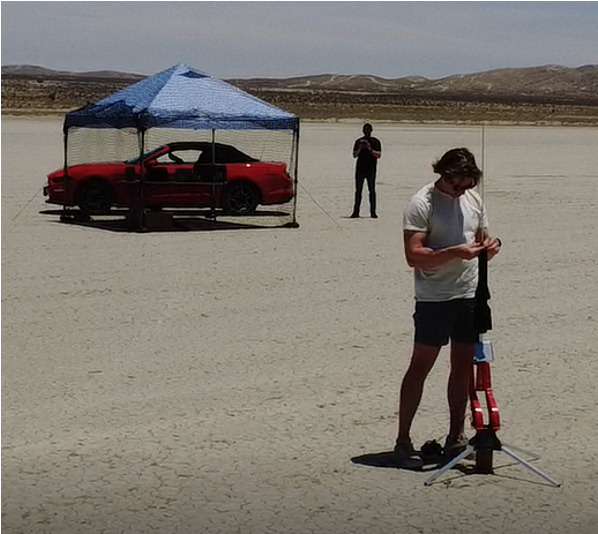
Perseus made its early progress with a strict two-week design-build-test cycle. In eight weeks the team moved through four major guided-missile iterations and conducted more than 30 live-fire flight tests. During Y Combinator, the founders slept on couches in San Francisco and drove about seven hours to the range on weekends. The picture is less "future of defense" than folding canopy, dry lake bed and a car full of tools. Reality rarely arrives with art direction.
This cadence is the transferable part of the story. Speed does not mean skipping analysis. Cornelius comes from computational aerodynamics, supercomputing and aircraft design. Speed means arranging analysis so it must regularly meet evidence. Each test creates an answer that a meeting can only postpone. The loop is especially useful in hardware, where an elegant model may conceal an inelegant connector, a manufacturing tolerance or a gust of wind.
The company brought its system to Fort Hood for the 1st Cavalry Division and briefed officials at the Pentagon and members of Congress. It also began work toward cooperative research agreements with several U.S. Army development organizations. In late 2025, Perseus announced a $6 million seed round. By early 2026 it had selected Buda, Texas, for an engineering and manufacturing headquarters. The move placed the next phase near test space, defense customers and the less poetic necessities of production.
Technology, manufacturing, politics
Cornelius has reduced the defense-founder job to a three-part formula: technology, manufacturing and politics. The first makes the object work. The second makes enough of it. The third finds the end users, champions and procurement path required to put it in service. A company that masters only one has a demonstration, a factory with nothing useful to make or a splendid collection of meetings.
His own career has quietly rehearsed all three. NASA supplied technical rigor. The wind and drone competitions supplied build-and-test pragmatism. International-affairs study, teaching and public speaking supplied practice translating complex work across institutions. Even the four languages feel less like résumé garnish than evidence of a recurring instinct: difficult systems become more tractable when you learn how their participants speak.
“A defense tech company has to do three things well: technology, manufacturing, and politics.”Jason Cornelius
What the garage can borrow
A founder does not need a wind tunnel, a launch rail or seven scuba certifications to borrow the useful machinery here. The first practice is to make the mission narrow enough to test. Perseus did not begin with the entire problem of drone warfare. Its founders concentrated on one expensive mismatch: the kinetic interceptor used against a small, inexpensive aircraft. That boundary made the interviews sharper and the hardware legible.
The second practice is to give the learning loop a fixed duration. A two-week cycle creates useful impatience. The team must decide which uncertainty matters now, build enough to expose it and accept the result. The calendar prevents research from becoming a soft room where every question deserves another month. It also prevents a single failed test from becoming a verdict. In a loop, failure is information with a return date.
The third is to treat the buyer's system as part of the product. Perseus describes launchers that accept targeting information from command-and-control or sensor systems, mesh with nearby units and synchronize their engagement envelope. The interceptor cannot be merely impressive in isolation. It must arrive where people already work, speak to what they already use and reduce the burden rather than introducing a ceremonial new one.
Cornelius learned versions of these lessons before founding a company. A student fly-off has a date. A NASA mission has an environment. A classroom has people who must understand the idea well enough to use it. Each setting punishes a different kind of vagueness. Put them together and the founder's method becomes simple to say, difficult to fake: specify the problem, shorten the route to evidence and design for the world outside the workshop.
There is still an enormous distance between a fast prototype and a widely fielded defense system. Perseus must turn test cadence into repeatable manufacturing and navigate government adoption without losing either speed or precision. Cornelius does not need the story varnished. The engineering claim is interesting precisely because it can fail in so many measurable ways.
The charming contradiction is that the engineer once preoccupied with flight in Titan's alien atmosphere now spends his weekends proving hardware on earthly dust. Yet the two missions share a discipline. Define the environment. Understand the user. Build the vehicle for conditions as they are. Then test every assumption available to test.
One clock teaches patience with a far horizon. The other insists on an answer by next Friday. Cornelius appears determined to keep both running.