VerdeGo Aero began with the thing every electric-aviation startup seemed to want in 2017: its own handsome vertical-takeoff aircraft. The PAT200 promised to hop over traffic with swiveling propellers and a hybrid heart. It was the photogenic business. Within a year, the founders had demoted the aircraft and promoted the heart. Instead of betting on one cabin, one wing and one certification campaign, VerdeGo would build powerplants for everybody else's flying machines.
That decision is the company. From a technical center in Daytona Beach, Florida, VerdeGo now develops integrated machines that turn Jet-A, military JP-8 or sustainable aviation fuel into electricity. The electricity can feed motors distributed around a drone, air taxi, cargo aircraft or high-speed rotorcraft. A smaller battery remains onboard to absorb sudden demand during takeoff and landing. The fuel supplies the energy for the long middle of the trip.
It is a pragmatic, mildly impolite answer to a market raised on battery optimism. Electric motors are light, responsive and easy to distribute. Batteries are heavy, remain heavy after their energy is spent, age over time and must leave enough reserve for weather, diversions and closed runways. VerdeGo kept the first technology and stopped requiring the second to do every job.
“The transformative technology that makes electric flight interesting isn't batteries - it's electric motors.”
The moveOne air taxi became an engine shelf
The pivot followed a useful piece of systems thinking. The downstream half of an electric aircraft - motors, propellers, fans, rotors and control surfaces - changes wildly with the airframe. The upstream half - the source of electricity - can settle into common power classes, just as conventional aircraft reuse familiar engine sizes. VerdeGo could fight for one aircraft program, or become the standardized supplier to many.
Nothing dramatic had to explode first. What failed was the original scope. Hundreds of teams were designing aircraft, while relatively few were volunteering to solve the same unpleasant upstream work: engine-generator matching, high-voltage electronics, thermal rejection, electromagnetic interference, controls, safety logic and certification. Early partner aircraft from Transcend Air, XTI, Jaunt and Airflow were later superseded. Moog's HE350 Recluse program, which evaluated VerdeGo development hardware, was cancelled. The airframe market was going to churn. A reusable powerplant platform could survive that churn.
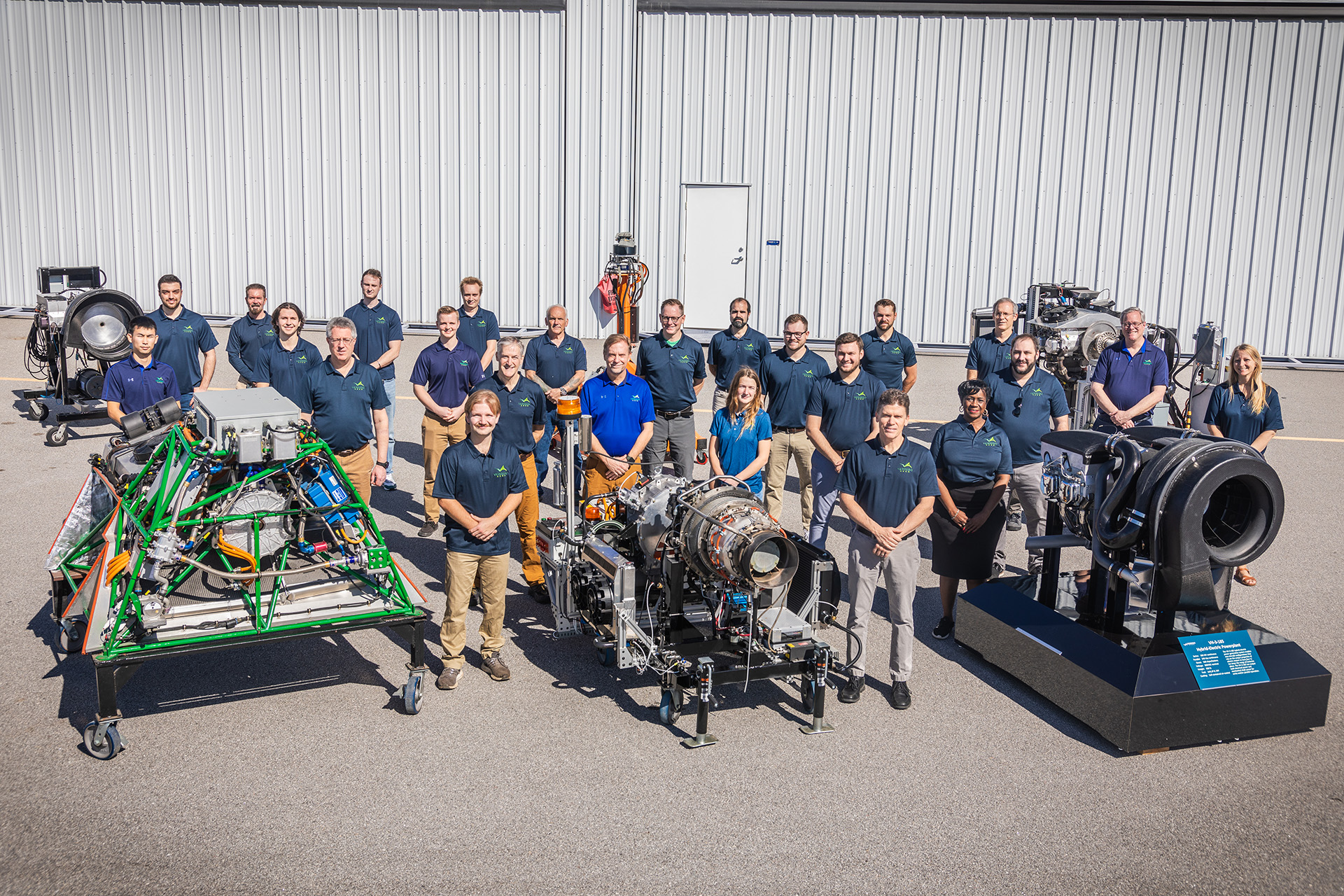
The machineryThree power classes, one stubborn idea
The product shelf now starts with the VH-3-185, a piston-driven system rated for 185 kilowatts of continuous electrical output. VerdeGo positions it for two-to-six-seat aircraft and unmanned systems. It can supply electricity in a series hybrid, mechanical shaft power in a parallel hybrid, or both. The company reports a complete-system weight of 650 pounds and says the design is meaningfully more fuel-efficient and quieter than comparable turbine hybrids.
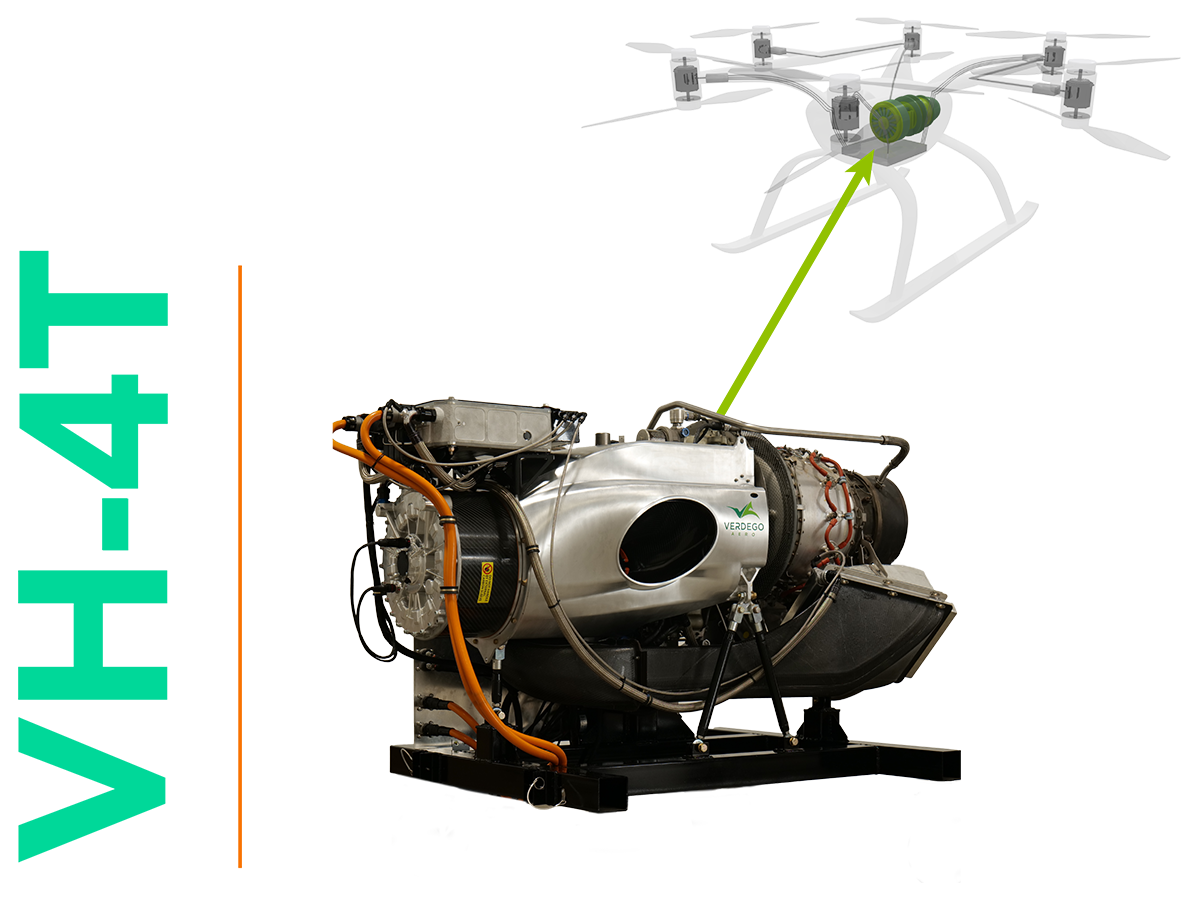
The middle child is the VH-4T. Its developmental RD model produces 375 kW continuously in a 511-pound package and entered low-rate production in late 2025. The first units began shipping to customers in 2026 for ground and unmanned flight testing. The production-intent VH-4T-415 raises continuous output to 415 kW, adds single-fault tolerance and supports series or parallel operation. It is built around Pratt & Whitney's PW206/PW207 helicopter-engine family. VerdeGo has filed an application for an FAA type certificate and says the 415 version is intended for production applications.
VH-3 piston hybrid
VH-4T-415 turbine hybrid
VH-5 blended turbofan
Then comes the stranger proposition: the VH-5 blended turbofan. Instead of choosing between thrust and electrical generation, the architecture can divide turbine-core power between them. VerdeGo's illustrative 1.5-megawatt configuration would also provide roughly 4,000 pounds of cruise thrust. In hover, more power could go to electric lift fans; in forward flight, more could become jet thrust. It remains a developing architecture being refined with airframers, not a catalog engine waiting on a loading dock.
The engine shelf
Bar lengths show product-class scale, not physical dimensions. Published specifications remain preliminary.
The physicsThe battery is no longer asked to be a fuel tank
Chief executive Eric Bartsch offers a blunt comparison. A battery-only design might carry 2,000 pounds of cells and still manage only dozens of miles after reserves. Replace most of that pack with a roughly 550-pound, 400 kW hybrid, restore about 200 pounds of batteries for transient loads, and add fuel according to mission. In VerdeGo's modeling, range can rise eight to ten times. The battery becomes a sprinter. The generator becomes the marathoner.
That does not make the hybrid emission-free. It burns fuel and makes noise. Sustainable aviation fuel can reduce lifecycle carbon intensity, but it does not make exhaust disappear. For a 20-mile urban hop where local emissions and neighborhood noise dominate, battery-only propulsion may be the cleaner fit. For cargo, surveillance, medical evacuation or regional travel, where payload, hundreds of miles and legal reserves matter, VerdeGo's trade starts looking less like compromise and more like arithmetic.
The businessHardware, integration and government-funded patience
VerdeGo sells and leases developmental powerplants, then works beside airframers to make them useful. The second part matters. A customer is not buying a boxed generator and plugging it into a wall. Its engineers need to size the hybrid around cruise demand, let batteries handle peaks, route high-voltage power, reject heat, suppress interference and make controls speak safely to the aircraft. VerdeGo's Hybrid Systems Integration Lab now includes hardware-in-the-loop flight simulation, letting a pilot and aircraft model interact with real powerplant controls before the hardware leaves Daytona Beach.
The capital stack is equally hybrid. RTX Ventures led a $12 million Series A in 2022, joined by aviation and manufacturing investors. An A-1 round closed above its $4 million target in 2024. Government programs pay to remove specific technical risks: a $1.9 million Air Force TACFI effort for a production-intent VH-3, NASA SBIR Ignite work applying the products to several aircraft concepts, and a $9.7 million Air Force Phase III program for the VH-4T-415. Private money funds a product company; public contracts accelerate dual-use hardware the government may eventually buy.
Customers are aircraft manufacturers, not passengers. Some are public - Moog historically, XTI Aerospace through successive collaborations, and U.S. government programs. Most current airframers remain unnamed. In 2024, Bartsch said VerdeGo had memoranda covering thousands of prospective powerplants across military drones and passenger aircraft. That is an order-book signal, not the same thing as certified aircraft deliveries. The concrete milestone arrived in 2026 when developmental VH-4T-RD units began shipping.
The stealBuild beneath the crowded market
Founders can copy the structure without copying the engine. VerdeGo entered a market crowded with charismatic end products, identified the component every contender would repeatedly need, and moved down the stack. It kept the knowledge learned from designing the PAT200 but stopped carrying the full cost and binary risk of certifying its own aircraft. Then it wrapped the component in services, because hard-tech customers rarely need hardware without integration.
The VerdeGo playbook
- Find the layer that varies least while customer products vary wildly.
- Turn your abandoned end product into a test bed for the enabling component.
- Sell engineering access with the hardware when integration is the real bottleneck.
- Use non-dilutive programs to retire technical risk that also benefits commercial buyers.
- Ship developmental units early enough that customer learning improves the certifiable version.
It will not work everywhere. The component must actually standardize; a powerplant that requires a fresh redesign for every aircraft loses the platform advantage. Customers must survive long enough to reach flight test. Certification must converge before cash runs out. Fuel logistics must be acceptable. And on routes short enough for batteries, a combustion engine adds cost, noise and maintenance that nobody ordered.
What comes nextThe test is repeatability, not imagination
VerdeGo has crossed several thresholds: full-scale rigs, customer hardware, government-backed product maturation, low-rate production and initial shipments. The VH-4T-415 shown in 2026 adds quad-redundant architecture aimed at the much less forgiving world of certifiable, repeatable flight. Its planned availability and the pace of customer aircraft programs will determine whether a clever pivot becomes a durable aerospace supplier.
The company fits between engine makers and a noisy field of electric-aircraft OEMs. Ampaire and VoltAero develop hybrid aircraft, ZeroAvia works on hydrogen-electric propulsion, and established turbine and piston suppliers defend familiar territory. VerdeGo's difference is its insistence on being a fuel-flexible, integrated hybrid supplier across multiple output classes - plus the shop that helps fit the machinery into aircraft conceived before the machinery was ready.
That is less cinematic than a flying car. It may be more useful. The sleek aircraft still gets the rendering, the launch video and the imagined commuter. VerdeGo gets the plumbing, heat, software, certification paperwork and a purchase order from whoever finally makes the rendering fly.