The useful thing about rocket fuel is that it makes objections wonderfully concrete. Either the grain burns as designed or a test stand delivers a much louder opinion. Firehawk Aerospace learned this after government buyers declined meetings and dismissed its central idea: propellant made through additive manufacturing. The concept had been tried before, they said. It had failed before. Please take the next appointment with someone else.
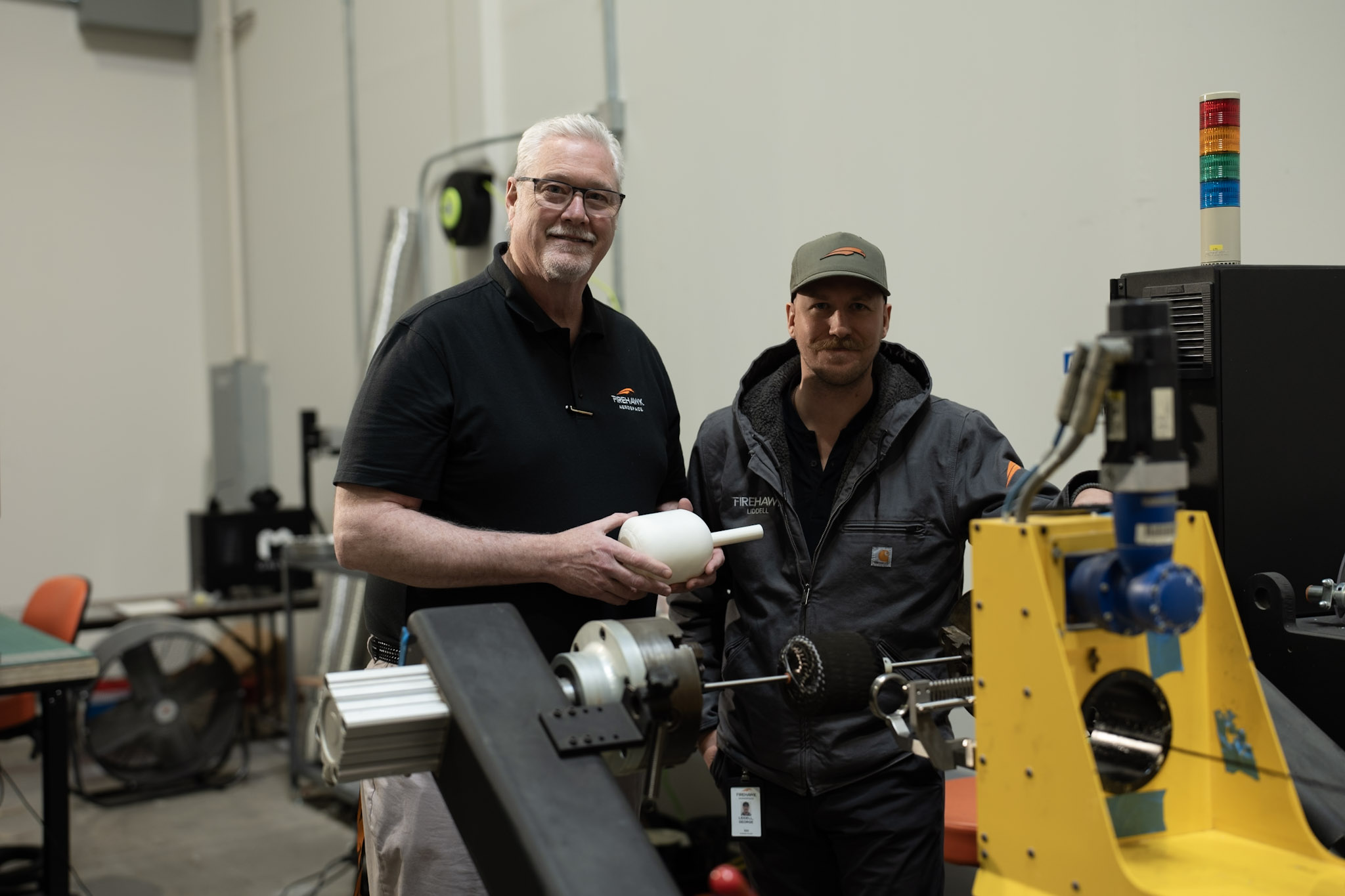
So Will Edwards and his team moved the sales meeting to West Texas, whether the customer attended or not. They brought a roughly $5,000 3D printer to Firehawk’s Midland test site, printed propellant, put it in a motor, fired it and collected the data. Then they sent the evidence to the people who had refused the pitch. In defense technology, where a slide deck can die of old age while waiting for a procurement cycle, the demonstration was a neatly insolent reply: here is the printer, here is the flame, here are the numbers.
The demo opened a door, but it also exposed a larger mistake. Firehawk had been selling hybrid rocket engines as a replacement for the solid motors the military already used. The military did not especially want to replace a proven architecture with an unproven one. It wanted more motors, sooner, without redesigning everything around them. Edwards’s distilled lesson was blunt: make an “easy swap” for what the customer already uses, then make it faster and cheaper.
The pivot hiding inside the propellant
Firehawk’s technical origin predates its polished defense pitch. Rocket scientist Ronald D. Jones had spent years working on fuel-grain geometry and hybrid propulsion. Edwards later described finding Jones printing rocket fuel in a garage in 2019. Will’s father, Steve Edwards, helped bring the group together. Jones supplied the deep propulsion work; Will supplied a commercial reframing: stop treating the invention as the seed of another space-launch company and aim it at defense production.
The company formally dates its founding to 2020. Its first public identity centered on hybrid engines, which keep a solid fuel grain separate from a liquid or gaseous oxidizer. Hybrids can be controllable and easier to handle than some alternatives. Firehawk also argued that printed internal geometries could increase burn surface area, influence flow and tailor performance. The company built a patent portfolio around those fuel grains and associated propulsion hardware.
But elegant engineering met institutional gravity. A missile program has qualified hardware, interfaces, suppliers, safety cases and operators. Asking it to change propulsion architecture does not produce one decision; it produces a small civilization of decisions. Firehawk changed the wrapper around its invention. The feedstock and manufacturing control could also serve solid motors that resemble the systems buyers know. Novelty moved inside the tube, where it could improve production without demanding a new missile around it.
“Make things faster and cheaper. Do not disrupt supply chains. Improve them!”Will Edwards, reflecting on the company’s adoption lesson
What the machine actually does
Traditional solid propellant production is commonly a batch process: mix energetic ingredients, cast the material into a motor or mold, then cure and inspect it. The workflow can be slow, capital-heavy and tied to fixed tooling. Firehawk instead creates an energetic thermoplastic feedstock. It can hold that feedstock until a requirement arrives, then 3D print it, compression-mold it or extrude it depending on the motor size and geometry.
The Firehawk production idea
That separation is the business idea. Inventory can sit as feedstock rather than as one finished grain waiting for one motor. Digital files can define internal shape. A smaller production cell could, in principle, make different grains without a warehouse of dedicated tooling. Firehawk says a job that normally takes roughly 15 to 60 days can fall to about six hours. That is the company’s claim, not a universal stopwatch for every qualified motor, but it explains why military customers are paying attention.
The customer is buying replenishment
Firehawk now sells to a narrow, powerful audience: the U.S. Army, the U.S. Air Force, defense primes and, eventually, allied production partners. The offering spans printed propellant, solid rocket motors, hybrid engines, base bleed motors for artillery and full rocket-system integration. Revenue comes from development contracts, prototype programs, qualification work and production agreements. This is B2G manufacturing with B2B alliances attached, not a printer-in-every-garage licensing scheme.
The Army Applications Laboratory selected Firehawk under SBIR Phase III work connected to Javelin-, Stinger- and GMLRS-class needs. Firehawk says it flight-tested additively manufactured launch motors in Javelin- and Stinger-class analogs and flew a GMLRS-class hybrid analog above 18,000 feet. Air Force work has included shelf-stable propellant, extended-range solid motors and hybrid-engine development. In August 2025, the company said it had completed 58 hybrid and solid hot fires plus one hybrid flight test.
The work is moving closer to recognizable programs. In August 2026, the Army named Firehawk among four companies receiving prototype agreements intended to diversify the Hydra-70 rocket supply base. Reporting on the program says each supplier is expected to deliver 24 M151 prototypes and an updated technical data package within 18 months. Success could lead to other Hydra variants. The award does not make Firehawk a high-volume Hydra producer today; it gives the company a route to prove that it can become one.
From clever recipe to acreage
The company has raised accordingly. A $2 million seed round arrived in 2020, followed by additional seed capital, a strategic investment from Raytheon Missiles & Defense in 2022 and a reported $17.6 million Series B. In 2025, 1789 Capital led a $60 million Series C, later joined by European defense fund Presto Tech Horizons. Hanwha Defense USA also made an undisclosed strategic investment. The money has pushed Firehawk past the photogenic prototype stage and into the less forgiving world of factories.
In Lawton, Oklahoma, the company is developing a roughly 340-acre propellant and motor campus called Great Plains Arsenal. In Crawford, Mississippi, it acquired a DCMA-rated integration facility on 636 acres under a long lease. Mississippi officials described a $16.5 million corporate investment and 100 planned jobs. Firehawk says the site can handle load, assembly, packing and all-up-round integration. Research and development remains centered in Texas, alongside static-fire and flight-test locations.
This map reveals where Firehawk thinks its moat will live. Patents matter. Recipes matter. But energetic materials require permitted land, hardened buildings, magazines, safety systems, trained workers and enough test history to satisfy customers whose products are designed to explode only on command. The company’s advantage will not be established by whether it can print one excellent grain. It will be established by whether grain number 10,000 behaves like grain number 10.
Where the plan can fail
Six-hour forming does not erase qualification, inspection or integration. The model weakens if printed lots vary, feedstock supply becomes constrained, programs refuse new material processes, permits slow distributed sites, or production economics lose their edge at larger diameters. It also works best when a customer values surge capacity and accepts Firehawk’s process inside a familiar architecture. A program with ample incumbent capacity and no appetite for a second source has less reason to move.
The factory, not the fireball
Firehawk’s competitive set stretches from propulsion incumbents Northrop Grumman and L3Harris’s Aerojet Rocketdyne to newer manufacturers including X-Bow Systems, Ursa Major and Anduril. Comparisons are imperfect because these firms cover different motor sizes, architectures and levels of integration. Firehawk’s specific wager is that thermoplastic energetics plus flexible forming can make it a useful second source and, later, an end-to-end supplier.
Partnerships make that ambition less lonely. Raytheon invested and collaborated on hybrid propulsion. General Dynamics Ordnance and Tactical Systems entered an exclusive teaming arrangement for certain international 155mm base bleed opportunities, pairing its munitions integration with Firehawk’s thermoplastic propellant and molding. Presto Tech Horizons and industrial group CSG are exploring how the technology might strengthen allied European production. Each relationship offers something a startup cannot print: program access, qualification experience or a path into an established munition.
The arc from garage to arsenal is amusingly literal, but the management lesson is broader. Firehawk did not abandon its technical insight when customers rejected the first product. It narrowed the amount of change customers had to swallow. The propellant stayed novel; the interface became familiar. It answered disbelief with a cheap demonstration, then followed the demo with expensive infrastructure.
What another founder can steal
- Turn the buyer’s objection into the smallest credible live test.
- Preserve the technical edge while removing adoption work around it.
- Sell the customer’s urgent outcome - here, replenishment speed - not the novelty of the method.
- Use partnerships for qualification and distribution, not just logo decoration.
The remaining question is wonderfully unromantic: throughput. Firehawk has described capacity in thousands per month and wants its Oklahoma operation to become a major domestic propellant source. Those ambitions now face buildings, schedules, lots and acceptance tests. A rocket startup can win attention with flame. A defense manufacturer wins the next order by making the same flame, on time, again and again.