Kaydon Stanzione’s first account of going airborne involves a kite, a 1964 Corvair and a mother wielding a broom. His father tethered a large kite to the car and put his son in a harness. Stanzione remembered rising perhaps 40 or 50 feet before his mother intervened. Aerospace, in this household, came with a remarkably direct parental review process.
He would go on to study engineering at Syracuse and Rutgers, work around advanced vertical-flight aircraft and help found Jaunt Air Mobility. Yet the childhood episode offers a useful opening to a career spent moving between the excitement of flight and the arrangements required to make it work. Someone has to think about the tether.
Today Stanzione is CEO of LogistiWerx. The company works on freight coordination across different forms of transport. His recent aviation research concerns airport operations and uncrewed cargo aircraft. Read backward from that work, and the Jaunt years look like part of a continuing inquiry: how do you turn an interesting machine into a usable journey?
A flying machine needs a reason to be there
Stanzione’s professional formation included advanced aircraft design at Boeing in the early 1980s. He later described working in a small group that examined different ways to combine vertical flight with speed. Analytical models, simulation and testing were part of the process. These were opportunities to investigate configurations, compare their behavior and discover what an attractive idea demanded in practice.
His subsequent work included advising on U.S. defense aviation programs and experience as a flight test pilot and engineer. That combination gave his entrepreneurial career a technical foundation. In a field full of drawings of things that might fly, he had worked on evaluating what flight required.
By the time urban air mobility became a business proposition, Stanzione was interested in the relationship between traffic congestion and ride-sharing platforms. The appeal was clear enough: a ground journey could be painfully slow even when its destination was close. Vertical flight offered another way to approach distance. A transportation company would still have to make that alternative convenient.
In 2020 he explained the interest plainly: “That compelled me to look more closely at how people moved.” The phrasing puts the traveler ahead of the vehicle. It also opens up a larger problem than aircraft design. A useful trip has a beginning and an end beyond the minutes spent airborne.
The case for slowing down
Jaunt acquired Carter Aviation’s slowed-rotor technology and entered Uber’s aircraft partner program in 2019. Stanzione co-founded the company with Martin Peryea. Its proposition brought together features associated with helicopters and fixed-wing aircraft, with electric propulsion intended to support a different kind of short trip.
The technical concept is easier to understand as a sequence than as an acronym. A rotor provides vertical lift. During forward flight, a wing takes on the lifting work and the rotor slows. The company’s 2019 technical paper described this as a reduced-rotor-operating-speed aircraft. Stanzione wrote that paper with Georgia Tech’s Daniel Schrage and PRICE Systems’ Apinut Sirirojvisuth.
The collaboration matters as much as the unusual configuration. Aircraft design, academic analysis and cost modeling appeared together on the author list. That is a useful picture of the work behind a transport proposal: different disciplines have to agree on the same machine, even when each arrives with a different set of questions.
Rotor supports a vertical departure.
Wing carries lift; rotor speed reduces.
Return to a vertical arrival.
Uber’s requirements supplied a concrete brief. In early 2020, the targets included 150 mph cruise, a 60-mile range and room for a pilot and four passengers. They also included the ability to perform repeated short trips. That last requirement is particularly revealing. A demonstration can be memorable once. A service needs a routine.
Stanzione said Jaunt aimed to exceed those requirements. The statement described the company’s ambition during development. It belongs alongside the targets, rather than being mistaken for evidence of a passenger service already carrying customers. In aviation, the distance between a proposed capability and an operating business can occupy years of work.
The neighbor gets a vote
A passenger might welcome a faster trip across town. The person underneath the route might have other questions. Stanzione acknowledged that tension in 2020, discussing the understandable concern of people asked to accept large numbers of aircraft over their homes and businesses. Public acceptance had a place in his thinking alongside performance.
That makes the air-taxi problem unusually social for something often presented through machinery. The customer, operator, airport and neighborhood do not experience the same journey. One sees saved time. Another sees turnaround tasks. Another hears an arrival. Success has to survive those different viewpoints.
His stated ambition was affordability for the general public. That sets a demanding test. A transport system can be technically interesting and still reach too few people at too high a price. The economics have to extend beyond making an aircraft possible to making repeated use of it worthwhile.
There is a dry practicality in putting those questions beside the dream of lifting over a traffic jam. The traffic jam is persuasive advertising. The eventual customer still wants to know how to reach the departure point, what the ticket costs and whether the connection works. The freedom of the sky arrives with a surprising amount of administration.
“Never make important life decisions based on money.”
Kaydon Stanzione
Stanzione’s personal decision-making advice is less financial than his professional subject matter might suggest. He offered that maxim while also describing a hiring approach built around competence, integrity, passion and contribution to a team. He said he sometimes tried to discourage prospective teammates, looking for people who remained determined to join.
It is an unusual recruitment test: enthusiasm has to withstand an argument from the person doing the recruiting. His explanation places weight on the relationships inside a company. A collection of impressive résumés, in that view, still has to become a group capable of working together.
After Jaunt, the connections continued
By late 2020, Stanzione had stepped away from Jaunt to pursue other ventures. Peryea took over as interim CEO and said the aircraft development strategy remained the same. That transition is an essential boundary in Stanzione’s story. Later developments at Jaunt belong to the company’s continuing history; his own work took another route.
The route has led toward freight and the information that accompanies it. LogistiWerx describes a platform for planning, executing, tracking and settling shipments across land, air and water. Its product range includes mobile applications, connected devices and interfaces intended to work with existing transport and warehouse systems.
Those functions place the company in the spaces between physical movements. A shipment needs a plan, a vehicle, a record of its condition and confirmation of delivery. Each handoff can require information from another participant. The software’s purpose is to keep those pieces connected through the movement.
- 01Plan the load
- 02Coordinate the vehicle
- 03Connect the handoff
- 04Confirm delivery
A conceptual view of freight coordination, informed by LogistiWerx’s published product scope.
Seen through that work, his move beyond Jaunt has a clear connection to aviation. An air cargo leg still has to fit the rest of a freight journey. Flight can change a route without removing the need to coordinate its two ends. The loading dock has no obligation to be impressed by the aircraft.
Augusta brings the idea to ground level
In 2025, Stanzione and Augusta Regional Airport’s Diane Johnston co-authored a paper on preparing the airport for new vertical-flight operations. It examined the infrastructure around electric aircraft: charging, taxiways, hangars, maintenance and the way approaches and departures use terminal airspace.
Battery conservation gives those arrangements particular significance in their analysis. An electric aircraft’s arrival and departure procedures affect its energy use. Ground facilities and airspace management therefore belong in the same discussion. The aircraft and the airport have to be considered together.
Stanzione also signed LogistiWerx’s side of a collaboration memorandum with Augusta Regional Airport in July 2025. An agreement and a technical paper are steps in planning. They show the work moving into a specific operating environment, where broad promises encounter facilities, responsibilities and procedures.
His 2026 research extended the connection to uncrewed freight. With John Piasecki and Marco Cavazzoni, he co-authored a paper about generative AI freight orchestration for the Piasecki KARGO II. It examined a proposed combination of aircraft capability and logistics coordination for time-sensitive middle-mile cargo.
The paper describes a multiphase pilot program to evaluate that combination. Its argument favors cargo as an earlier commercialization opportunity than passenger missions. That is the authors’ assessment, with a program intended to test the operational proposition. The interesting question is whether the coordination works alongside the aircraft, under the conditions in which freight actually moves.
A career with more than one landing
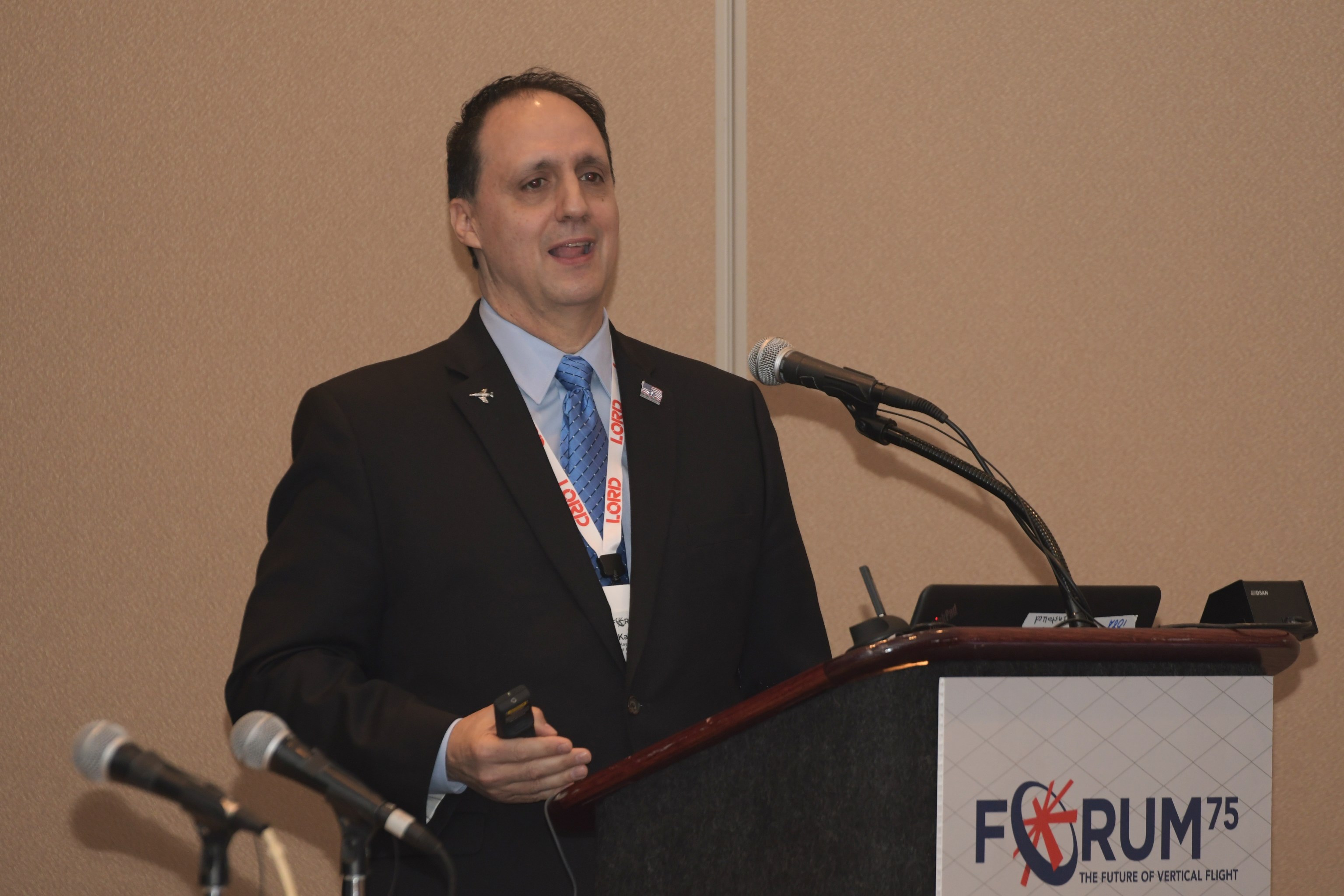
Stanzione has continued participating in the professional community around vertical flight. In 2024 he spoke at the American Helicopter Museum as LogistiWerx CEO and the Vertical Flight Society’s membership vice president. The event announcement highlighted his involvement in student outreach. The society’s 2026-2027 board announcement lists him as an appointed director.
At Forum 82 in 2026, the program also listed his history presentation on computer-aided VTOL design, spanning slide rulers and artificial intelligence. That is quite a range of tools to fit into one working life. It is also a reminder that today’s software sits within a much longer effort to understand machines before committing them to the air.
The kite story survives because it is funny. The subsequent career is interesting because flight kept leading Stanzione toward the things attached to it: engineering teams, operating plans, airport facilities and freight systems. The car tether has given way to less visible connections. They still matter when something leaves the ground.