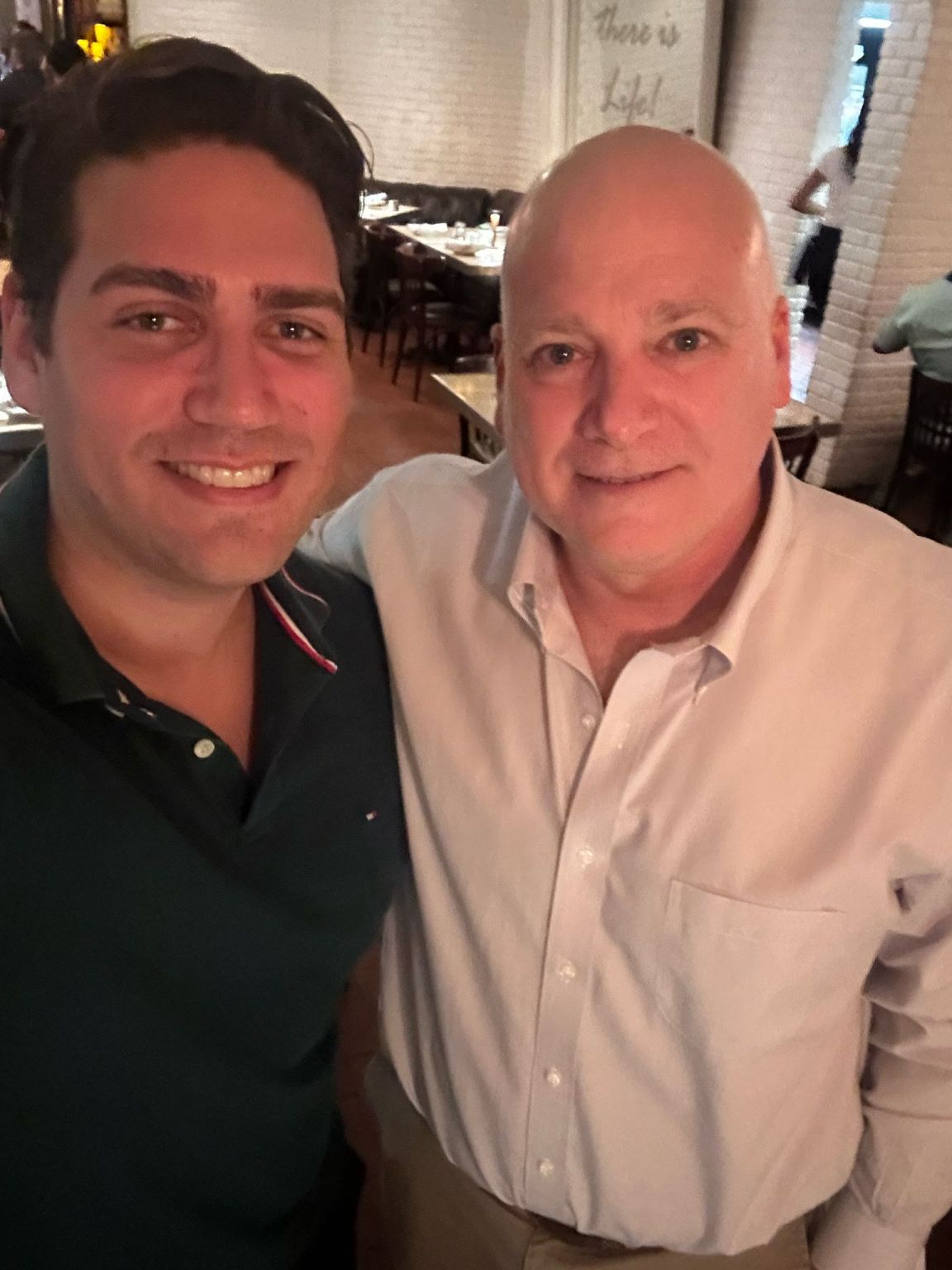
At eighteen, Nahuel Candia needed somebody to take a chance on him. Gustavo Castenetto did. Nybble Group was a ten-person team, and Candia became its first junior developer. Twelve years later, the former employee and his first technology boss met again in Miami. By then, each was building a company with ambitions beyond his home country. A first job had become a shared point of departure.
Candia remembered learning to build mobile apps at Nybble, a skill that helped him start his own business. He eventually founded the payments company Rebill. Castenetto greeted the reunion with affection, pride, and a small excursion into Star Wars: their time together belonged to a distant galaxy. The photograph is more straightforward. Two people, smiling. Careers have a way of making ordinary pictures acquire footnotes.
The episode offers a useful entrance to Castenetto’s life in business. He founded Nybble in 2005 and has led it through international expansion and repeated growth-list appearances. Yet when he talks about what the enterprise means, he keeps returning to the people.
Before the founder, the developer
Castenetto’s career began well before the familiar founder title. His professional history lists software development at Fobesa - S+H Sistemas from 1989, followed by project management at Business Compass and leadership of the software factory at Neo Compass. These are different seats around the same problem: how to make something work, and then how to get people to make it work together.
His education included time at the University of Buenos Aires between 1989 and 1994. The overlap with his early working years places his technical formation alongside professional practice. Later roles extended into IT and online marketing operations, with a period as a managing partner at Fresh Pepper. The career crosses development, delivery, management, and commercial work.
Business partner Maurice Parraud has described a colleague involved in details and concerned with customer results beyond his immediate responsibilities. His assessment also emphasized Castenetto’s attention to quality and to creating an attractive working environment. That combination helps give the founder’s public language a more concrete shape. Customers need somebody who follows the consequences of a decision; colleagues need a place where they can do the work. Castenetto’s professional relationships bring both concerns into the picture.
Founding Nybble in 2005 gave that experience an organizational home. The company’s work now includes custom software engineering, enterprise applications, intelligent automation, and artificial intelligence. The assortment is broad, but the practical concern is recognizable: businesses need systems that fit the way they operate, and people who understand what those systems are supposed to accomplish.
One example he has described is an insurance portal. A customer can compare quotes, choose a product, adjust aspects of a policy, and receive a contract. Behind those apparently simple steps sit design decisions, software architecture, connections to other systems, and the work of making the whole journey understandable. Castenetto’s description starts at the concept and follows it through to the components that make it operate. It helps explain why his business combines different kinds of expertise: the customer encounters one experience, however many disciplines were required to build it.
The colleague who came back
Candia’s story has a companion in the career of Natalia Daffunchio, Nybble’s UX lead. She had already worked with Castenetto on web projects before joining the company. Their first interview moved quickly: her portfolio made its case, and she had a new job the next day. Later, after that working period had ended, she continued with freelance projects.
Castenetto contacted her again in 2018 about a particular assignment. The connection developed into a longer place on Nybble’s design team. It is the kind of business history that tends to disappear when a career is compressed into a list of employers. A name leaves one organization and reappears in another; the relationship between those entries remains alive.
There is a particular economy to knowing somebody’s work over time. The next conversation can begin with shared experience. In Daffunchio’s case, an earlier collaboration became part of the company’s later design capability. Castenetto’s account of team culture has these individual histories behind it.
A company grows; the credit travels
When Nybble passed one hundred team members, Castenetto used a quarterly town hall to discuss numbers and their limits. He acknowledged their usefulness in measuring progress and correcting gaps, then turned to the commitment and enthusiasm of the people represented by the total. His public response to the milestone put the team at the center of the celebration.
The distinction is revealing. Software businesses can produce an impressive vocabulary of measurements. Headcount, utilization, delivery schedules, and revenue all deserve their place. An organization also depends on whether colleagues care enough to help each other when the plan becomes inconvenient. That contribution is harder to display in a neat column.
“Our biggest investment is always in nurturing our culture and empowering our team.”
Gustavo Castenetto, 2023
Nybble’s Inc. 5000 record supplies a visible sequence of business milestones: appearances in 2022, 2023, 2024, 2025, and 2026. The ranking concerns company revenue growth. It gives a useful external measure of the business Castenetto leads, while saying little by itself about an individual employee’s experience of working there.
Each dot marks an appearance. This is a record of inclusion, not a chart of revenue or rank.
For the fifth appearance, Castenetto again thanked the Nybblers, as team members are called, and the clients who had trusted them. His account emphasized habits and standards repeated over time. The award may arrive on a particular day; the work responsible for it has the less glamorous habit of arriving every morning.
Madrid, Atlanta, and the work between
Castenetto’s professional map stretches across Argentina, the United States, and Spain. In describing Nybble’s plans in 2023, he identified Spain as a prospective center for wider European operations. The ambition was specific: build on a model already serving North American and Latin American clients, with development and operational teams supporting work elsewhere in Europe.
His later public activity gives that ambition a social geography. He attended Madrid Platform and South Summit, and visited Madrid Tech Show to meet industry contacts and explore developments in cloud computing, cybersecurity, commerce, data, and AI. The former employee who met him in Miami described him as living in Madrid. Nybble’s own account of its distributed organization includes Spanish locations alongside its American and Argentine operations.
Across the Atlantic, his connections have included the Consulate General of Argentina in Atlanta and the Latin American Chamber of Commerce Georgia. He has publicly thanked their teams for conversations about collaboration and opportunities. Expansion, in these episodes, involves showing up, listening, meeting again, and giving people a reason to keep talking.
The practical counterpart is Nybble’s distributed approach to delivery. Its stated model brings people in different locations into the same projects and combines capabilities ranging from user experience to automation. For Castenetto, whose own working relationships cross those borders, the geographical reach makes collaboration a recurring operational concern. A company can put several cities on a contact page quite easily. Having colleagues work together across them takes a rather more sustained conversation.
A camp with a question in the middle
A distributed company has to make occasions for colleagues to meet. At Nybble, one recurring occasion is Nybble Camp, an annual week-long gathering. Its fifth edition, in 2025, adopted a talk-show format and made artificial intelligence its subject. The choice allowed room for questions about both the machinery and the working day around it.
The program drew on people from different disciplines. Data scientist Martín Garret discussed AI agents and design patterns. QA automation specialist Eynar Pary explored how to validate models whose answers are not always deterministic. Nayla Nostrala brought a talent acquisition perspective to boundaries and productivity. Outside guests contributed views on organizational change and creativity. These were colleagues approaching a shared subject from different responsibilities.
That breadth matters in a company led by somebody who repeatedly argues for the human part of technology. An engineer, a tester, and a recruiter will encounter different consequences of the same tool. Putting them in the conversation together makes the subject more interesting, and considerably less tidy.
In March 2026, Nybble also sponsored and participated in the Future Workforce Global Summit in Buenos Aires. Castenetto’s response again emphasized people and collaboration across institutions. The setting changed; his concern with how organizations adapt remained familiar.
Ten minutes in traffic
Castenetto has supplied his own modest example of resistance to technology. Driving to an event in Atlanta, he ignored an unfamiliar route suggested by his navigation app. After ten minutes in traffic, he tried it. The app’s recommendation was faster. Experience had expressed a firm opinion; traffic had offered a rebuttal.
He used the episode in his 2026 writing about AI to explore trust. A system can offer a useful answer before its user feels ready to follow it. That tension becomes more consequential when the decision belongs to a workplace rather than a commute. Castenetto’s interest falls on the organization surrounding the technology: responsibilities, permissions, and the confidence to use judgment.
- Define the action.What can the system do?
- Set the boundary.When must a person confirm?
- Name the owner.Who answers for the outcome?
His argument calls for clear ownership before AI systems enter everyday workflows, alongside experimentation and a willingness to correct course. The founder who once hired a junior developer now confronts another version of a familiar management task: deciding where to place trust, and how to support the work that follows.
The reunion photograph is worth returning to. It contains no ranking, technical diagram, or prediction. It shows two careers crossing again after an early opportunity. For Castenetto, whose business has carried him through different technologies and across borders, those continuing relationships give the growth story its human scale.