At six o’clock, a software company can develop an unexpected problem: everybody knows what time somebody else went home. At Copper Mobile, Arvind Sarin had colleagues in Dallas and Noida, with an ocean between them and a growing suspicion that the other office enjoyed the better end of the arrangement. One group’s evening was another group’s working day. The clocks were accurate. The picture of the work was incomplete.
In 2015, he described opening up the details of a Los Angeles client project: revenue, rates, expected duration and workflow. He wanted both offices to understand the same commercial purpose. His explanation was blunt: “When you don’t give people information, they assume the worst.”
It is an unusually useful episode in a founder’s biography. There is no theatrical unveiling, just a boss discovering that the people building the product also needed a better view of the business. The founder and CEO of what became Copper Digital had encountered a problem familiar to anyone who has ever muttered about a colleague’s calendar.
“Copper like the metal!”
Arvind Sarin, on choosing the company name
An engineer learns the customer’s language
Sarin grew up in New Delhi and made his professional home in Dallas. Between those cities came an education combining technical depth with commercial training: a master’s in electrical and computer engineering at Texas A&M University, followed by an MBA at the University of Texas at Austin’s McCombs School of Business. It is a combination that gives a person two different ways to interrogate a promising idea.
The engineering question concerns whether a system will work. The business question concerns whether anybody has a reason to pay for it. A software company has to keep answering both, often while a customer is changing the question.
Before Copper, Sarin spent three years in software development at Fujitsu Network Communications and later ran a mobile division at a software outsourcing business connecting Dallas and Chennai. His early career therefore included both building technology and working across borders. The geography that later complicated management at Copper was already part of his professional world.
His work with enterprise customers centered on productivity and return on investment. That is a less picturesque brief than inventing a new social habit. It also requires a particular kind of attention. A client may arrive asking for an application; the useful conversation starts with the task the application is supposed to improve.
That distinction gives Sarin’s career its continuity. The labels around the work change, but someone still has to translate a customer’s intention into something a development team can deliver. An engineering degree helps with one side of that conversation. Commercial experience helps with the other.
Copper, like the metal
In 2010, Sarin and his brother Aakash Sareen started Copper Mobile. The new app economy offered an opening; they had experience to bring to it. Sarin supplied the sales enthusiasm, while Aakash brought a complementary perspective. Rupak Lohit, a co-founder and COO, helped give their operation structure.
The name was practical. Copper suggested the communications once carried over wire, now moving into mobile. It also had the advantage of being a word a prospective customer already recognized. “Copper like the metal!” was Sarin’s explanation. A founder could spend a fortune teaching the world a new word. This one chose something already in the dictionary.
The early company accepted a broad range of app work before finding its focus in enterprise projects. That move gave the business a more specific identity: understanding organizational problems and building around them. The familiar little icon on a phone could have a much larger job behind it.
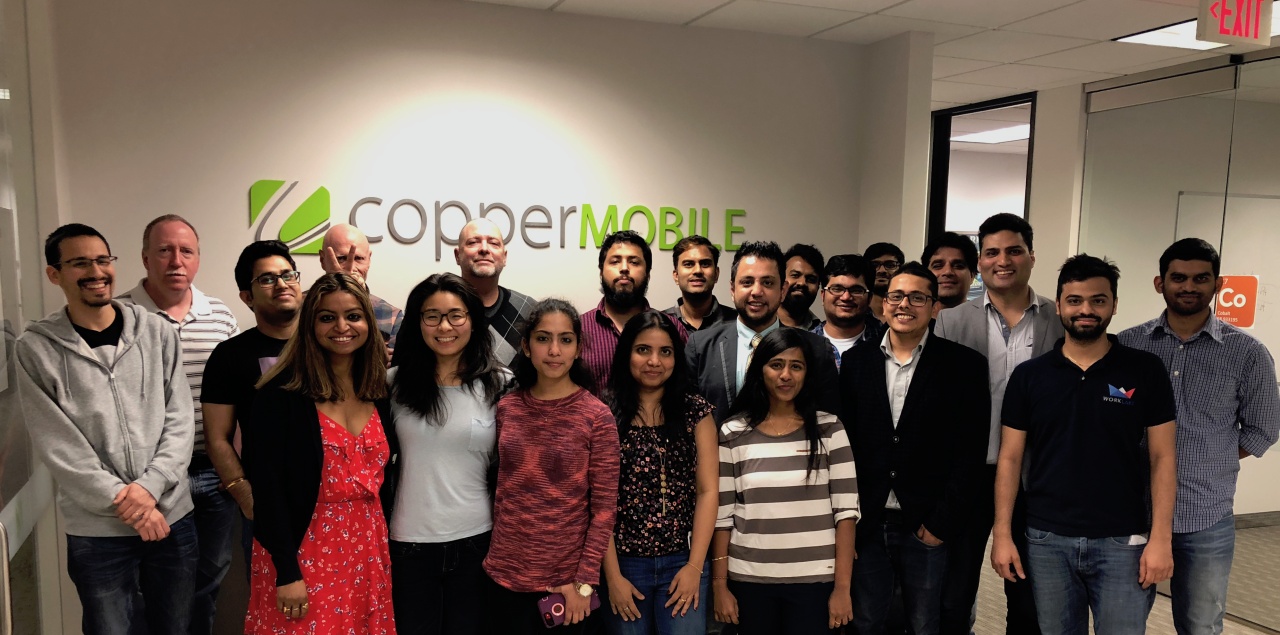
There is a revealing modesty in giving the other founders distinct jobs in the account. An idea needs advocates, but a growing organization also needs people who can turn enthusiasm into repeatable work. A sales conversation produces a promise. The rest of the company must be able to keep it.
A way to read Sarin’s career: customer needs, technical delivery and the people connecting them.
The fantasy football test
A more playful side of the work appeared in September 2015, when Copper Mobile announced its work on FANSeye. The sports platform gathered player information and conversations in one place, giving fans a place to compare opinions and follow what others were discussing. It was an app with an audience Sarin could personally understand.
He described himself as a fantasy football fan and looked forward to using the product to help his own season. For once, the CEO evaluating a software project could also picture himself using it with a very ordinary motive: winning.
The delivery assignment was substantial. Over twelve weeks, the team redesigned an earlier version, added features, developed an Android edition, revised the architecture and created a content management system. The announcement described a product initially focused on NFL content, with room to add other sports.
There are two stories inside that project. One concerns the visible pleasures of following a game. The other concerns the less visible work required to make a product maintainable and expandable. Sarin happened to have an interest in both. That overlap gives the episode a human scale a list of technical services would struggle to supply.
When the name caught up
In 2021, Copper Digital appeared on the Inc. 5000 at No. 3,295. Its company listing identified Sarin and Rupak Lohit as leaders. A Power Partner Award followed in 2022. These are dated company distinctions, milestones in the organization’s progress rather than decorations to hang on the founder alone.
A February 2023 announcement explained the move from Copper Mobile to Copper Digital. The business had expanded into services including digital strategy, automation, data analytics and cloud migration. The broader name described a broader remit.
The change is interesting because a company’s original specialty can become an awkward boundary. Customers do not necessarily divide their work according to a supplier’s first business card. An app might depend on other systems; improving one screen can lead to questions about the information feeding it, the process around it and the infrastructure underneath.
Read that way, the name change marks an adjustment in how Copper described the work it was taking on. Mobile remained part of its history, while digital made room for a larger set of assignments. The metal survived the rebranding. The device category did not.
Growth makes coordination more consequential. A wider menu of services creates more opportunities for customers, and more handoffs for the people doing the work. Sarin’s career is interesting at those handoffs: between sales and engineering, a client and its supplier, or colleagues whose working hours barely overlap.
That is also where a founder’s job becomes less photogenic. Announcing a product gives everyone a clear occasion. Explaining how a project fits together can require several conversations with people who have different priorities. The latter work rarely gets a launch party, though a company may depend on it just as much.
It is tempting to organize a technology career around the arrival of new tools. The more revealing units can be smaller: a brief that becomes clearer, a relationship that survives a difficult project, a team that understands why its work matters. These are useful ways to read the transitions in Sarin’s professional life, even as the vocabulary of the industry keeps changing.
A founder with a departure gate
Outside the company description, Sarin offers another introduction: CEO Nomad. His personal link hub points toward travel, stories and mysteries from around the world, with routes to YouTube, Instagram, Facebook and X. The brief description makes room for curiosity without requiring every interest to justify itself as business development.
The distinction adds texture to the portrait. Dallas is his professional base, and travel is a publicly stated interest. Both can be true without an elaborate theory about how every journey improves a quarterly result. Sometimes a person who runs a technology company also wants to see somewhere else.
His public profile lists English and Hindi alongside limited working proficiency in Spanish and elementary Korean. The qualifications are part of the charm: a list of languages with the rough edges still attached. Curiosity is often more convincing when it comes with an admission that there is more to learn.
By March 2026, Sarin was discussing entrepreneurship, customer focus and adapting through technology changes with Jessie Warner on The Achieve Podcast. The topics included the value of a specific niche, strong partnerships and maintaining a longer view while the business evolves.
Those questions fit a career that has crossed software development, selling services and running a company. Each role offers a different view of the same assignment. Developers need a workable brief. Customers need a reason to invest. Colleagues need enough context to make their part of the work intelligible.
There is pleasure in the ordinary details that remain: a recognizable company name, a sports fan wanting an edge in his league, an executive with a travel channel. They keep the biography attached to a person. Sarin’s work has involved plenty of technology; some of its more revealing moments concern how people understand one another.
Follow the conversation
More from Arvind Sarin, plus the career episodes behind this profile.