A nurse finishes a home visit, gets into the car and drives away. The patient has been seen. The work, perversely, has only begun. There is still a clinical note to complete, perhaps a Start of Care assessment to wrestle into shape, and a QA team that cannot move until the chart is ready. Copper Digital built its current business around that interval: the space between care delivered and care documented.
- Copper Digital began in 2010 as a mobile software firm; it now concentrates on AI-assisted home health documentation.
- Its public Avatar Home Health case study lists pilot charges of $2 per referral, $20 per OASIS Start of Care chart and $4 per visit note.
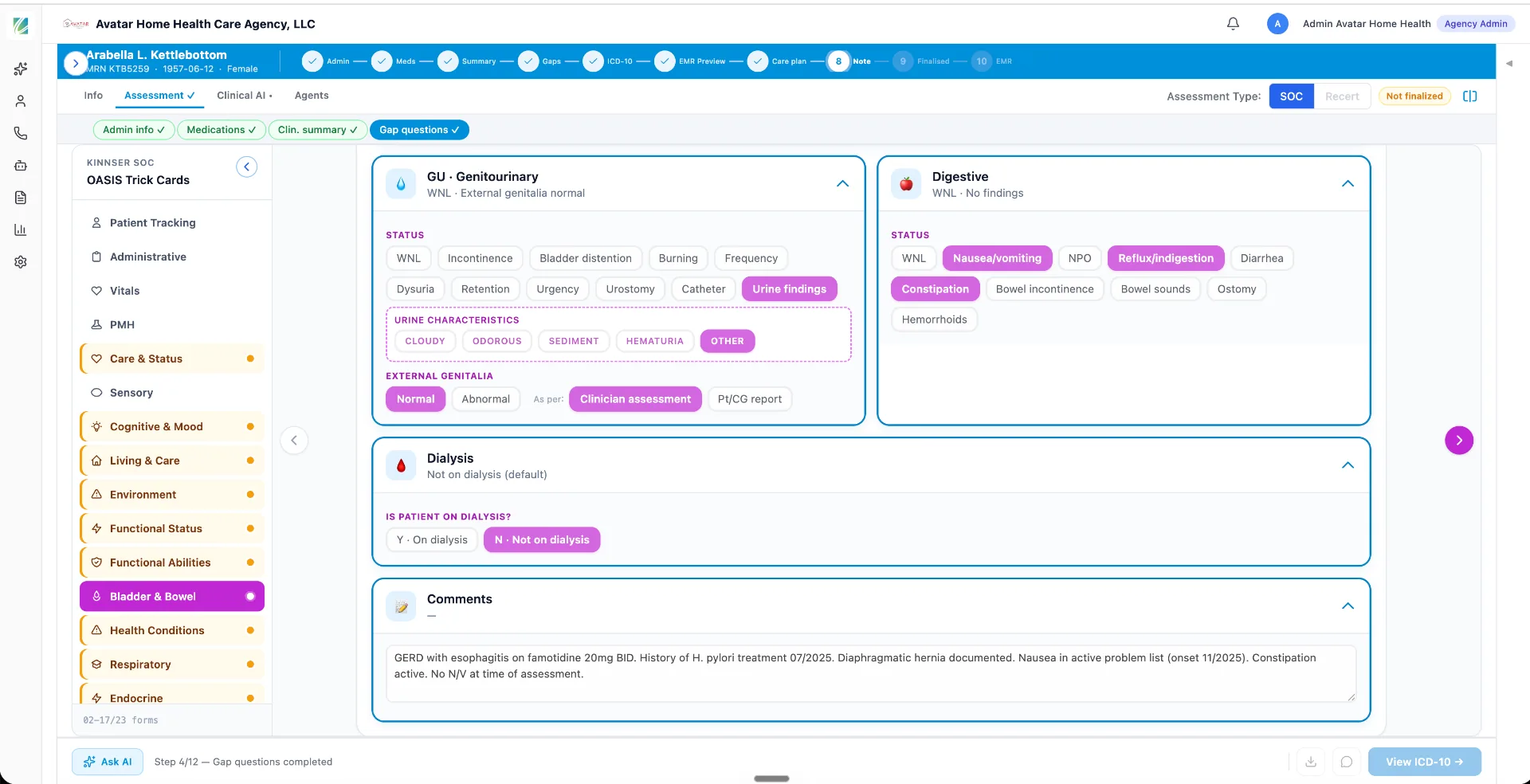
- The company says more than 3,000 visits have passed through its live WellSky/Kinnser workflow. A clinician approves the final note.
That $20 figure is unusually useful. Software companies often ask buyers to imagine a sweeping transformation. Here, a buyer can count charts. An agency can compare a line item with the hours its nurses spend typing at night, the QA backlog in the morning and the claims that wait behind it. The published price comes from one pilot, so it is an invitation to calculate, not a universal tariff.
First, they built for everyone
Copper Digital’s predecessor, Copper Mobile, started in 2010 under founder Arvind Sarin. Its old résumé was broad: mobile applications for enterprises, then wider digital transformation work. In 2023 it announced the Copper Digital name, with a menu stretching from web and data to AI, cloud and connected devices. The company’s historical materials point to hundreds of enterprise clients. Sarin’s older public biography names Cisco, Visa and the U.S. Army among them.
A broad services business can be good at solving a client’s problem and still struggle to become a repeatable product business. Sarin’s own account of the later healthcare search is refreshingly plain. His team tested AI answering services, intake automation and scheduling. Each addressed a genuine annoyance. None, he said, produced a revenue model that scaled past a pilot. What failed first was not the software’s ability to do a task. It was the business case for doing that task again and again.

The OASIS prototype changed the conversation. In an interview published on Copper Digital’s own podcast page, Sarin remembers nurses asking when their agencies could have it. That response matters more than polite applause at a demo. OASIS, the assessment used in Medicare home health, sits near the beginning of an episode of care. A slow or incomplete chart can ripple through review, coding and reimbursement. The person who dislikes the task and the organization that pays for delay are both easy to find.
“When can my agency have this.”Arvind Sarin, recalling nurses’ response to the prototype
A note with a route through the business
Copper AI starts with a brief voice debrief after a visit. The clinician tells it what happened; the product organizes that account into a structured note, checks for gaps and routes it through human review. The nurse can edit and approve it before it enters the agency’s electronic medical record. It is a workflow product whose output happens to be text. Its customer is the home health agency, while nurses, QA staff and billers each encounter a different part of the result.
CaptureThe nurse gives a short account of the visit.
StructureAI drafts a visit-specific note and flags gaps.
CheckHuman review and clinician approval precede the record.
DeliverThe approved note reaches the existing EMR for agency QA.
This is also why a generic transcription tool is an imperfect comparison. A transcript can save keystrokes and still leave a nurse to fit every detail into the right clinical fields. Copper Digital claims to handle more of that passage from field account to QA-ready record. Existing EMR tools, ambient medical scribes and home health automation vendors remain alternatives; the useful test is which one gets a correct, approved note into the agency’s actual workflow with the least extra work.
The pilot that put numbers on the problem
At Avatar Home Health in Houston, Copper Digital says it deployed referral ingestion, OASIS Start of Care automation, visit-note automation, a human QA layer and a Kinnser push. Its case study says nurse finishing time fell to under ten minutes, QA moved toward spot checks and billing moved to the next day across the census. Those are company-reported pilot results, and the case-study page says the full story awaits permission after a paying, full deployment. The distinction matters when a buyer is deciding what evidence to demand.
Published pilot rates; agency contracts and implementation scope may differ.
By September 2026, the company’s website reported more than 3,000 completed, human-verified visits at Avatar, an agency it describes as having more than 500 patients on census. It also explicitly said that Copper AI had one live EMR integration: WellSky/Kinnser. That is a more modest claim than “works with every system,” and a more useful one. An agency already on Kinnser can ask to see the complete route of a real note. An agency on another EMR would have to price and test a new integration before expecting the same outcome.
live EMR integration claimed by Copper Digital as of September 2026: WellSky/Kinnser.
The lesson hidden in the chart
Copper Digital operates at an awkward junction in healthcare technology. The EMR holds the official record, yet it does not erase the clinician’s after-hours work. A standalone scribe may capture words but leave the chart unfinished. Copper’s answer is to own the handoff: capture, draft, check, approve and deliver. Its clinical advisor Kathy Duckett, a home health nurse with more than 30 years in the field, gives the company a direct view of what happens between a visit and the record.
There is a practical idea here for builders in any regulated industry. Trace one piece of work until it triggers the next team’s action. Price the completed unit. Keep a human signature where responsibility lives. Then integrate with the system people already use. Copper Digital’s own history shows why the sequence matters: the earlier AI ideas had real users and real friction, but the company found a clearer buyer and a clearer economic chain in the unfinished home health chart.
For an agency considering the product, the homework is equally concrete. Count late notes before a pilot. Measure nurse finishing time, QA corrections, time to bill and the share of notes needing edits. Ask who reviews each draft and whether the quoted per-chart rate includes that review. Confirm the EMR path in production. If the backlog does not shrink without creating new QA work, the cleverness of the voice interface will be beside the point.
A visit ends at the patient’s door. The economics of that visit may not settle until the chart reaches the right screen. Copper Digital found a business in those missing hours, and a sharper identity in the small act of finishing a note.