Kamalavel Rajendran’s reason for starting a software company included a remarkably concrete requirement: it should create opportunities in his hometown. In Karur, Tamil Nadu, he saw people who could do the work. He wanted them to have access to technology careers without having to relocate. The address belonged in the business plan.
That decision is the useful starting point for understanding the co-founder and CEO of Mallow Technologies. International customers, mobile applications and marketplace analytics all enter his career. Yet he returns to the question of what those activities can make possible close to home. A company reaches outward; the opportunity it creates can remain nearby.
There is a practical tension here. Serving a distant customer requires a team that understands the customer’s business, communicates clearly and delivers working software. Creating local opportunity requires worthwhile work to arrive in the first place. Rajendran’s stated purpose puts these obligations together. The hometown ambition has to survive contact with a client’s requirements.
A career within reach of home
His education and early employment cross technical and commercial territory. He studied instrumentation technology at Anna University in Chennai between 2001 and 2005. His later studies at SVPITM ran from 2006 to 2008. From June 2008 until September 2010, he worked as a marketing manager at Mallow International. His tenure leading Mallow Technologies begins in October 2010.
The sequence matters because his public account of leadership includes both people and delivery. He describes placing colleagues where they can contribute and establishing processes that keep the organisation functioning. He also describes remaining involved in projects and process improvements. The CEO title, in that account, does not put the actual work out of view.
His phrase is “empowering the right person at the right position.” It is a modest formulation beside the usual vocabulary of entrepreneurial destiny. It also describes a recognisable management problem: a capable person still needs a suitable role, and a suitable role still needs a system around it.
An early stop in Paris
Four years into Mallow’s life, a piece of its work was concerned with helping people navigate Paris. On May 5, 2014, Sprylogics announced an agreement to integrate its Poynt-enabled software development kit into Mallow’s Paris by Metro app. The planned addition involved local search and sharing capabilities.
The application already dealt with the practical business of travelling: routes between stations, maps, tourist destinations and airport transfers. Rajendran, identified at the time as Mallow’s executive director, discussed improving the experience of users searching and planning routes. A traveller trying to work out a journey is a pleasingly specific customer for a technology business.
The announcement offers an early, tangible example of international product work. It connects a software company founded in Karur with a Canadian technology partner and an application for navigating a French city. There is no need to turn that arrangement into a grand metaphor. The map already supplies enough geography.
It also gives the career a useful scale. Software is often described through the technologies used to build it. Here, its purpose can be understood through the person using it: someone needs to find a station or choose a route. The engineering has a destination.
The customer’s side of the screen
As Mallow’s CEO, Rajendran has described a different obstacle: the hesitation businesses feel when choosing a development partner. A buyer may need skilled people and still struggle to decide which team to trust. His stated aim is to reduce that uncertainty through the quality and reliability of the service.
His description of how Mallow works is concrete. It includes progress reports, visibility into delivery and a clear point of contact. He says the company uses an in-house team across the project lifecycle. Communication, in this account, belongs alongside the technical work rather than being left until the work is finished.
For a buyer, an application under construction can be an awkward thing to purchase. Money is leaving; the finished product is still ahead. A clear update gives the customer something to evaluate in the meantime. It allows a question to be raised while an answer can still influence what gets built.
That is the practical reading of Rajendran’s priorities. His attention to processes, role placement and project involvement suggests an operator concerned with how confidence is maintained between milestones. A reassuring sales conversation has a limited shelf life. Eventually, somebody has to answer the next message.
“I am proud to have started a business in my home town”
Kamalavel Rajendran
When the numbers need explaining
KwickMetrics brings a second kind of customer into the story. Rajendran is a co-founder of the product, which serves marketplace sellers. On September 30, 2022, he joined Karthick from KwickMetrics for a conversation about data on The Asian Seller podcast. The discussion covered sales, profitability, inventory and preparations for the final quarter of the year.
The subject has an everyday commercial sharpness. An online seller can have an abundance of figures and still need help deciding what they mean. Inventory ties up money. Sales and profitability answer different questions. A useful business tool has to make those distinctions easier to see.
His conference appearances followed that practical territory. The Ecom India Summit programme lists him for a session about growth metrics on October 10, 2022, and another about recovering money from Amazon on October 8, 2023. These are topics with consequences for people running businesses, often while several other tasks demand their attention.
KwickMetrics now presents tools for Amazon and Walmart sellers, including analytics, inventory, advertising and reimbursements. The product and Mallow’s services address different working situations. Together, they show Rajendran working on both a company’s software requirements and a merchant’s need to understand an existing business.
Back in the room with the students
On May 4, 2024, Rajendran was a chief guest at Chettinad College of Engineering and Technology’s College and Placement Day. He shared the occasion with Vijayakumar Thavamani, a college alumnus and staff software engineer at Vantiva. Their message encouraged students to develop employability skills and consider the opportunities available to engineers.
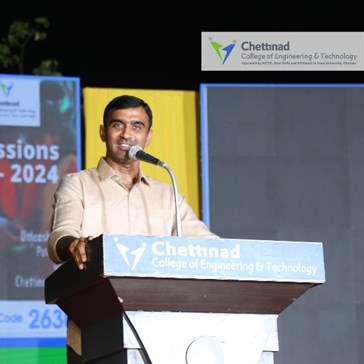
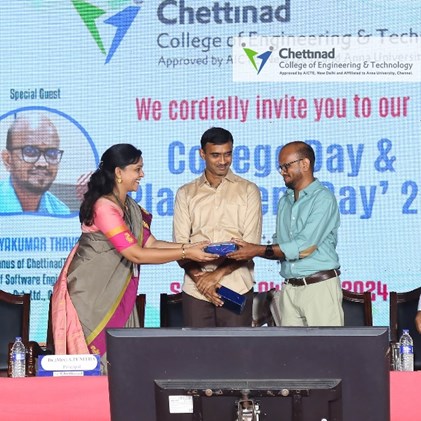
The appearance gives his hometown purpose a human setting. Students preparing for work are precisely the people for whom the location of a technology employer can matter. He helped build a software business locally; here he was addressing people preparing to enter the profession.
A placement celebration also makes an abstract word such as opportunity easier to understand. It concerns skills, employers and the next step after study. Rajendran’s public account of founding Mallow speaks to that same transition: how someone with ability gets the chance to use it.
The questions he keeps answering
His writing returns to decisions facing software buyers. Articles under his name cover outsourcing, choosing development partners and offshore development centres. An October 2024 piece addresses concerns about working with teams in India, including communication, quality and the difficulties of collaborating across time zones.
The intended reader is easy to recognise: a business owner who needs software, understands that the decision matters and has questions before committing. The recurring subjects make his commercial focus visible. The work of explaining a development relationship begins before the relationship itself.
In May 2025, his guide to offshore development centres set out a more structured version of that discussion. It covers defining requirements, evaluating technical and operational capabilities, reviewing management practices and understanding costs. The questions move from whether to work with a remote team to how such an arrangement should function.
An offshore development centre is a team in another country working on a client’s software. His guide treats the arrangement as something that needs to be designed: the people involved, the infrastructure, the expectations and the way responsibilities fit together. That emphasis gives substance to the idea of access to talent. Finding developers is one part of the decision. Establishing how they will work with the client, over time, is another. It is familiar ground for someone whose management priorities include the processes surrounding a team.
Read together, these topics offer a picture of what occupies him professionally. They concern the arrangements around software as much as the software itself. Requirements need definition. Responsibilities need owners. Customers need enough understanding to participate in decisions. The mundane details have an inconvenient habit of deciding whether the ambitious plans work.
A new syllabus, the same address
In June 2026, Mallow announced that its team had completed the NASSCOM AI Champions Program. The company described learning about AI strategy, governance, readiness and responsible adoption. The programme adds a further subject to the company’s ongoing technical learning.
Rajendran has also expressed ambitions for a stronger international presence, including further expansion into the United States, while continuing to develop emerging technology expertise. These are stated intentions. Their interest lies in the combination: more reach for the business alongside the local purpose with which he explains its beginning.
Away from those business concerns, he enjoys tennis. It is a welcome small detail in a career otherwise described through applications, processes and customer decisions. Even a founder whose work involves the cloud has reasons to spend time on an actual court.
The Karur decision remains the most distinctive part of his story. It gives the international work a point of origin and the employment ambition a place where it can be tested. Rajendran wanted worthwhile technology careers to exist closer to home. Every new kind of work asks the company to make that original choice useful again.
Follow the work
More from Rajendran and the businesses he helps lead.