A vacation rental becomes a technology company at the exact moment someone books Tuesday night on Airbnb while somebody else is buying the same Tuesday on Booking.com. Add a cleaner who has not seen the new checkout time, an owner asking where the payout went and a guest staring at a lock that refuses to open. The charming apartment is still charming. The business behind it is suddenly an air-traffic-control problem.
Guesty exists for that unphotogenic second act. Its software sits behind the listing and gathers calendars, reservations, messages, prices, payments, owner statements, tasks and distribution into one operating layer. The customers are not travelers. They are hosts with a few units, professional managers with hundreds and hospitality groups with portfolios large enough to make a spreadsheet feel like a practical joke.
The useful origin storyFirst, they did the chores
Twin brothers Amiad and Koby Soto found the problem in 2013 while managing their own short-term rentals. Their first answer was SuperHost, a one-stop property-management service for Airbnb hosts. This matters because it was not a clever dashboard dreamed up at a whiteboard. They answered messages, arranged the work and lived inside the interruptions.
SuperHost joined Y Combinator's Winter 2014 batch, became Guesty and raised $1.6 million. The labor-heavy concierge did not produce a spectacular public failure. It did something more instructive: it receded. By 2016 the company was building a full software suite for property managers. A multi-calendar gave operators one view of reservations; a unified inbox pulled scattered guest conversations into one place. In 2017, a Booking.com integration moved Guesty beyond its Airbnb-only beginnings.
“Successful hospitality requires a focus on people, not processes.”Guesty's stated operating belief
What changed their minds? Guesty does not narrate one thunderclap. The public timeline suggests a quieter realization: a service can solve one host's evening, while software can solve the same repeated problem for thousands of managers. The initial service was market research with laundry attached. The durable product was hiding in its checklists.
The control-room idea
The productA single login keeps swallowing the workflow
The calendar and inbox remain the wedge, but the suite now reaches much further. The channel manager synchronizes availability, rates and listing data. Automation tools trigger messages and tasks. PriceOptimizer recommends rates. GuestyPay handles transactions and reconciliation. Trust Accounting organizes owner and vendor money. The Owners Portal reports performance without a manager emailing another spreadsheet. A website builder and booking engine help operators take direct reservations. LocksManager, protection products, guest screening and a 24-hour communications service fill in the awkward edges.
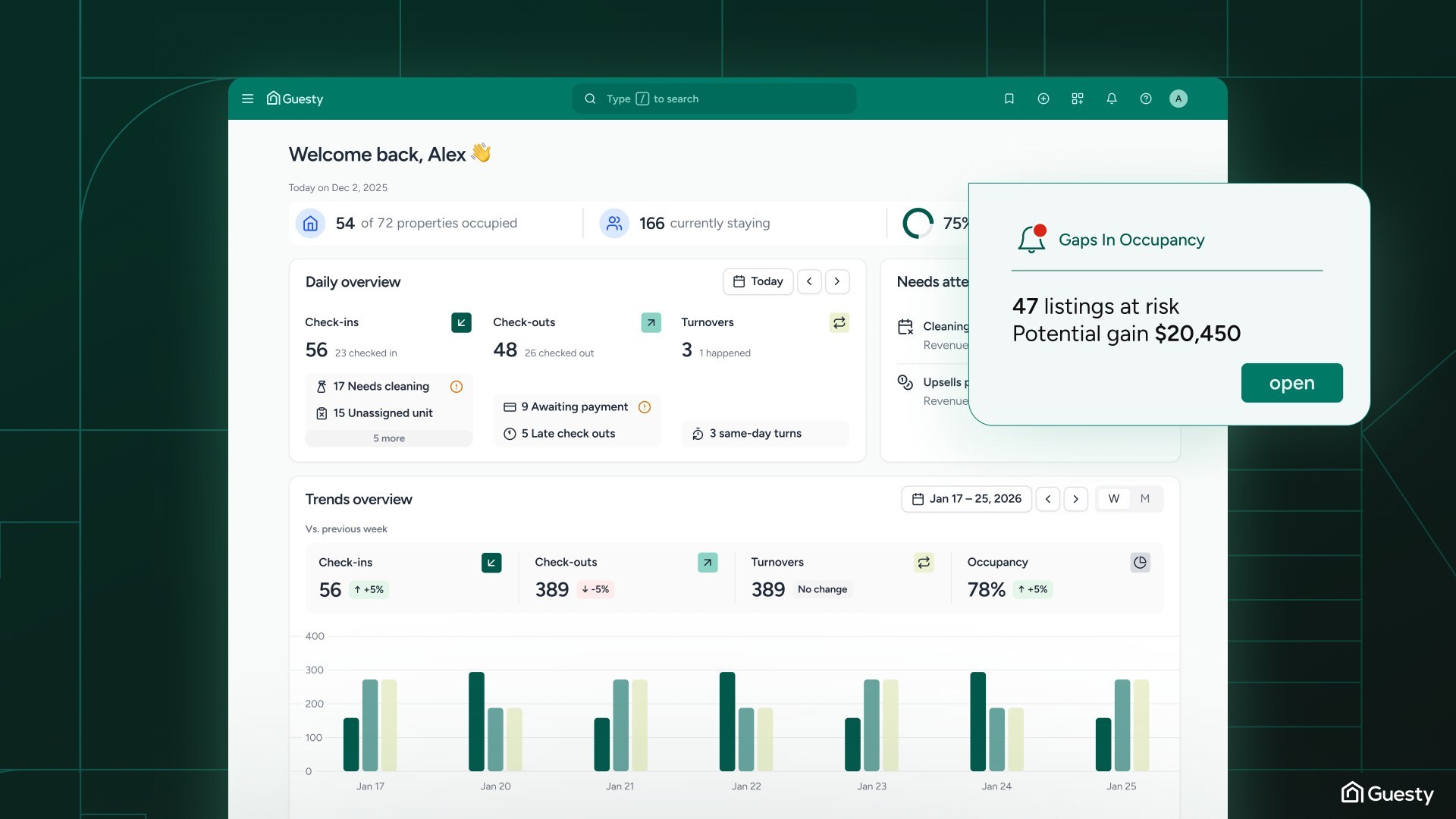
This breadth is Guesty's difference and its burden. Hostaway, Lodgify, Hostfully, Hospitable, OwnerRez, Streamline and Avantio all offer versions of the property-management stack. A manager can also assemble a homemade system from a channel manager, pricing tool, payment processor, messaging app and accounting package. Guesty's pitch is fewer joins between those parts, deeper connections to the large booking marketplaces and a product ladder that stretches from one listing to enterprise portfolios.
The company has reinforced that position by acquisition: MyVR and Your Porter in 2021; YieldPlanet, HiRUM and Kigo in 2022; StaySense in 2023; and Rentals United in 2024. The last deal added a channel-management network that Guesty said powered 500,000 listing connections. CEO Amiad Soto put the strategy plainly: “We believe in consolidation.” Translation: this market has too many plugs, and Guesty would like to own the power strip.
Its expertise is unusually specific. Traditional real-estate software thinks in leases and months; hotel systems think in rooms, front desks and nightly inventory. Short-term rentals borrow from both while adding remote homes, scattered cleaners, individual owners and marketplaces that each keep their own rules. Guesty lives in that seam. Customers such as Roami, OptiNest, Angel Host and Great Dwellings use the platform to turn collections of rentals into repeatable operations. Casago named it a certified PMS of choice during the operator's expansion after acquiring Vacasa.
That places Guesty one layer below the travel marketplaces and one layer above the physical work. Airbnb and Vrbo bring the shopper. A cleaner, maintenance technician or local manager prepares the home. Guesty carries the reservation between them, tells the parties what changed and records the money. It is infrastructure, but infrastructure with a guest-facing consequence: the wrong rate, stale availability or missed message escapes the back office immediately.
What it costsThe cheap door opens into a large house
Guesty's public pricing starts at $9 per month per listing. Lite is aimed at one to three listings; Pro covers four to 199; Enterprise begins at 200. The larger plans require a quote, and advanced functions such as dynamic pricing, payments, protection, websites, smart-lock management and communications can arrive as add-ons. An annual contract is discounted against monthly billing.
PUBLIC ENTRY PRICE
QUOTE + ADD-ONS
CUSTOM PLATFORM
That is classic land-and-expand SaaS, except the unit of expansion has a mattress. Subscription revenue grows with listing count; embedded payments and premium services deepen the account. It can be economical when it replaces several tools or avoids costly errors. It can look expensive when a small operator needs only a calendar and templated messages. Buyers should price the workflow they will actually use, including onboarding and add-ons, not the number printed nearest the “start” button.
Capital for the control room
Selected disclosed rounds. The 2024 round, led by KKR, reportedly valued Guesty near $900 million post-money.
The new wagerFrom suggesting the work to doing it
In 2026 Guesty began describing itself less like a box of tools and more like a workplace for software agents. Copilot lets a manager ask questions of live operating data in ordinary language. ReplyAI can answer routine guest messages with controls for timing, confidence, category and sentiment. Other agents look for occupancy gaps, draft tasks from complaints, reconcile bank transactions and surface revenue opportunities. Guesty says 40 specialized agents are live across the portfolio, with more planned.
The distinction is consequential. Old SaaS waits for a user to click. An agent watches, decides and acts. At 2 a.m., that can mean a guest gets an answer before a human wakes up. It can also mean a bad rule travels faster. Guesty's emphasis on per-property guardrails, approval steps and visible activity is therefore not decorative product language. It is the trust architecture.
The data advantage is plausible: more than a decade of short-term-rental operations across half a million properties can teach a system what a normal question, risky payment or weak Tuesday rate looks like. Still, scale is not wisdom. A furious guest, a local regulation or a delicate owner relationship may require context that does not fit neatly inside the reservation record. The winning automation will know when to stop.
What a founder can steal
- Do the job manually before automating it. Repetition reveals the real product specification.
- Start with the expensive error. Guesty's early calendar solved double bookings, not a vague desire for “efficiency.”
- Own the system of record, then expand into adjacent transactions and workflows.
- Segment by customer complexity. A host with two cabins should not enter through the enterprise door.
- Give automation a visible leash. Controls and audit trails sell the agent as much as intelligence does.
The limitsWhen the playbook stops working
Guesty's formula works when a manager has repeated operations, multiple channels and enough volume for centralization to pay back. It becomes stronger as the portfolio grows because the avoided handoffs compound. A manager with 300 homes cannot afford 300 private versions of the truth.
The model is weaker for one simple listing, a deeply bespoke hospitality concept, a team unwilling to standardize, or a business whose critical channels do not integrate cleanly. It also depends on the major booking platforms continuing to provide reliable access.
Acquisitions add another condition. Buying product surface is quicker than building it, but the customer eventually notices whether the pieces share data, permissions and design. A suite that feels like seven companies can recreate the fragmentation it promised to remove. Guesty's job after consolidation is integration - the slow, expensive craft hidden behind the deal announcement.
The company says it shipped 333 features and updates in 2025. In April of that year it was named Best PMS at the Shortyz Awards; later it appeared at No. 1,688 on the Inc. 5000 with 259 percent three-year growth. Those are useful signals, but the sharper test is operational: fewer double bookings, faster answers, cleaner owner statements and more nights sold without matching growth in headcount.
Guesty began with the founders inside the mess. That remains its best strategic asset. The control room wins only if it remembers the apartment outside the screen - the tired traveler at the lock, the cleaner racing across town and the manager whose phone has finally, mercifully, stopped buzzing.