The awkward thing about a lien is that it can remain invisible until someone else gets paid first. Breakout Finance, a small-business lender, had a practical question: did its data provider really know which creditors already had claims on a borrower’s assets? It assembled 100 borrower files with known lien positions and ran them through its existing vendor and Baselayer. In one case, the incumbent returned two active liens. Baselayer found seven.
- Baselayer combines business verification, legal records and fraud signals in a console and API.
- Its customer stories show the value of matching the right records to the right business.
- Its next bet: identifying the AI agent, the principal behind it and its delegated authority.
01 / The five liens that changed the conversation
The extra five liens mattered because a lender’s place in the repayment queue can determine whether it recovers its money. According to Baselayer’s published account, Breakout’s test produced correct lien-hit matching above 98%, against roughly 70% for its previous provider. Those are results from one customer’s comparison, not a universal scorecard. Still, the experiment had a useful feature: the answers were already known.
“It wasn’t close, which was a bit shocking,” said Ian Bradley, Breakout’s head of operations and technology. The company reported getting Baselayer into production within 72 hours. What changed its mind was a controlled comparison on its own borrowers. Procurement, for once, had an answer sheet.
02 / First, the founders needed a bank account
Baselayer’s origin contains an appropriately irritating detail. In early 2023, following a succession of bank failures, Jonathan Awad and Timothy Hyde struggled to secure a business banking account themselves. Launch reporting described a manual review lasting more than a month, with bills and vendors waiting. They encountered the consequences of a system built to investigate businesses slowly.
Awad became CEO; Hyde, whose background included building and selling a machine-learning company, became CTO. Their response was to build an AI-based knowledge graph for business verification. Baselayer emerged from stealth in May 2024 with a $6.5 million seed round. The founders had turned a bottleneck they experienced into something they could sell to the institutions creating it.
 Jonathan Awad / CEO
 Timothy Hyde / CTO
03 / A registered company still needs a second look
Know Your Business, usually shortened to KYB, sounds like a lookup. In practice, it means resolving names, addresses, tax identifiers, officers and records into a defensible picture of one entity. An abbreviation can hide a legitimate applicant. A misleading industry label can conceal an activity a lender would never finance. Finding a company’s registration starts the investigation.
Baselayer supplies verification and KYB ratings, industry prediction, lien searches, lawsuit and bankruptcy checks, and website analysis. Its console lets analysts investigate; its API feeds those signals into another system’s decisions. Banks and credit unions, payment processors, fintechs, marketplaces and SMB lenders are the intended buyers. The company sells information and workflow tools, rather than lending money itself.
OatFi’s account makes the benefit tangible. The embedded-finance company reported 52% fewer KYB-driven manual reviews after switching to Baselayer. Of businesses earlier vendors missed, Baselayer located and classified 88.5%. OatFi also valued classification informed by online activity, rather than accepting a self-reported industry code. Better screening can rescue a good applicant as well as expose a bad one.
A missing record and a risky business can look identical to an automated rejection rule.
The operational problem
The lesson for a buyer is to measure both mistakes: admitting the wrong business and failing to recognize the right one. Faster decisions are useful only when the underlying identity is correct. A lender that counts approvals without checking entity matches may simply have made its uncertainty more efficient.
04 / The next institution gets a memory
Baselayer’s network adds another ingredient. Its Identity Network uses inquiry patterns to surface anomalies; its Fraud Consortium connects confirmed fraud events contributed by financial institutions to business identities. Portfolio Monitoring follows changes after onboarding. A registration checked on Monday does not tell you everything that happens on Friday.
This sits in a crowded market. Middesk also offers business verification and KYB automation. Trulioo offers business verification across more than 195 countries. Baselayer’s proposition combines entity matching, credit and legal signals, and shared fraud intelligence. Its integrations also complicate the tidy competitor list: Alloy, an identity and fraud platform, appears among its partners. Financial infrastructure often sells best when it fits inside someone else’s machinery.
That distinction matters when choosing a tool. A team onboarding overseas entities needs to establish jurisdictional coverage. A team with an existing decision engine needs usable evidence and predictable integration. Neither should assume one customer’s matching result transfers intact to its own applicant population.
05 / The meter starts at $150
Baselayer publishes monthly Start-up plans beginning at $150 and Growth plans beginning at $750. Both use credits across products, with higher-priced overages after the allowance runs out. Enterprise pricing is custom, with annual contracts; lien filing and portfolio monitoring sit in that tier. A credit allowance is not a promise of an equal number of complete investigations.
The sensible calculation is therefore cost per useful decision: which checks each application needs, how many cases still reach an analyst, and what errors survive. Start with known files, as Breakout did. Compare coverage, matching and review effort separately. The test is portable even when the vendor’s results are not.
06 / Now the applicant is software
On September 22, 2026, Baselayer announced a $35 million Series A led by M13 and launched its Agentic Identity Suite. The company reported serving more than 2,300 financial institutions and payment companies. That network is the starting point for its expansion into agents that act for businesses.
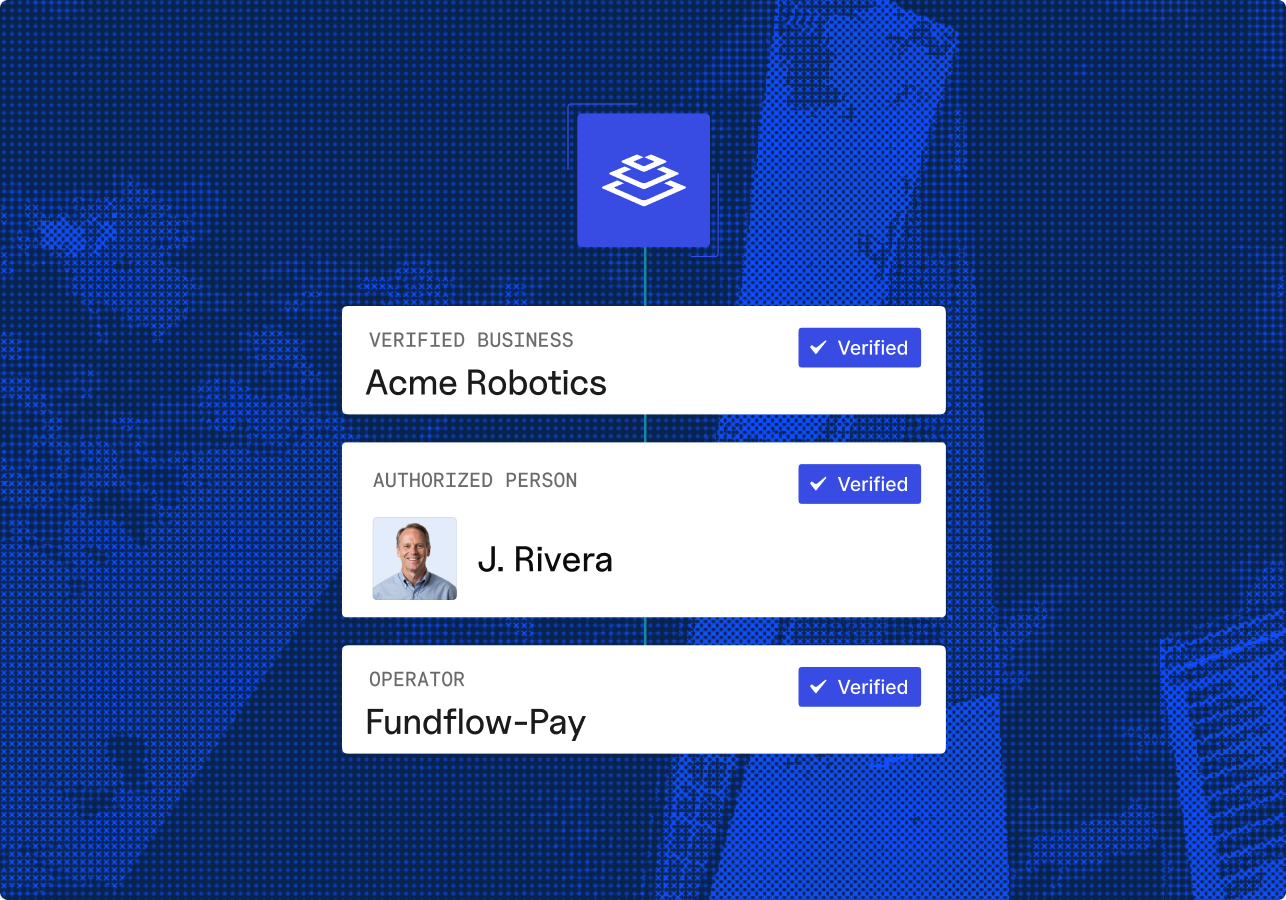
“Agents don’t carry ID,” Hyde said. Know Your Agent connects software to its operator and the person or business that delegated authority. Counterparty verification and a trusted registry extend the same idea across a transaction. The question that began with a borrower’s liens now follows an agent to checkout: who stands behind this action, and what evidence makes that answer worth trusting?