The essential problem in Jonathan Awad’s business is also an enduring problem in commerce: a stranger is asking to be believed. The stranger may be a small business applying for credit, a merchant opening an account or, increasingly, a piece of software arriving with permission to spend someone else’s money. The applicant says it is real. The institution across the table has to decide whether that sentence is worth anything.
Awad, the New York co-founder and chief executive of Baselayer, has spent much of his career orbiting that moment of doubt. He began in banking, helped build a market for real-estate securities, moved through a bank-tech company and a business-identity startup, then returned to the founder’s chair. Each stop offered another angle on the same awkward exchange: money would like to move, but trust has not caught up.
His reason for caring is not purely technical. Awad’s parents immigrated to the United States in 1986. He has written about what their early years lacked: no credit file, no history and no institution ready to vouch for them. They had to establish their legitimacy again and again. At family dinner decades later, that story sounded less like family lore than a product brief. Baselayer, he wrote, had by then run more than 60 million business verifications. On one side sat institutions seeking proof. On the other were ordinary businesses that might be entirely legitimate and almost entirely unknown.
The education of a second attempt
At Skidmore College, Awad studied Government alongside Management and Business. The combination now looks prophetic: institutions on one page, incentives on the next. He led the investment club, served on the finance club board and presided over the pre-law society. In a college newsletter, he described reading The Wall Street Journal every day and pursuing banking with the zeal of a person who had already ironed tomorrow’s shirt.
A JPMorgan internship became a banking career. In 2017, he left to start LEX with friends, pursuing what he later called the first stock exchange for real estate. By 2019, the company had raised $30 million. Awad’s own verdict is more interesting than the number. He has said the overall experience was not a good one and that he did not learn as much as he should have. Founders are trained to turn every bruise into a parable. Awad simply logged the bruise.
He returned to employee life, taking growth, strategy and investment work at OakNorth and then growth and product at Middesk. The detour mattered. It put him close to commercial lending and business identity without requiring him to pretend that his first founding experience had made him omniscient. One lesson from that period became a favorite injunction: identify “what I suck at,” then find clever people who fill the gap.
Leaves investment banking to help build LEX, a market for real-estate securities.
LEX raises $30 million. Awad later gives the chapter a candid, mixed review.
Returns to operating roles at OakNorth and Middesk, working near lending and business identity.
Incorporates Osiris Ratings, raises $5 million and recruits Timothy Hyde.
Renames the company Baselayer and puts its first customer live on April 5.
Announces a $35 million Series A and expands the identity network to AI agents.
Baselayer began with calls rather than code. Awad says he spoke with 50 prospective customers; 20 agreed to work with the company if it built a fraud consortium. The premise was communal self-defense. A fraudster discovered by one lender should not be able to stroll into the next institution wearing the same false moustache. Shared, anonymized reports could turn isolated losses into an industry warning.
Then came the co-founder negotiation. Awad called Timothy Hyde and asked him to quit his job. Hyde declined. Awad asked what would change his mind. Raise $3 million, Hyde replied. In March 2023, as Silicon Valley Bank collapsed and the startup world refreshed its bank balances with mounting horror, Awad raised $5 million. Hyde joined soon afterward.
A company built on clean borders
Second-time founders are often praised for pattern recognition. Sometimes the useful pattern is knowing where not to stand. Awad and Hyde designed conspicuous boundaries. Hyde owns engineering. Awad owns everything else. They share the roadmap with product leader Juan Escrig Martínez de Salinas. Awad does not visit engineering standups; Hyde does not wander into growth. They debate, Awad says, but do not let disagreement become personal. Side-channel instructions and executive drive-bys are unwelcome.
The arrangement sounds almost constitutional, which may suit a graduate of government studies. Its purpose is practical: decisions remain fast because authority remains visible. Each founder gets room to be wrong without enduring a running commentary from the other. Affection helps too. Awad describes Hyde as a close friend. Friendship without defined responsibility can become a long lunch. Their version comes with jurisdiction.
The habits travel down the organization. Awad says every new hire produces real work on the first day. Engineers ship a pull request. Salespeople send a cold email and join calls. Designers touch a live feature. The philosophy is not subtle: the work is the orientation. Baselayer’s first New York office made the same point in architectural form. Ten people, mostly engineers, converted Hyde’s old Brooklyn townhouse into a workplace. Later came an office in Chelsea, then another squeeze for desks as the team grew.
The social science of selling trust
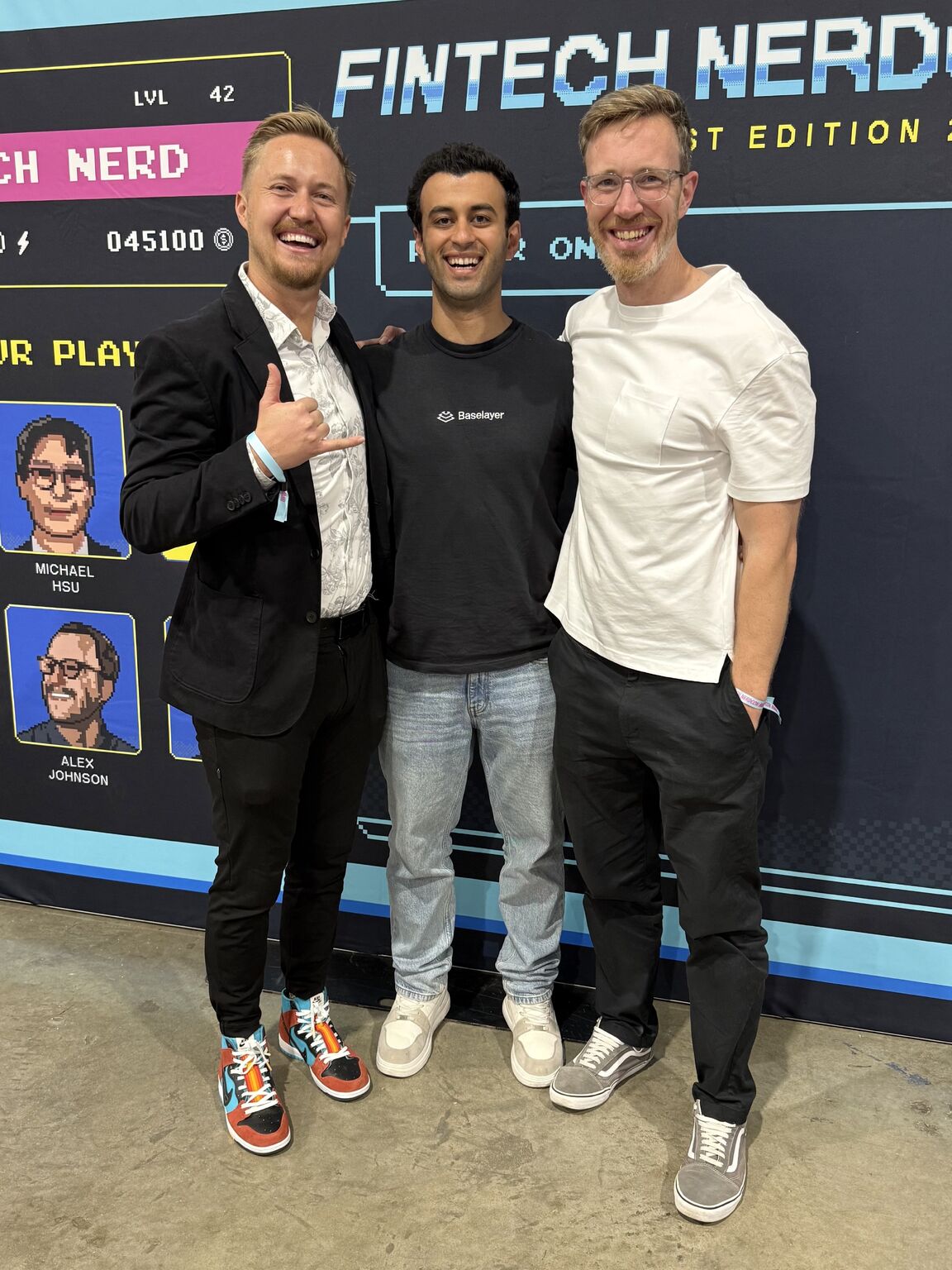
Awad’s personal site lists psychology, anthropology and socioeconomic class among the subjects that occupy him. It also says he enjoys angel investing, career coaching, basketball and “collecting interesting people.” The last phrase is revealing. Baselayer sells software, but Awad thinks about distribution as a web of human obligations.
In his newsletter, Disarm and Charm, conferences become both field research and commercial theater. His vocabulary includes “network nodes,” “earned favors,” “halo building” and “manifesting serendipity.” The terms risk sounding like a management consultant has discovered friendship. The underlying practice is warmer: introduce useful people, host gatherings they actually want to attend, plan enough to look competent and leave enough space for luck.
For one Baselayer and Fundbox event, Awad reported roughly 650 signups, 420 confirmations and 280 attendees. He recommends intimate lunches as well as larger gatherings, thoughtful seating and introductions made without immediate expectation of return. He also admits that he once avoided panels, podcasts and stages because the company seemed too early. He later called that a major mistake. In a market where buyers are asked to trust a young vendor with fraud decisions, visibility is not glitter. It is evidence of continued existence.
He brings similar skepticism to artificial intelligence. In a 2024 conversation about fraud, Awad argued that customers care less about the tool than whether their problem gets solved. The mechanic’s wrench is rarely the reason a driver returns. AI can accelerate research across public records, websites and private data, but the pitch must end with a better decision, not a fashionable noun.
The fraud problem is particularly sharp in business lending. Commercial accounts can be large, while many identity defenses were designed around consumers. Synthetic applicants assemble plausible companies from fragments, then seek credit across institutions. Awad has argued that a single fraudulent account may require the returns from three or four good ones to cover the loss. Prevention, in that arithmetic, is not merely compliance overhead. It is revenue protected before anyone applauds it.
The Awad test: technology earns attention only when it improves the decision. In his telling, customers and investors want results, a credible team and proof that the system works outside the slide deck.
When the stranger is software
In September 2026, Baselayer announced a $35 million Series A led by M13, with Torch Capital, Picus Ventures, Afore Capital and Socure’s Matt Thompson participating. The money arrived beside a broader claim: the next unfamiliar applicant may have no face at all. The company launched an Agentic Identity Suite intended to establish which AI agent is present, whom it represents and what it is permitted to do.
The extension is less of a pivot than it appears. Financial systems were built to recognize people and registered businesses. Autonomous software may open accounts, make purchases or move money on their behalf. An institution needs to connect the software to a principal and an authorization. A trustworthy business represented by an unauthorized agent is still a bad transaction.
Baselayer reported that its platform served more than 2,300 financial institutions and payments companies at the time of the round, and that customers had prevented more than $1 billion in fraud losses. Those are company figures, not a peek into every customer ledger, but they explain the ambition. A useful identity network becomes more informative as more institutions contribute signals. The first customers bought a product; the later ones encounter accumulated memory.
Awad’s story is often told in the clipped language of venture milestones: seed, revenue, customer count, Series A. The better thread is about records. His parents arrived without one. His first company left him with one he was willing to judge harshly. Baselayer gathers many of them and tries to turn scattered evidence into a fairer, faster answer.
Every trust system also decides who is delayed, doubted or excluded. That makes the work less glamorous than the phrase “agentic commerce,” and more consequential. Awad’s task is to build machinery suspicious enough to catch the invented business, but curious enough to recognize the real one nobody has heard of yet. The future may arrive as software. It will still have to introduce itself.