The useful thing about a light bulb is that it makes a room less mysterious. The inconvenient thing about buying one is everything that happens before the switch: wattage, base, beam angle, color temperature, ingress rating, dimmer compatibility, stock and the small matter of whether it will arrive before an electrician starts charging for a second visit. Grupo efectoLED built a European company by organizing that confusion. From a base in the Valencian town of L'Alqueria de la Comtessa, it put an enormous lighting counter online, localized it country by country and placed logistics behind the screen.
The company says it holds more than 20,000 technical and decorative references in stock. Its range runs from bulbs, tubes and LED strips to industrial high-bay lights, street lighting, pool fixtures, solar products, controls, switches, decorative pendants and electric-vehicle chargers. This is not a precious design boutique. It is closer to a searchable lighting district, with products for a bedroom on one aisle and a warehouse on the next.
It sold certainty, not LEDs
Grupo efectoLED began in 2013, when LED adoption was turning a once-sleepy replacement category into a technical migration. Its corporate history describes young entrepreneurs combining industrial-engineering and computing experience. The expansion sequence came quickly: Spain first; Portugal and France in 2014; Italy and Germany in 2015; the United Kingdom and Poland in 2016; the Netherlands in 2018; Belgium, Ireland, Austria and Switzerland in 2021; and the Czech Republic in 2023.
That sequence is the business in miniature. A lighting catalogue can travel, but only if the retailer does the unphotogenic work: language, merchandising, search, payments, customer service, returns and inventory placement. The group now describes five logistics platforms with more than 25,000 square metres of space. In 2018, private-equity firm Miura Partners invested an undisclosed amount to accelerate the international plan. At the time, Miura said the group employed more than 220 people, served more than 500,000 professional and consumer customers and expected about €60 million in annual turnover.
The deeper advantage was not being early to a diode. LEDs became widely available and competitors multiplied. The advantage was making a technical purchase feel low-risk. efectoLED advertises rapid delivery, customer support and product guarantees subject to conditions. Its home page points to European certifications including CE, RoHS and TUV across relevant products. It also offers customized lighting projects rather than leaving buyers alone with filters and specifications.
A catalogue becomes a moat only when the stock is real, the answer is useful and the wrong choice is easy to undo.The efectoLED operating thesis, in plain English
One cart, two very different buyers
The clever part of the model is that the same infrastructure serves two economies. A household may want one warm pendant for a dining table. An installer may need 80 panels, photometric confidence and a predictable return policy. The consumer brings reach and frequent search demand. The professional brings repeat orders, higher baskets and project complexity. Grupo efectoLED can sell to both without pretending they behave alike.
Its PRO CLUB makes that segmentation explicit. Entry is free for companies and self-employed professionals. Published tiers run from Silver through Gold and Platinum to Diamond. Benefits can include discounts, longer return periods, financing subject to approval, technical material, personalized products and DIALux lighting studies. The top tier requires at least three annual orders and more than €12,000 of yearly purchases. It can receive project-study targets as short as two business days, provided the brief is complete and complexity allows it.
This is where the company differs from a marketplace. A marketplace can present endless choice, but responsibility is scattered among sellers. A brand can offer expertise, but only inside its own range. A home-improvement chain can offer proximity, but its lighting depth competes with paint, timber and garden furniture. efectoLED sits between them: specialist breadth, direct commerce, recognizable third-party brands and an in-house service layer. Its alternatives include lighting specialists such as Lampenwelt and Any-Lamp, other Spanish online sellers, electrical distributors and broad chains such as Leroy Merlin.
The browser met its match
Then came the most revealing change. In October 2024, after 11 years of online expansion, efectoLED opened its first physical shop for professionals in Catarroja, near Valencia. The store includes technical and decorative displays, an ordering area, immediate collection, returns and personalized project advice. CEO Francisco Mas called it a prospective center of excellence and best practice for professional lighting.
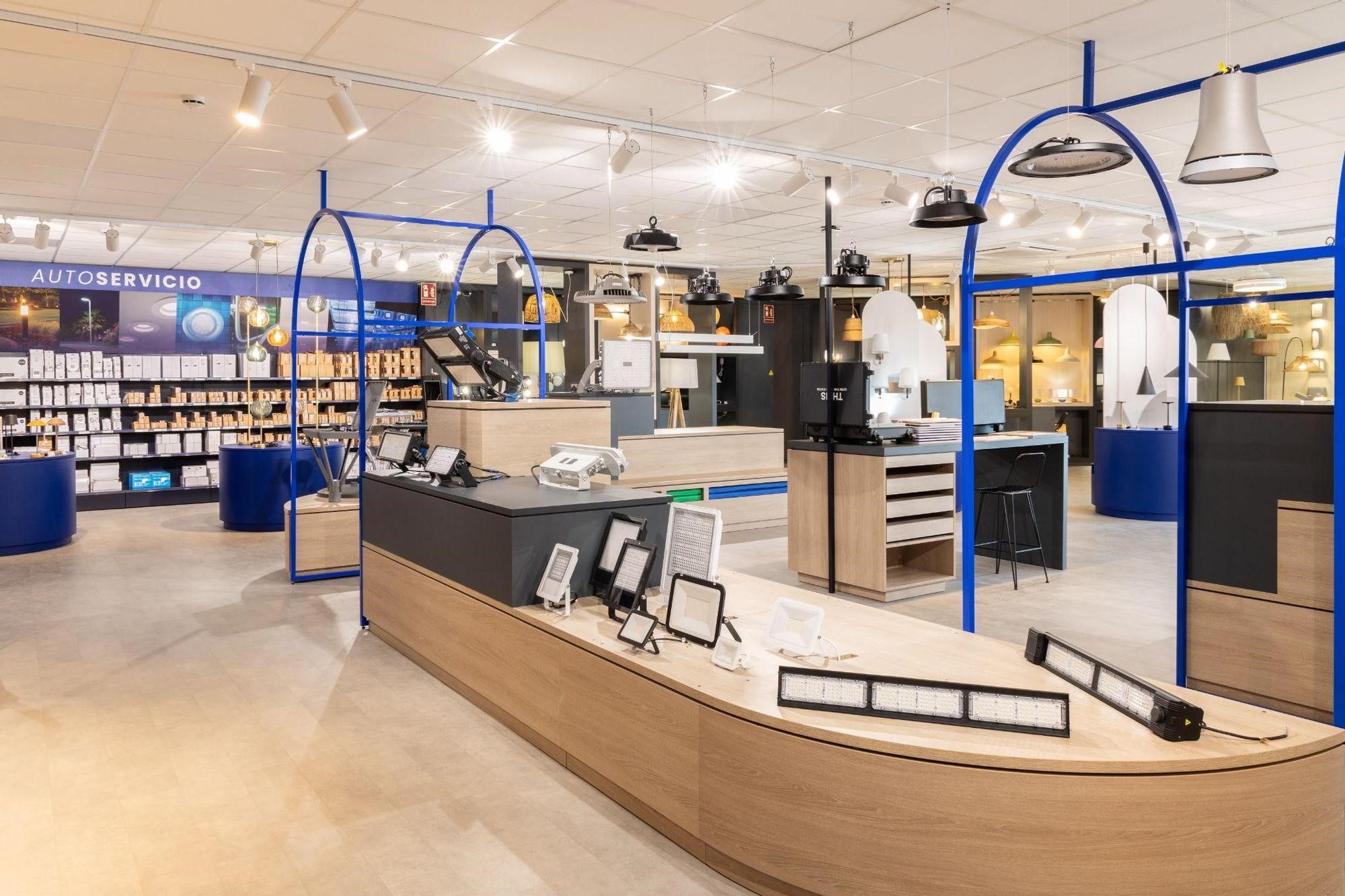
The company has not publicly framed this as an online failure, and it would be silly to do so. The website remains the distribution engine. But the store shows what failed first at the edge of a pure digital model: not checkout, but confidence. Professionals work against deadlines. They need to see how a fixture throws light, hand back the wrong component, collect a replacement now or explain a plan to someone who knows DIALux. A screen can document those jobs. A nearby counter can finish them.
What changed the company's mind? The action supplies a careful answer: more than 6,000 recurring professional customers in Spain created enough concentrated demand to justify a place designed around their unfinished tasks. The store's format suggests a practical response to customer behavior rather than a philosophical conversion to bricks and mortar. The physical location is best understood as a logistics edge, advice desk and customer-research lab wearing a retailer's clothes.
Do not open a shop to repeat your website. Open one to perform the jobs the website cannot finish.
Buying growth instead of translating it
International expansion also became less purely digital. In 2021, efectoLED acquired British online lighting retailer Lyco Group for an undisclosed price. Lyco brought an established UK position and additional decorative and offline channels. The transaction marked a shift from launching another localized storefront to buying customers, knowledge and operating infrastructure already in market. The price was not made public, so any neat calculation of payback would be theater.
The acquisition also exposes the conditions behind this playbook. Localization works when products can share a supply chain, regulations are navigable, gross margin can absorb delivery and returns, and search behavior repeats across borders. Acquisition works when the target adds market access or capability that would take longer to build. Neither works merely because a homepage can be translated. Bulky inventory, fragile fixtures, local electrical rules and expensive reverse logistics can turn apparent geographic reach into working-capital indigestion.
What a reader can actually copy
First, choose a category where selection is painful and availability matters. The winning promise is not infinite choice; it is enough relevant choice that can ship. Second, segment the occasional buyer from the working professional without building two companies. Shared inventory can support distinct pricing, service levels and messaging. Third, turn expertise into a product. A project study, reliable specification sheet or fast human answer can defend margin better than louder advertising. Fourth, use content after the sale as well as before it. efectoLED's blog publishes installation and troubleshooting material, the sort of information people search when a strip flickers or a floodlight refuses to wake up.
Copy it when
- The category has technical choice and repeat professional demand.
- Inventory accuracy and delivery speed are controllable.
- Advice can reduce costly mistakes and returns.
- Several countries share products and buying behavior.
Skip it when
- Every market needs a different product or certification stack.
- Shipping and reverse logistics erase the margin.
- Demand is too sparse for deep stocked assortment.
- A physical site only duplicates online browsing.
The company is still exposed to the ordinary pressures of retail: price comparison, private-label quality, inventory bets, customer acquisition costs and the fact that efficient products last longer and therefore need replacing less often. Its sustainability case also deserves precision. LEDs can reduce electricity use relative to older lighting technologies, but a distributor's environmental impact includes manufacturing, packaging, freight and disposal. Selling efficiency is useful. It is not the same as proving a complete footprint.
What Grupo efectoLED has built is less romantic and more durable than a lighting brand story. It is a coordination machine for a category full of small decisions. The five logistics platforms, localized shops, support agents, professional tiers and first physical counter all do the same job: shorten the distance between “I need light” and “this is the correct fixture, here, now.” The lamp is what arrives in the box. Certainty is what the customer was shopping for.