At GLAMCOR’s first makeup show, the cosmetics might as well have been tablecloth. Visitors kept pointing at the portable lamp. They wanted to know where they could buy it, how it folded and whether it could rescue them from the dim hotel rooms, backstage corners and borrowed chairs where professional makeup actually happens. Founder Erik Kaiser had spent a year developing a bundle of cosmetics and lighting. The crowd edited his strategy in an afternoon.
Kaiser’s recollection is wonderfully blunt: “At our first makeup show, no one cared about the cosmetics, they just wanted the light.” GLAMCOR dropped the decorative half of the idea and became a lighting company. Fifteen years later, the New York business sells portable LED systems, lighted mirrors, magnifying lamps, device mounts and studio accessories to professionals and consumers in 85 countries. The catalog serves makeup artists, lash technicians, estheticians, tattooists, photographers, performers and creators. It is less a collection of lamps than a kit for making lousy rooms behave.
The recession supplied the shove
This was not Kaiser’s first company. He lost a construction business in 2009, when the recession punished work tied to one local market. Looking for something global, he noticed an unglamorous gap: beauty professionals lacked standardized lighting that was bright, durable and easy to carry. On January 1, 2010, he moved to China with limited knowledge of the LED supply chain. He lived in inexpensive hotels, met Wanchen Kaiser, who would become his wife and GLAMCOR’s co-owner, and spent roughly $200,000 of his savings while earning no income.
The first products arrived in February 2011. That year and that budget answer the question founders tend to sand smooth later: what did it cost? It cost a previous livelihood, a transcontinental move, about twelve months and six figures of personal money before the market offered a useful verdict. The first verdict was not “yes” to the plan. It was “keep this one component.”

“At our first makeup show, no one cared about the cosmetics, they just wanted the light.”Erik A. Kaiser, founder and CEO
The customer-led product map
What failed first was growth
A clean pivot did not produce a clean ascent. Around the two-year mark, GLAMCOR had no growth and not enough cash to finish building its office. Kaiser sat in the factory wondering whether he had exaggerated the market’s pain. That is the less photogenic part of product-market fit: customers may like a product without creating a company fast enough to save it.
Then a woman in the United Kingdom began carrying an early GLAMCOR light to lash-extension training. Kaiser knew little about the lash industry. Her students knew exactly why the product mattered. A technician attaching individual extensions needs a bright, stable view of tiny work for hours, often while leaning over a client. The educator did not pitch a generic lamp; she demonstrated a professional advantage in the room where it counted. Orders rose over the next six months.
What changed GLAMCOR’s mind was use in public. First, trade-show behavior removed cosmetics. Then an educator’s workflow added lashes. Later, people bought the lights for YouTube videos, pushing the company toward content-creation kits. This is not mystical founder intuition. It is patient observation of who borrows a tool and what job they recruit it to do.
The job behind the lamp / editorial assessment
A portable studio, sold piece by piece
GLAMCOR’s professional line revolves around adjustable LED light on foldable arms and stands. ELITE X and REVOLUTION X kits handle general beauty work. HORIZON reaches over treatment beds. SATURN adds magnification for close detail. GALILEO folds an 18-inch ring light into a travel case. MULTIMEDIA X places a phone, tablet or camera between two lights, with adjustable brightness and color temperature, Bluetooth capture control and a family of clips, mirrors and bases.
Those accessories are more consequential than they look. A clear rolling base slides beneath a treatment bed. A phone arm lets an esthetician record without holding a device over a client. A mirror converts the lighting rig into a makeup station. Compatibility turns one purchase into a system, while replacement parts and repair promises reduce the fear that a broken hinge will retire an expensive tool.
The consumer side lives under RIKI LOVES RIKI, a separate brand owned by GLAMCOR GLOBAL LLC. Its portable lighted mirrors translate the same LED and mirror expertise for a buyer applying makeup at home or on the road. In 2018, Kaiser called RIKI SKINNY the best-selling product across both brands and described its then-price of $195 as customer-led: ask buyers what they will pay, then engineer toward that value. The professional brand supplies authority; the consumer brand supplies a much larger addressable audience.
Where the business earns its difference
GLAMCOR is a privately held manufacturer with no disclosed institutional funding, valuation or revenue. Its model combines direct ecommerce, retailer sales and international distribution. By 2018, Kaiser said the United States produced about a quarter of revenue, supported by a California distribution center and a direct website that protected margin and made limited tests possible. Today the company operates a Shopify storefront and says verified distributors carry its products across 85 countries.
Mass-market ring lights
Cheap and abundant. They solve basic illumination, but often compete on diameter and price rather than repairability or a professional workflow.
Creator lighting
Brands such as Elgato, Godox, Neewer, Nanlite and Westcott bring strong photo-video pedigrees, often with broader studio ecosystems.
Salon task lights
Specialist lamps from companies such as The Daylight Company compete directly for close-detail beauty and craft work.
Beauty mirrors
Simplehuman, Fancii and Impressions Vanity meet the consumer at the mirror, where design and convenience matter as much as output.
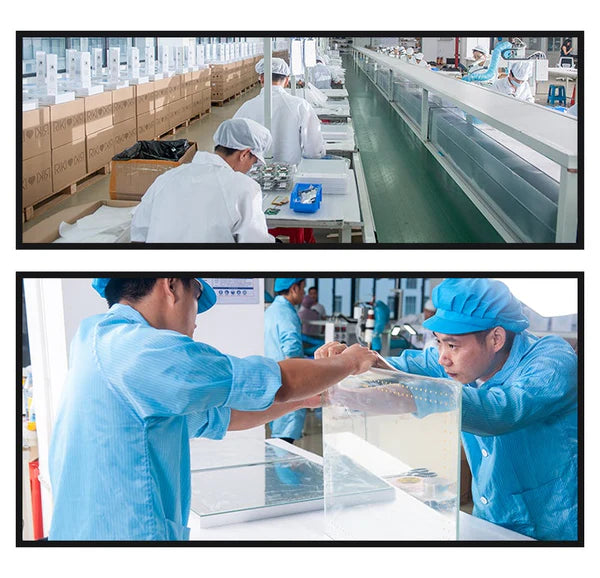
GLAMCOR’s distinction is the combination: beauty-specific ergonomics, portable hardware, integrated capture tools, a deep accessory catalog and manufacturing control. The company says it owns and operates a facility in Shenzhen and tests products before shipment. That control makes sense when quality is physical. Color rendering affects skin tone; a weak joint droops toward a client; a bulky base steals legroom; an unavailable part turns a repairable tool into waste.
Service is part of that hardware argument. GLAMCOR advertises a one-year warranty covering defects, function, parts, shipping and service on core products, with continued help after the first year when parts remain available. Its public support address, almost comically, is realperson@glamcor.com. The name is cute; the operational promise is serious. A freelance artist may have clients booked the morning after a lamp fails. Fast diagnosis, a replacement component or a swap can matter more than another setting on the control panel. For a tool used to earn money, the product is the light plus the probability that somebody answers.
It also adds risk. Factories create fixed costs, inventory exposure and operational complexity. Wanchen Kaiser’s role has included day-to-day factory operations, HR, compliance, labor policy and brand collaboration. The glossy mirror is the visible inch of a business that must coordinate electronics, plastics, freight, distributors and customer support across time zones.
What a reader can copy
Steal the observation loop, not the factory
- Bring the unfinished bundle into a place where real work happens. Watch which component attracts questions without prompting.
- Recruit educators whose credibility comes from doing the job. A demonstrated tool travels farther than a broad claim.
- Track adjacent users who improvise with the product. Their workaround may describe the next accessory or market.
- Build a compatible system only after repeat behavior appears. Clips and stands are valuable when they remove observed friction.
- Separate professional and consumer positioning when the technical core overlaps but the buying language does not.
This playbook is not universal. It works best when professionals face a frequent, visible problem; the product materially improves paid work; users gather in teachable communities; and hardware can be adapted across neighboring jobs. It is weaker when purchase frequency is too low to support accessories, when cheaper general-purpose equipment is genuinely good enough, or when owning production locks the company into inventory before demand is legible.
Nor should every founder mistake a curious crowd for a market. GLAMCOR’s first signal mattered because professionals later paid, carried the product into classrooms and recommended it. The lash breakthrough paired attention with repeatable economic value. If the light merely looked good on a trade-show table, the company would have owned an expensive conversation piece.
The feature stealing attention may be the company hiding inside your product.The GLAMCOR lesson
The company now names products GALILEO, SATURN, PHOTON, HORIZON and COSMIC TWINS, a miniature solar system of working lights. The poetry is amusing; the commercial idea is practical. GLAMCOR does not sell daylight. It sells a controllable patch of it, folded into a case, rolled under a bed or clipped around a phone. Its origin is a reminder that customers rarely deliver strategy in a memo. Sometimes they simply ignore half your booth.