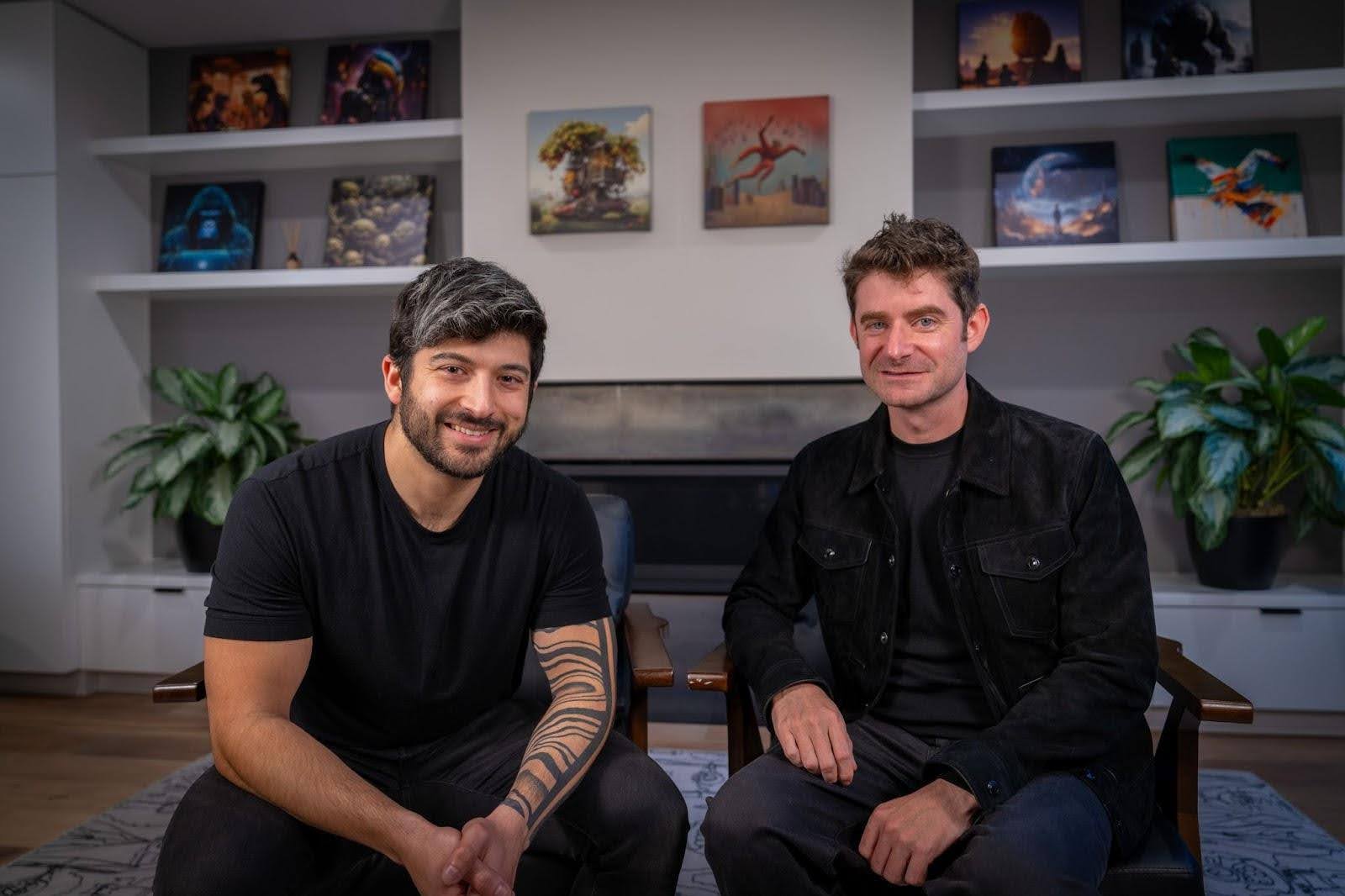
He taught printers to spin continuous carbon fiber. Now he is teaching AI to think in three dimensions - so anyone can make a real object by simply describing it.
Greg Mark (right) with co-founder and CTO David Benhaim. Two Markforged veterans, one new obsession: closing the gap between imagination and a printed part.
On December 19, 2024, Backflip AI shipped its first product, and the pitch was almost rude in its simplicity. Type a sentence. Sketch a shape. Drop in a photo. One click later, an AI hands back a 3D model you can actually print - in plastic, in carbon fiber, in metal. It behaves a bit like Midjourney, except the output is not a pretty picture. It is a part.
Gregory Mark runs the company. His day job title is Founder and CEO, but the more useful description is the one he keeps circling back to in interviews: he wants to remove the last thing standing between a person's idea and a manufactured object. For most of history, that last thing was skill - years of it, hunched over CAD software. Backflip's bet is that the skill can move into the model.
The company is small and pointed - roughly a dozen people, headquartered on Howard Street in San Francisco with roots in Boston. What it lacks in headcount it makes up in pedigree. The $30 million Series A was co-led by NEA and Andreessen Horowitz. The angel round reads like a who's who of people who build the future for a living: Microsoft CTO Kevin Scott, Android founder Rich Miner, and Ashish Vaswani, a co-author of "Attention Is All You Need," the paper that lit the fuse on the entire generative-AI era.
Backflip's edge is not marketing. It is architecture. The team built what CTO David Benhaim calls a novel neural representation that teaches AI to think in 3D - claiming training that is 60x more efficient, inference 10x faster, and spatial resolution 100x sharper than the tools built for animation and games. The difference matters, because a movie prop only has to look right. A bracket has to bolt on.
1. Describe your design with text, a drawing, or an image.
2. The AI converts the prompt into a 3D model - one click.
3. Print it in metal, carbon fiber, or plastic.
I want to live in the future.- Gregory Mark, on why he started Backflip
Long before neural networks, there was a Ferrari and a problem. Mark's first company, Aeromotions, made computer-controlled composite wings for race cars. The engineering brief was brutal in its precision: build a wing that weighs 12.5 pounds, that holds together at 200 miles per hour, mounted on the back of a Ferrari, on a track that might be 115 degrees Fahrenheit. Get any variable wrong and the physics stops being theoretical.
That is the throughline. Mark is an MIT aero/astro engineer - class of 2003, bachelor's and master's - who cut his teeth on the university's Formula SAE team building lightweight cars. He started and sold two companies before he was widely known. Composites, aerodynamics, power electronics for solar: different domains, same instinct for making strong things lighter and lighter things stronger.
In 2013 he founded Markforged, and he did it by calling his old Formula SAE teammates. The company introduced the first process to 3D print continuous carbon fiber - real structural reinforcement, not decorative infill - and later brought metal 3D printing down to a price ordinary shops could stomach. Markforged parts ended up in serious places: prototypes for the U.S. Marines, hardware for the International Space Station, production work touching names like BMW and Tesla.
Mark led Markforged as CEO until 2020, moved to chairman as a new CEO stepped in, and the company went public through a SPAC merger in 2021 at a peak valuation around $2.1 billion. He left the company and its board late that year. Then he did something founders rarely admit to. He stopped.
Race car wings. Carbon-fiber and metal printers. Now generative AI for physical parts. Three companies, one question: what if making things were as easy as imagining them?
After Markforged, Mark stepped away from the industry entirely. He took time. He learned to fly airplanes. For a person whose whole life had been about building the next thing, the interesting part is the gap - the deliberate empty space before the next obsession arrived.
It arrived anyway. The pull to build came back, and this time the raw material was not carbon fiber but attention layers and 3D neural representations. The world, Mark likes to note, is inherently three-dimensional. Most AI had learned to draw it flat. He wanted a model that understood volume, geometry, the stubborn constraints of things that have to exist.
Backflip is deliberately built for three kinds of people at once: the complete novice who has never opened CAD, the veteran engineer who wants to skip the tedium and move faster, and the manufacturing worker who knows machines cold but was never trained on the software. Mark talks about junior engineers learning with AI at their side, and about factory-floor workers whose creativity finally has an on-ramp.
The novice - who never learned CAD.
The engineer - who wants hours back.
The maker - mechanical knowledge, no software training.
That last barrier? We took it away.- Gregory Mark, on removing the need to know CAD
The first process to 3D print continuous carbon fiber composites - structural reinforcement, not just plastic that looks the part.
Grew Markforged from a 2013 idea to a public company at a peak valuation near $2.1 billion.
Markforged parts used on the ISS, by the U.S. Marines, and in production touching BMW and Tesla.
Backflip's $30M Series A co-led by two top-tier firms, with angels from the Transformer paper to Microsoft's CTO.
Started and sold two companies before Markforged. Backflip makes three, plus a couple of earlier ventures.
A neural representation built for physical manufacturing, not animation - the difference between looking right and bolting on.
Greg Mark on the "Being an Engineer" podcast - the full origin story, from race wings to AI.
PodcastA long-form conversation on inventing continuous carbon fiber printing and starting over.
Try itSee the text-to-3D tool that turns a sentence into something you can hold.