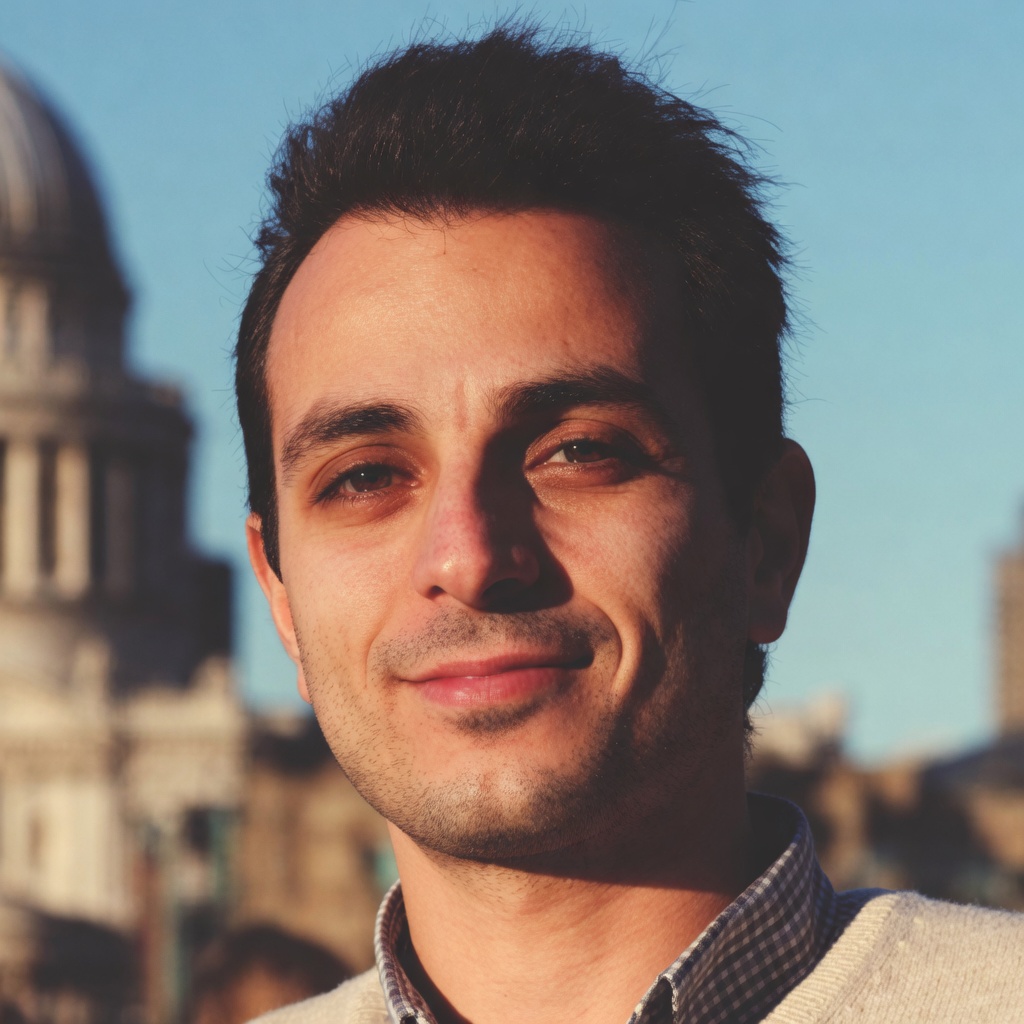
Profile
The Physicist Who Builds Data Pipelines for the AI Age
Most people who help build the world's AI infrastructure started with computer science. Hovhannes Kuloghlyan started with the cosmos. His PhD from Yerevan Physics Institute examined cosmology and quantum physics - the kind of work that involves staring at equations that describe the behavior of the universe at scales humans can't perceive. That training turned out to be unexpectedly good preparation for what he does now: building systems that operate at scales most people can't perceive, processing datasets that power the world's most advanced AI models.
Kuloghlyan co-founded Wirestock in March 2019 alongside Mikayel Khachatryan, Ashot Mnatsakanyan, and Vladimir Khoetsyan. The original pitch was practical: photographers, videographers, and illustrators spent hours uploading the same images to dozens of stock platforms. Wirestock would handle the distribution. Upload once, appear everywhere.
What started as a distribution utility became something considerably more consequential. When AI companies began systematically consuming visual content to train foundation models, Wirestock was already sitting on something rare: a platform with direct relationships to hundreds of thousands of creators who understood licensing, who knew their work had value, and who were willing to engage ethically with how it was used.
"The future of AI will always rely on human creativity - our platform connects the two in a way that is transparent and fair."- Wirestock founding team, About page
From Consulting to Cosmos to Code
Before Wirestock, Kuloghlyan's career moved through an unusually varied set of environments. He founded his first company - Im Card Hamakarg - in 2008, before most of his current competitors had discovered the internet. From there, he became CTO at Geno6, then co-founded The Drop (Katil), a venture that honed his technical leadership across backend and frontend systems.
The most formative pre-Wirestock chapter may have been his work with Ripple. What began as an independent contractor role evolved into a full collaboration between Kuloghlyan's Yerevan-based software firm Grōksmith (then operating as Hex Division) and the Ripple network - connecting multinational bank infrastructure directly to the XRP Ledger. Building payment rails for international banking, at a time when crypto was still considered speculative, required the same kind of thinking Wirestock demands: systems design for environments where trust, verification, and data integrity are non-negotiable.
Grōksmith, which Kuloghlyan chairs today, grew into a global software operation whose client list includes PwC, the Ethereum Foundation, UEFA, and Dubai Electricity and Water Authority. The range speaks to something about Kuloghlyan's approach: he gravitates toward clients operating at institutional scale, where the stakes of getting infrastructure right are genuinely high.
The Pivot That Changed Everything
In 2023, Wirestock made a decision that looked obvious in retrospect and required genuine nerve in the moment. The company pivoted from stock photography distribution - a market with well-established competitors and thin margins - to AI multimodal training data. The bet was simple but large: AI labs need premium, ethically sourced visual content, and they cannot get it from web scraping. They need a platform with real creator relationships, consent infrastructure, and quality control pipelines. Wirestock had built all of that already.
The numbers since the pivot suggest the bet was correct. Creator payouts grew 20 times year-over-year. Annual revenue run rate crossed $40 million. Wirestock now works with six of the world's largest foundation model makers - names the company keeps confidential, which itself signals how competitive access to quality training data has become. The platform's curation process layers human expert review with AI-assisted moderation to produce datasets with the tight image-text alignment and dense semantic annotations that vision-language model training demands.
The May 2026 Series A - $23 million led by Nava Ventures, with participation from Sheryl Sandberg's SBVP, Formula VC, and I2BF Global Ventures - validates the thesis. Nava Ventures founder Freddie Martignetti noted Wirestock's "deep understanding of what foundational models and hyperscalers need in terms of multimodal data." That understanding didn't come from a pivot deck. It came from years of managing creator relationships at scale.
"All major AI players are quickly shifting to using ethically licensed content - partly due to legal pressures but also because it's a practical solution for companies needing reliable data."- Mikayel Khachatryan, CEO of Wirestock
Operations at the Intersection of Ethics and Scale
Kuloghlyan's role as Head of Operations at Wirestock puts him at the hardest part of the platform to get right: the human infrastructure. With 700,000+ creators across the globe contributing images, video, 3D models, design work, and spatial data, the challenge is not just technical. It is organizational - maintaining quality standards, consent frameworks, metadata pipelines, and creator payout systems at a scale most platforms never reach.
His background in consulting, blockchain infrastructure, and physics research turns out to be an unexpectedly coherent preparation for this. Consulting teaches you that clients at institutional scale have zero tolerance for ambiguity in contracts and deliverables. Blockchain teaches you that trust must be encoded into systems, not assumed. Physics teaches you that the universe does not cooperate with approximations when precision matters.
Wirestock's data pipeline reflects all three. Every asset is sourced, curated, and structured specifically for machine learning - not repurposed from a general stock library. Creators understand how their work will be used and are compensated when it is. The curation layer is designed to produce datasets with high signal-to-noise ratios, not just volume.
Thinking Out Loud: Ideas, No-Code, and Science Fiction
Kuloghlyan's EVN Disrupt podcast appearance in June 2024 revealed a thinker who ranges broadly. He discussed the growing importance of niche solutions over broad-market approaches in AI product development - a counterintuitive stance for someone building a platform that claims global scale, but consistent with Wirestock's focus on serving specific technical needs for specific clients rather than being everything to everyone.
He spoke about no-code platforms disrupting SaaS businesses, a trend his Grōksmith background positioned him to observe from both sides. And he cited science fiction as an underused tool for imagining future possibilities - a habit of mind that tracks with a career built on building infrastructure for categories that did not yet exist when he started working in them.
His Instagram, which documents travels from Amsterdam to Egypt to Goa to Norway, reflects a person in constant motion who maintains a distinct eye. (There is also a dedicated story highlight for his cats, which is the kind of detail that tells you something useful about someone.) His handle across platforms is @h0vhannes - the 'o' replaced by a zero - a small quirk consistent across LinkedIn, Twitter, GitHub, and Instagram. You notice it once and immediately understand that he set up these accounts before the handles were taken, which means he was paying attention before most people knew to.
What Comes Next
With $23 million in fresh capital and a platform that now serves the top tier of the AI industry, Wirestock's next phase focuses on expanding dataset capabilities across more modalities - images, video, 3D models, design, film, and music - while scaling the creator tools and annotation infrastructure that makes each asset genuinely useful for model training.
For Kuloghlyan, the aspiration appears to be something larger than a data business. Wirestock's stated mission positions the platform as the definitive infrastructure layer where creative data is born - not scraped, not synthesized, but created intentionally by humans who understand the value of what they are producing and are compensated fairly for it. In an AI landscape increasingly contested over questions of consent, copyright, and creator rights, that positioning is both ethical and strategic.
A physicist who built blockchain rails, then built creator infrastructure, now operating at the edge of where AI meets human creative output. The through line is infrastructure - systems that work at scale, built on the assumption that getting the foundational layer right is the only thing that matters.