A robot that sweeps a parking lot has an awkward relationship with applause. It can perform beautifully for a demonstration, collect its compliments and still leave a water bottle beside the curb. The bottle remains. Someone has to pick it up. Gregg Ratanaphanyarat has built much of his working life around closing that gap between a machine doing something impressive and a customer getting a job done.
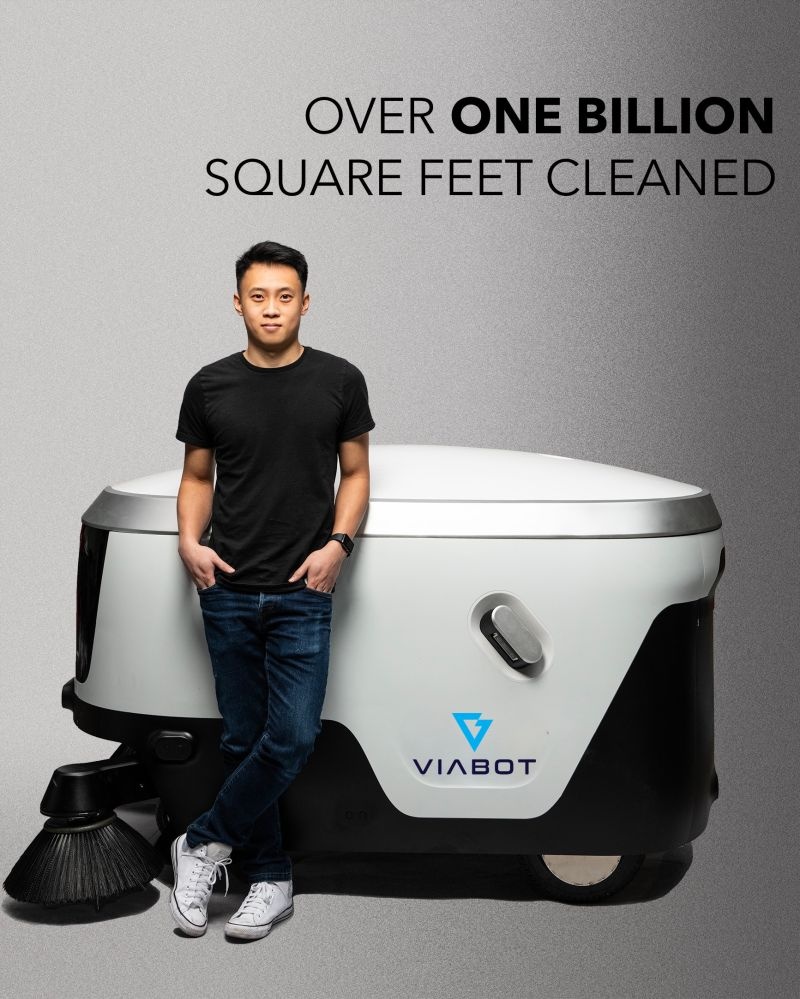
He is the co-founder and CEO of Viabot, the California company whose outdoor robots sweep commercial properties. In September 2026, the company said its fleet serviced 25 million square feet. That is a substantial amount of ground on which to be judged by the morning’s leftovers. A property manager can admire the technology, but an unswept corner has a way of bringing the conversation back to earth.
Ratanaphanyarat’s career has taken him from school robotics to college prototypes, hardware acceleration and enterprise customers. Along the way, the question has become more exacting. Building a machine is one accomplishment. Arranging for it to work, return, empty itself and work again requires a business willing to take responsibility for the whole routine.
Pennsylvania supplied the chores
At Penn State, Ratanaphanyarat noticed how the outdoor work kept changing with the calendar: grass, leaves, snow. He met his future co-founder, Dawei Ding, also known as Andre, and began developing a modular robot. The seasons offered a practical argument for a machine that could switch tasks. There was always another chore coming along.
His interest in machines already had a history. He had led the Gunn Robotics Team in Palo Alto before attending Penn State. His LinkedIn record lists engineering and design awards from school competition years, including the team’s 2012 Chesapeake regional win. Those competitions provided something unusually useful for a future founder: a deadline, a physical object and a public test of whether the object actually worked.
He studied computer engineering at Penn State and later left without graduating. The project continued. Viabot’s own founding account dates the company to 2016. A college idea had acquired the obligations that follow a company name: customers, a product to deliver and decisions about which problems deserved the next stretch of engineering time.
The machine that could change its job
Modularity runs through Ratanaphanyarat’s patent record. He and Ding are named on the autonomous modular robot patent granted in January 2019. Later grants address a modular sweeper, programming work zones and conveyor stations for emptying debris. Read together, those titles describe an engineering agenda that extends beyond making a robot move.
Movement gets the machine to the task. Attachments let it perform the task. Zoning tells it where work belongs. Emptying lets it continue after collecting something. Each is a fairly plain requirement when described in words. Each becomes a separate design problem once a machine has to carry it out repeatedly.
That makes the patent trail a revealing companion to the founder’s biography. It records attention paid to the joins between activities. A sweeper that cannot unload will eventually become a small, expensive container. A mobile platform that can accept different tools has more possible uses, but the connections have to work outside a drawing.
RUNO, the early robot, took its name from “robot one.” By Viabot’s public launch in May 2021, the company had disclosed $6.1 million in funding and a partnership with Cushman & Wakefield, which had deployed the robots at Bay Area properties. Sweeping gave the modular idea a specific place to prove itself.
The business around the brushes
Ratanaphanyarat has been candid about the business education that accompanied the hardware. He recalled an early pitch to friends that ran for roughly half an hour, concentrated on the technology and raised no money. Some future colleagues did come out of it. Even a commercially unsuccessful presentation can have a useful afterlife.
By 2020, his explanation of the company had become more compact: “It’s really about automating a service.” The statement gives the robot a different set of obligations. A customer buying sweeping needs the work completed with a tolerable amount of effort. The shape of the machine matters within that larger promise.
“It’s really about automating a service.”
Gregg Ratanaphanyarat, 2020
The model now presented by Viabot includes monitoring, maintenance, repairs, parts and consumables. Brushes wear out; someone remains responsible for replacing them. Including those responsibilities in the offer makes the company answerable for more than the machine’s initial arrival. It also gives the customer a clearer way to think about what is being purchased.
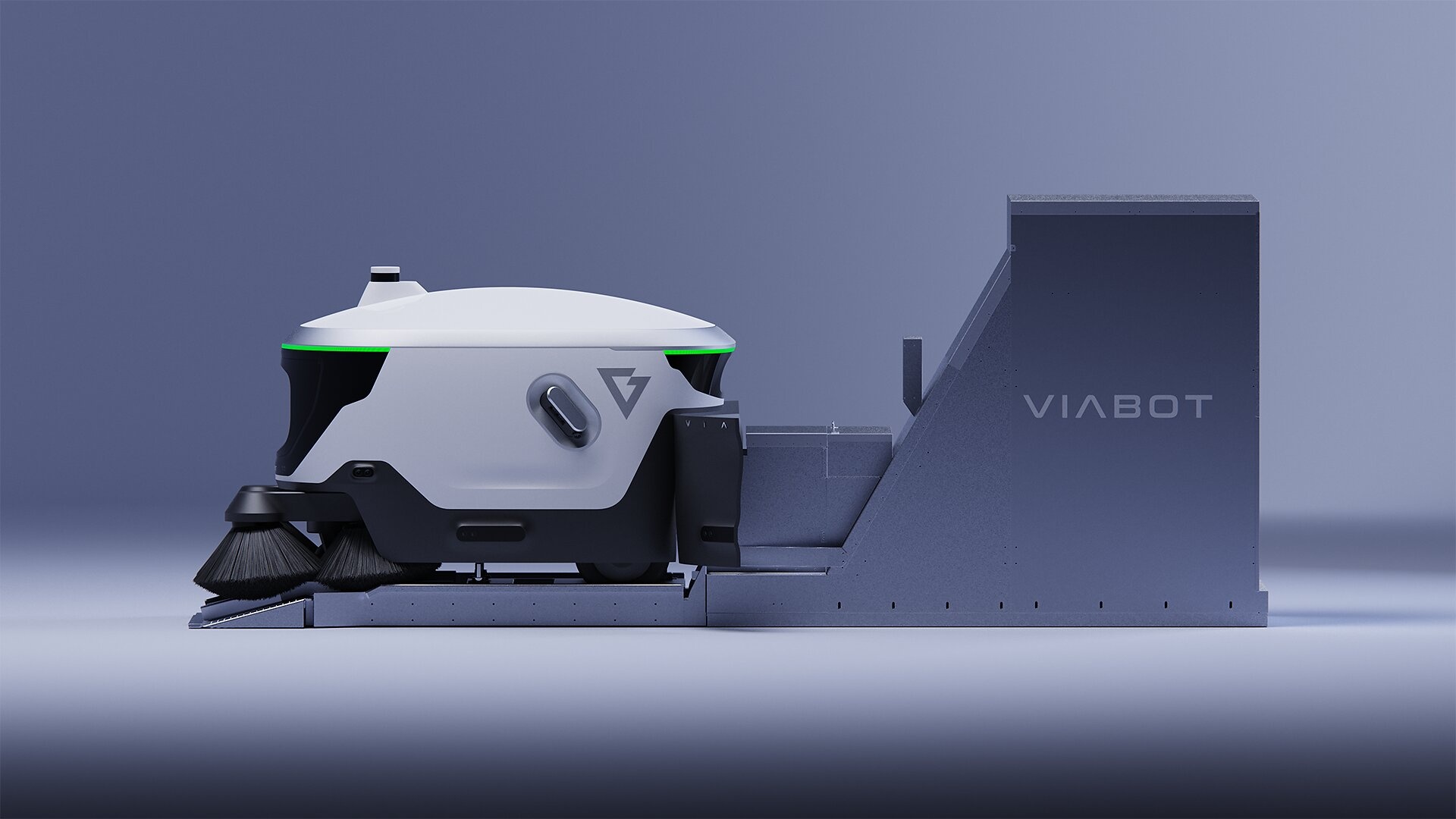
The current product description is almost domestic in its practical detail. A dock fits with the robot inside a parking space. Power comes from a standard 120-volt outlet. Collected debris goes into a conventional rolling bin. These are modest details for a robotics discussion, and precisely the details a facilities team might want settled before discussing the future.
A parking lot refuses to hold still
In October 2026, Ratanaphanyarat described the difficulty of working outdoors: a site changes between visits. Parked vehicles, carts, temporary barriers and shifting conditions complicate navigation. The machine must keep doing useful work in a place that has declined to remain as it was mapped.
His description of fleet monitoring is equally practical. People review uncertain situations and help the system learn from them. “Unattended does not mean unmonitored,” he said. The distinction places human oversight inside the operating model. Customers may have little involvement in a run while the company continues watching for exceptions.
It also changes what reliability means. Ratanaphanyarat says Viabot measures whether scheduled service happened, including interruptions arising from conditions at the site. A blocked dock may be an explanation, but the morning’s maintenance requirement still exists. There is a useful severity to judging the service from the customer’s end of the transaction.
- 01DeployFollow the scheduled route
- 02SweepCollect outdoor debris
- 03ReturnDock and empty the load
- 04RechargePrepare for another run
His own public explanation of spot cleaning names machine learning, computer vision and depth perception as parts of the problem. A piece of litter has to be detected before the robot can plan a movement toward it. The visible result is simple enough to take for granted. The engineering underneath has several opportunities to be wrong.
A decade, then another round
Ratanaphanyarat’s work drew Forbes recognition in the Manufacturing & Industry class of 2024. The profile placed him among founders turning engineering into companies. It also described customers ranging from commercial offices to shopping centers and retail stores. These are settings where the same practical task returns regardless of how recently its inventor received an award.
The longer development path matters when reading Viabot’s September 2026 financing. The $24 million Series A came about ten years after the company’s stated founding. Walden International led the round, with CDIB Capital Group and Stalwart Ventures participating alongside existing investors. Viabot reported $43 million in total capital raised.
The announced spending priorities were sales and engineering growth, new products and further development of the service and Viabot One. The company also listed deployments across eight US states. Hardware development had become a question of supporting an operation across geography, with all the less photogenic work that expansion brings.
The money supplies capacity to pursue that work. It cannot do the sweeping. In Ratanaphanyarat’s case, the round sits within a longer record of prototypes, patents and deployment. The relevant next chapter will happen in the repeated service calls and completed routes that allow a customer relationship to continue.
A future with room for a trash bin
Ratanaphanyarat’s public account of his ambitions gives design a place beside engineering. He wants robots that are helpful, attractive and able to fit into ordinary life. That is an interesting standard for a machine assigned to litter. Outdoor maintenance equipment will share space with shoppers, employees and visitors who have other things on their minds.
The longer-term platform he describes would take on further surface care, road-condition monitoring and routine checks of property assets. Some capabilities remain ambitions. The underlying idea is consistent with the modular work: a machine already moving around a site may become useful for additional tasks, provided each addition earns its place.
For Ratanaphanyarat, the personal progression is visible in what receives attention. There are the competition robots, the college project and the named inventions. There are also the contract, the worn brush, the dock and the person who receives an alert. The circle of responsibility has grown around the machine.
A parking lot offers a stubbornly concrete setting for that ambition. It will have visitors, weather and another day’s debris. Viabot has to come back. Ratanaphanyarat’s version of a useful future makes room for that repetition, and for the ordinary satisfaction of finding that someone has already taken care of the sweeping.