The first drone Blake Resnick showed the Las Vegas Metropolitan Police Department had an embarrassing habit. It could fly into a dangerous room, which was the point. It could also crash, land on its back and remain there like an expensive beetle, which was not. The SWAT team passed. Resnick was 17, curly-haired, short on credentials and long on nerve. Three months later he returned with a machine that could right itself. This time, the officers invited him on ride-alongs.
That small mechanical correction contains most of the useful truth about Resnick. The story usually arrives decorated with the ages: college at 14, a fusion reactor in the family garage, McLaren before he could drive, then Tesla and DJI, all before the ordinary graduation photos would have been taken. The numbers are irresistible. They are also a distraction. His real talent has been finding rooms where an idea can collide with consequence, then staying for the critique.
At BRINC, the Seattle company he founded, consequence is part of the product specification. Its aircraft are built for police, fire and rescue agencies. They squeeze through windows, navigate buildings without GPS, relay video through concrete and let a remote operator speak to somebody on the other side of a barricade. The outdoor models are designed to launch from stations after a 911 call. Resnick's ambition is to put one on every police and fire station roof in the United States. There are roughly 80,000 of those roofs. Modesty has never been a load-bearing component.
An education in things that break
As a child in Las Vegas, Resnick took apart toys, then hair dryers, then microwaves. At 14, he built an inertial electrostatic confinement fusion reactor in the garage and started college. His route into McLaren was suitably odd: he had spent so much time on online forums devoted to the carmaker that a connection led to an internship. There he worked on a cheaper brake-cooling system. At Tesla he modeled how network traffic could delay messages inside a car. At DJI he designed an active Kevlar tether meant to stop drones from flying away and tested lidar equipment.
Each assignment taught a different dialect of reliability. A supercar must shed heat. A vehicle network must deliver a message before congestion becomes failure. An aircraft must know where it is, and its operator must know where it went. Resnick studied mechanical engineering at Northwestern, but left in 2017. His education had acquired customers, tolerances and the unnerving habit of leaving the ground.
Then, on October 1, 2017, a gunman fired from the Mandalay Bay resort into the Route 91 Harvest festival in Las Vegas. A close friend was near the attack and called Resnick. Confused reports made it difficult for responders to understand where the danger was. Sixty people were killed. For Resnick, the engineering question became immediate: what could have reached the scene, looked inside and helped responders separate fact from panic?
He cold-called the officer leading the local SWAT team. The answer was not a polished procurement brief. It was a set of stubborn field problems. Indoor flight is hostile to elegant consumer drones. GPS disappears. Walls interrupt signals. Doorways are narrow. Rotors meet curtains, furniture and glass. A tactical machine has to tolerate indignity. Thus the protected propellers, the concrete-penetrating radio, two-way audio, night vision and the famous turtle mode that corrected his failed demonstration.
The proposed seventy-second city
The product is time, not flight
BRINC's first useful trick was entering a room before an officer. Its larger wager is arriving at an address before anybody in uniform. The Responder system, introduced in 2024, joined an outdoor aircraft to a network of charging nests and dispatch software. Guardian, unveiled in 2026, extended the idea with more than an hour of flight time, automated battery swapping and payload loading, weather resistance and satellite connectivity. A station can load an AED, naloxone, an epinephrine injector or a flotation device, depending on the call.
The change sounds technical, but it alters the grammar of emergency work. The old sequence is dispatch, travel, arrival, discovery. Resnick wants discovery to happen during travel. A camera reaches the corner. A voice comes through the aircraft. A commander sees heat through smoke or learns that an object mistaken for a weapon is something harmless. Sometimes the result may be faster action. Sometimes it may be the permission to slow down.
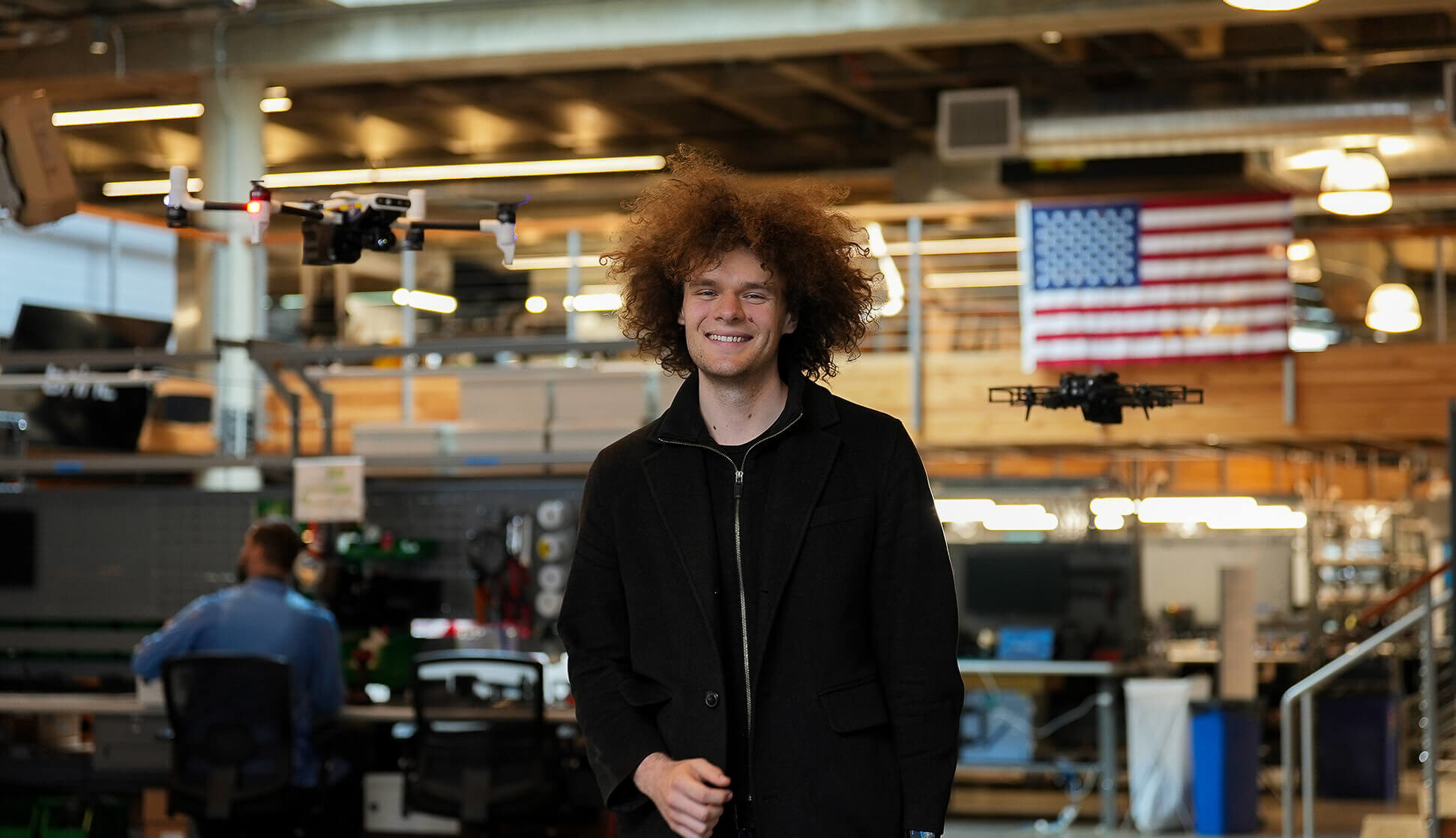
This is why Resnick describes the machine as a drone, a camera and a phone. Flight attracts attention; communication changes the encounter. A tactical team can look around a corner without placing a body there. An operator can speak with a barricaded person without shouting through a doorway. The glamour belongs to the aircraft. The useful work often belongs to the pause it creates.
A check, a collapse and a factory
For two years, BRINC was largely Resnick. The Thiel Fellowship supplied $100,000 in 2020. The more cinematic check came from Sam Altman. After an indirect introduction, Altman asked about revenue, customers, growth and the size of the round. Roughly 36 hours later he agreed to invest $2 million. Resnick's father warned him not to expect the money. It arrived the next day. The cash bought hires and headquarters; the investor's name made other rooms easier to enter.
Reality supplied a sterner endorsement in 2021. After part of the Champlain Towers South condominium collapsed in Surfside, Florida, engineers needed to assess areas under the structure that were unsafe for people. Resnick flew in to hand-deliver a BRINC drone. It carried lidar, video and a radio into the darkness beneath the building. The episode was a grim proof of the original proposition: send the machine where the risk to a person is unreasonable.
BRINC later moved its headquarters from Las Vegas to Seattle, close to an aerospace workforce and a deep manufacturing tradition. Resnick has insisted on keeping engineering near the assembly line. The proximity makes mistakes audible. A designer can walk downstairs and see which screw is awkward, which part arrives late, which clever tolerance becomes uncivilized on a production bench. In 2026, the company announced a factory three times the size of its existing space. It also raised $125 million in a round led by Motorola Solutions, bringing its total funding above $280 million.
Money has turned the teenage project into an industrial argument. BRINC says more than 900 agencies use its products and more than a fifth of American SWAT teams use its technology. The company more than tripled revenue in 2025 and quintupled monthly production capacity. Those are company figures, and they belong to a company trying to manufacture not merely aircraft but an expectation: that a camera in the sky should arrive as routinely as a siren in the street.
The hard lesson is restraint
Public-safety technology does not become virtuous because its founder has a good origin story. In 2018, before BRINC settled on its current mission, Resnick made a promotional video for a border-surveillance concept that included a drone equipped with a Taser. When the video resurfaced in 2021, it drew condemnation for its portrayal of a Latino migrant and for proposing force by remote control. Resnick apologized. He said the project had been abandoned and that BRINC would not build weaponized drones.
The episode is not a footnote to the story. It is the story's hinge. A gifted engineer can make a mechanism work before asking whether it should exist. A responsible company has to reverse that order. Resnick's later language centers de-escalation, communication and unarmed systems. The relevant test is not the language itself, but whether contracts, product choices and agency policies make it durable.
Drones above American cities raise ordinary democratic questions in unusually photogenic packaging. Who may watch? When does an emergency end? Can a resident know why an aircraft was overhead? Will a tool sold for urgent calls drift toward routine surveillance? Resnick's machines may reduce blind entries and needless dispatches. They may also expand the number of moments visible to government. Both statements can be true before breakfast.
This is where his youthful history becomes most interesting. BRINC began with the belief that speed could save a life. Its maturity will depend on proving that speed can coexist with limits. A drone can reach the scene in seventy seconds. Trust takes longer and flies in worse weather.
Every roof, one difficult promise
Resnick is now aiming beyond the tactical room. He talks about replacing some police-helicopter missions, delivering emergency supplies and placing aircraft across a city so that geography stops dictating who receives information first. Motorola's investment and platform integrations give BRINC access to the communications systems already sitting in dispatch centers. The new factory gives it room to build. The Guardian gives the vision longer legs and, literally, a fresh battery without human hands.
Yet the best explanation of his company remains that failed Las Vegas demonstration. The drone fell. The customer said no. Resnick returned after fixing the exact reason for the refusal. BRINC's next refusals will be civic rather than mechanical: rules about privacy, autonomy, airspace and force. They cannot be solved with turtle mode. They require the same appetite for criticism, only without the comfort of a workbench.
At 17, Resnick wanted a machine that could enter one dangerous room. At 26, he wants a network that can reach nearly any emergency in an American city. The distance between those ambitions is filled with capital, factories and hundreds of agencies. It is also filled with judgment. The future he proposes arrives quickly, humming above the traffic. The wisest thing it might give us is a moment to think.