BREAKING Rosie cleans 1,000+ sq ft an hour - no map required
1,000+ robots deployed across 12 countries
Lysol's parent company led the Series B
Founded in a Cornell dorm room as "Maidbot"
~54 minutes saved per labor hour
One robot can supplement up to $8,000 of labor a year
BREAKING Rosie cleans 1,000+ sq ft an hour - no map required
1,000+ robots deployed across 12 countries
Lysol's parent company led the Series B
Founded in a Cornell dorm room as "Maidbot"
~54 minutes saved per labor hour
One robot can supplement up to $8,000 of labor a year
// Who they are now
A robot is doing the part of the job nobody wanted.
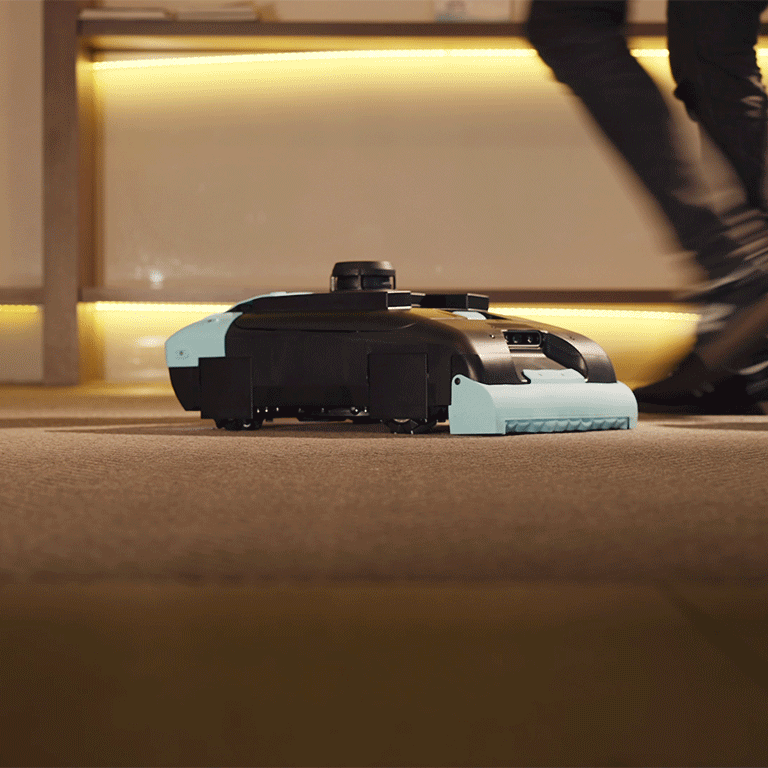
Walk into a hotel today and the most futuristic thing in the building might be quietly circling the conference room floor. Tailos makes that machine. Its name is Rosie, it weighs about as much as a carry-on, and it drives itself.
Tailos is a robotics company in Austin, Texas, with roughly 31 people and one stubborn conviction: the dullest, most physically punishing work in a building should be handled by something that doesn't have a back to throw out. The company builds autonomous cleaning robots for hotels, apartment towers, and senior-living facilities - places with endless square footage and not enough hands to cover it. More than 1,000 of its robots are already working in 12 countries.
// The problem they saw
Housekeeping is brutal. The labor to do it is vanishing.
Vacuuming a hotel is not glamorous robotics. It is repetitive, it is hard on the body, and it is exactly the kind of task properties cannot keep staffed. Cleaning is one of the most labor-intensive line items in commercial real estate, and the people who do it carry the physical cost in their knees, shoulders, and wrists.
The shortage isn't a forecast - it's the present tense. Operators have rooms to turn, hallways to maintain, and a hiring pipeline that keeps running dry. The conventional answer is to ask the existing crew to cover more ground. Tailos thought that was the wrong question. The right one: what if the floor cleaned itself, and the humans did the work that actually needs a human?
FIG. 1 - The thankless task, now outsourced to something with LiDAR.
// The founders' bet
It started on a housekeeping floor at Cornell.
Micah Estis Green worked as a room attendant at Cornell's Statler Hotel. He saw the job up close - the strain, the repetition, the turnover - and decided a machine should take the worst of it. He built the first version in a dorm room and called the company Maidbot. Then he did the thing the Thiel Fellowship is famous for funding: he bet that the work mattered more than the diploma.
Green was named a 2017 Thiel Fellow and landed on the Forbes 30 Under 30 list in 2018. The wager wasn't that cleaning was sexy. It was that the unsexy, physical world - the carpets and corridors that software people ignore - was exactly where autonomous robots could earn their keep. In March 2022, Maidbot grew up and became Tailos, named for Talos, the bronze automaton from Greek myth built by the god of technology. Ambitious for a vacuum company. That was the point.
// The product
Same sensors as a self-driving car. Pointed at the carpet.
Rosie navigates with LiDAR, a 3D depth camera, and proprietary SLAM - Simultaneous Localization and Mapping, the same stack that lets autonomous cars understand a street. There's no pre-mapping, no setup ritual, no engineer required. You press play and walk away. It finds the walls, dodges the furniture, and cleans.
The hardware is deliberately boring to operate, which is the hard part to get right. An 18-pound body, a touchscreen anyone can run after a minute of training, swappable batteries so it never has to stop for a recharge, and a subscription that bundles the robot, batteries, charger, and bags for around $479 a month - roughly $13 a day. Cancel month to month. The robot is sophisticated so the operator doesn't have to be.
Rosie
The self-navigating commercial robot vacuum. LiDAR + 3D depth camera + SLAM, ~18 lbs, touchscreen, swappable batteries. Cleans 1,000+ sq ft per hour.
Rosie 2.0
The next generation, sold solo or in multi-packs for larger operations that need more floor covered.
Tailos Swarm
Multiple robots coordinating to clean one big space - ballrooms, lobbies, conference halls - while the staff sleeps.
Analytics Dashboard
A web tool showing operators what got cleaned, how the fleet performed, and how much labor it saved.
FIG. 2 - Four products, one promise: press play, walk away.
// The proof
The numbers operators actually care about.
Robots are easy to admire and hard to justify. Tailos's argument is made in minutes and dollars, not adjectives. Rosie saves roughly 54 minutes of every labor hour. Room attendants who hand off the floor work clean up to 2.5 more rooms a day. One property's housekeeping manager saved 39 hours a month just by letting Rosie handle the hallways.
~54 min
Saved per labor hr
What one Rosie buys back
Operator-reported time and output gains, per Tailos
FIG. 3 - The pitch deck, minus the deck. Bars are scaled for readability.
The proof shows up in who's buying and who's backing. Rosie is at work inside major hospitality brands - MotorCity Casino Hotel among the named customers - and the Series B was led by RB, the maker of Lysol, a company that knows the cleaning business better than most. Rosie also picked up a Good Design Award. Validation, it turns out, looks like a vacuum with a trophy.
// The mission
This was never about replacing people.
It would be easy to file Tailos under "robots take jobs." The company frames it the opposite way. Rosie takes the repetitive vacuuming - the part that wrecks bodies and burns hours - so the human crew can do the work that needs judgment, care, and a guest-facing smile. The robot does the grind. The person does the rest. Tailos calls it building machines that work, so humans can live, and for once the slogan describes the product.
The broader bet is bigger than carpets. The rebrand to Tailos signaled an ambition to bring AI to the physical world generally - the offices, airports, and senior-living halls where software has historically had nothing to offer. Cleaning is just the beachhead.
// Why it matters tomorrow
The labor math isn't getting easier.
Every year the buildings get bigger and the hiring pipeline gets thinner. The properties that figure out how to cover that gap without burning out their staff will be the ones still standing. Tailos is betting that the answer rolls itself down the hallway, finds its own way around the furniture, and asks for nothing but a battery swap.
So go back to that hotel corridor at 2 a.m. The carpet is clean. The night auditor never picked up a vacuum. The housekeeper who used to do this shift is home, with knees that will last longer. The machine is already moving on to the ballroom. Nobody is watching, and that is exactly how Tailos planned it.