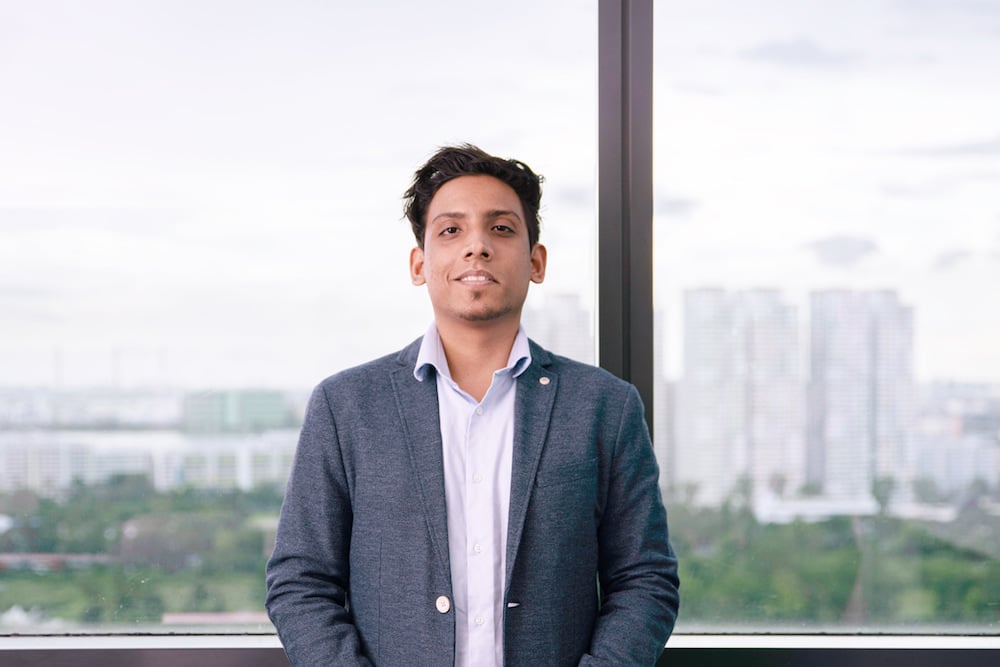
Aniket Singh Rajput left his doctorate in its first year. For a researcher, that is a fairly decisive edit. In 2020, he stepped away from Nanyang Technological University in Singapore and started Neuroglee. The next year, the company announced a $10 million Series A and plans for a Boston headquarters. The sequence has the brisk appearance of a founder biography: university, company, money, America. It becomes more interesting when you discover how Rajput describes himself.
He prefers to pause before making a decision. His older brother, Kuldeep Singh Rajput, co-founded Biofourmis, invested in Neuroglee and became its board chair. There was already an entrepreneur close enough to watch, question and learn from. Aniket had seen Biofourmis from its beginnings. Yet when asked about the difference between them, he described his own habit of stepping back and thinking a move through.
A pause can look rather unphotogenic beside a funding announcement. Nobody throws confetti over a carefully considered hesitation. But Rajput's career offers a useful question: what happens when someone trained to investigate a problem takes responsibility for building an organization around it?
Leaving the lab without leaving the questions
Before there was a company to run, there were research appointments. Rajput was a research scholar at the Hong Kong University of Science and Technology in 2018 and 2019, where his professional education record lists a master's in robotics. He then worked as a senior research assistant at the Singapore University of Technology and Design. In 2020, his route took him to NTU's Robotics Research Centre.
Those institutions give the story a particular geography. Hong Kong and Singapore were places where he studied and worked before Boston became his professional base. His background sits in robotics, algorithms and intelligent systems. The eventual job title, founder and CEO, arrived after that sequence of technical work.
Research and company building ask different things of the same person. A researcher can narrow a question until it becomes tractable. A founder must also decide who will work on it, how the work will be paid for, and how the resulting organization will operate. Rajput's change of direction put those practical questions alongside his technical ones.
He founded Neuroglee toward the end of 2020. Leaving in the first doctoral year meant interrupting an academic path relatively early. The company would now become the place where he continued his work. There is a certain economy to the decision: he changed the institution around his ambition before accumulating more years inside the old one.
Two rounds, nine months apart
In December 2020, Neuroglee announced $2.3 million in pre-seed funding. Eisai led the round, and Kuldeep participated. Aniket was the founder and chief executive of a new company with both a corporate backer and a family connection on its investor list. That combination made his first financing more specific than the usual tale of a founder wandering from door to door.
The next disclosed round came in September 2021: $10 million in Series A funding. Openspace Ventures and EDBI backed the round alongside existing investors. Eisai remained involved; so did Kuldeep. The announcement also named Biofourmis co-founder Wendou Niu and former Mundipharma chief executive Raman Singh.
The two announced rounds total $12.3 million. They are a record of capital committed to the company at those moments. For Rajput, they also mark a rapid change in the scale of the job. Within roughly nine months of the first public financing announcement, Neuroglee had announced a much larger round and a plan to establish a headquarters on another continent.
Money makes some decisions possible and gives others a deadline. A plan to recruit becomes a budget to manage. A proposed expansion becomes an organization that needs people, responsibilities and working relationships. The interesting part of Rajput's financing story is what accompanied the second round: a change in where the company would build its next team.
Boston was a hiring decision, too
The September 2021 announcement placed Neuroglee's planned new headquarters in downtown Boston, with the move scheduled for the fourth quarter. Singapore had been its headquarters before that. The expansion would add an American base to management and technology-development teams in Singapore and India.
Rajput connected the choice of Boston to its concentration of research institutions, technology centers, investment and potential partners. He also described plans to scale the company's engineering, operations and commercial teams. The city mattered as a place to assemble people and relationships.
That is an instructive detail in a biography that begins with algorithms. The founder was now talking about an environment in which an organization could grow. Technical capability still mattered, but proximity to collaborators and access to talent belonged in the decision as well. Geography had become part of the business plan.
A headquarters announcement can sound like a pin being dropped on a map. The staffing plans give this one more weight. Neuroglee was preparing to recruit locally while retaining teams elsewhere. The move brought a new set of organizational questions to Rajput's desk: how to build in Boston while keeping work connected across borders.
- Hong KongRobotics study & research
- SingaporeResearch & founding Neuroglee
- BostonCompany headquarters & leadership
An older brother at the board table
Kuldeep's involvement extended beyond writing a check. As Neuroglee's board chair, he had an official place in its governance. In 2021, he described sharing lessons and mistakes from Biofourmis to help the younger company avoid repeating them. Both Openspace and EDBI had also invested in Biofourmis, giving the two businesses connections to some of the same investors.
For Aniket, this put experience close at hand. He could draw on someone who had already built a company, while remaining responsible for his own. Advice from an older sibling comes with a long acquaintance; advice from a board chair comes with a formal obligation. In this case, the roles occupied the same seat.
The brothers also ran the horse-racing business Gandharvi together. A 2022 interview at Singapore Turf Club captured their easy banter and Kuldeep's direct criticism of Aniket's financial oversight. Aniket said he welcomed constructive feedback. It is a wonderfully ordinary interruption to the polished founder story: even at the stables, the finances could follow him.
“I like to always take a step back and think through decisions before I make my move.”
Aniket Singh Rajput, 2022
Experience belongs in the product
Rajput's public writing adds another dimension to the technical background. In a June 2022 essay, he argued that people need to enjoy using technology if they are going to continue using it. He placed experience and personalization close to the center of product development. A sophisticated system still has to earn someone's willingness to return.
There is a practical modesty in that argument. It grants users a vote. Developers can be satisfied with the machinery underneath a product while the person holding it remains unconvinced. Rajput's emphasis makes continued use part of the problem to solve, alongside the technology itself.
In another published essay, he examined the idea of a product's “wow factor” through the experience of the people using it. That choice of subject is revealing. His writing brings attention back to ordinary interactions rather than treating technical novelty as sufficient evidence of value.
This thread gives his career some continuity. The researcher worked on intelligent systems; the founder wrote about how people encounter systems. His argument asks engineering to remain interested in what happens after development, when someone has to navigate the interface and decide whether it deserves another visit.
Making room for other people's expertise
In January 2023, Neuroglee announced three senior leadership appointments. Among them was chief technology officer Ramesh Natarajan, whose background included more than twenty years in IT product development and cybersecurity. His responsibilities included performance, reliability, ease of use, security and data privacy.
Those are concrete concerns for a company expanding beyond its founding stage. They make the technology job sound appropriately demanding: the product must work, remain usable and handle data responsibly. Natarajan brought experience from CyGlass, where he had worked on cloud-based AI and machine-learning technology for identifying network threats.
Rajput welcomed the experience of the incoming leaders. A founder who began in technical research was now assembling a management team with expertise developed elsewhere. Company building made room for colleagues whose knowledge could extend the organization beyond what one person could supply.
The name changes; the work continues
In 2022, Rajput made the Forbes 30 Under 30 Asia list. His public celebration thanked the Neuroglee team, investors, partners and advisers. The acknowledgment fits the network already visible in his story: research institutions, an older brother, returning investors and senior recruits all had places in the company's development.
In June 2024, the company changed its name from Neuroglee Therapeutics to Neuroglee Health. The change was announced publicly on July 1. By then, the career that had begun with research appointments had become several years of founding, financing, relocating and recruiting.
The sequence returns us to his description of taking a step back. It sits beside some substantial moves: leaving doctoral research, starting a company and choosing a headquarters across the world. Rajput's account of himself leaves room for both deliberation and action. The pause comes before the move; the responsibilities arrive afterward. His story lives in that interval.