Joan Huaqiong Shen reached a perfectly respectable place to stop. She was chief executive of I-Mab, a company that had made its Nasdaq debut and signed a global partnership with AbbVie. There were public shareholders, an international organization and a title that could fill a business card without further explanation. At the end of 2021, she left. At the beginning of 2022, she founded NeuShen Therapeutics.
In the usual career diagram, the arrow points upward. Shen’s route is more interesting when drawn sideways: between countries, between kinds of company, between scientific training and the responsibilities of running a business. The founder arrived after the executive. By then she had worked inside institutions large enough to have established ways of doing almost everything. Starting her own company gave her the responsibility of choosing those ways herself.
There is a personal beginning to this story, too. Long before the executive appointments, she had wanted to be an artist. The interest survived the change of profession. It belongs in a portrait of Shen because a résumé, however accurate, has a habit of leaving out the person carrying it.
A family with room for music
Shen was born and grew up in Chengdu, in Sichuan. She was the youngest of four children. Academic achievement was expected in the family, and her father loved music and art. His advice was to keep music as something that could enrich her life, even if it did not become her profession. She entered medical school at sixteen.
Years later, she described Christmas gatherings where three generations made music together. Her daughter had become a full-time musician in New York. The artistic ambition had found more than one way to remain in the family. Shen also described yard work and household chores as activities that helped her recharge after intensive days at work. It is a pleasingly ordinary detail in a career crowded with acronyms. Even a founder has a garden to attend to.
The years before the founder
Her formal education took her from Southeast University Medical College, where she received her MD in 1983, to a master’s degree in anatomy at West China University of Medical Sciences in 1989. She completed a PhD in anatomy/neuroscience at Indiana University School of Medicine in 1996. The sequence matters because it places a substantial period of study before the corporate career that now tends to introduce her.
Eli Lilly came first in that industry career, followed by Wyeth and Pfizer. By 2011 she was heading Pfizer’s China clinical department. In 2013 she moved to Jiangsu Hengrui as chief medical officer and vice president. Two years later she became vice president and development head at Janssen, part of Johnson & Johnson. In September 2017 she joined I-Mab to head discovery and clinical development.
The dates describe changes in responsibility as well as employer. A multinational, a Chinese company and a younger international business each put a leader in a different relationship with the organization around her. An established company offers systems to work within. A growing company requires decisions about which systems to build. Shen’s record includes both kinds of work, followed by the job of founding a company herself.
- 2003Eli Lilly
- 2005Wyeth
- 2009Pfizer
- 2013Hengrui
- 2015Janssen
- 2017I-Mab
- 2022NeuShen
A bell in Times Square
Shen became I-Mab’s CEO in October 2019. On January 17, 2020, the company began trading on Nasdaq. The celebration took place at the exchange’s MarketSite in Times Square, where founder Jingwu Zang and members of the team rang the closing bell. It was an unusually visible marker in a profession whose daily work generally happens away from a camera.
A listing gives a company a public identity with a price attached. It also changes the audience for its decisions. Employees, directors and collaborators are joined by investors who can buy or sell their opinion of the business. The ceremony lasts minutes. The new responsibilities continue after the screens return to their regular programming.
Shen’s signature appears on I-Mab’s April 2020 annual-report certification. Among the responsibilities set out there were disclosure controls and the fair presentation of financial information. The contrast with a bell-ringing photograph is instructive. One records the occasion. The other records accountability. A chief executive has to appear in both pictures, even when one is composed entirely of paperwork.
First day of trading on Nasdaq. Shen had become CEO the previous October.
The work behind a partnership
In September 2020, I-Mab entered its partnership with AbbVie. The agreement included a $180 million upfront payment and a $20 million initial milestone payment. Rights were divided geographically, with I-Mab retaining Greater China and AbbVie receiving a license outside that territory. Those particulars give the transaction a shape that a celebratory headline can miss.
There is a difference between announcing that two organizations will collaborate and deciding how collaboration will work. Territory, payment and responsibility all need to be settled. A partnership becomes useful through those decisions. The business accomplishment in this part of Shen’s tenure was a company reaching an agreement with another company, with obligations detailed enough to be acted upon.
It would be tempting to make the executive the sole protagonist. I-Mab had a founder, a board, a team and counterparties. Keeping them in the frame produces a more credible account of leadership. Shen’s career is about working through organizations, which means the achievements belong to organizations as well as to the people who lead them.
Leaving with another beginning in view
I-Mab announced in December 2021 that Shen would step down as CEO on December 31 to pursue other interests. Zang thanked her for her contributions and the foundation she had helped establish. The next chapter followed quickly: NeuShen was founded in early 2022. She took the founder and CEO roles together this time.
A departure and a founding are distinct events. The first closes an appointment; the second creates a new set of obligations. The proximity of the dates gives this transition its energy. Shen brought an executive’s experience to the beginning of a company’s life. The new business would still need to earn its own record, hire its own people and persuade its own backers.
“I am always finding something new to be excited about.”
Joan Huaqiong Shen
That appetite for a new undertaking offers a useful way to read the move. By 2022, she had occupied roles with increasing authority. Becoming a founder changed her relationship with the business again. Choosing the next employer was now inseparable from creating it. The company name, NeuShen, even carries her surname into the venture.
A small team, a wide map
The new company’s early public life included a pre-Series A round of $20 million, noted when BayHelix named Shen its Woman Leader of the Year in 2022. The recognition arrived during the first year of her venture. It joined the Endpoints News and Forbes China recognitions she had received in 2021, before NeuShen’s founding.
Her response to the BayHelix award thanked colleagues and friends who had inspired her along the way. The wording keeps the social history of a career in view. People who appear briefly in a professional biography can remain important long after a particular job has ended. An award names one recipient; her response made room for others.
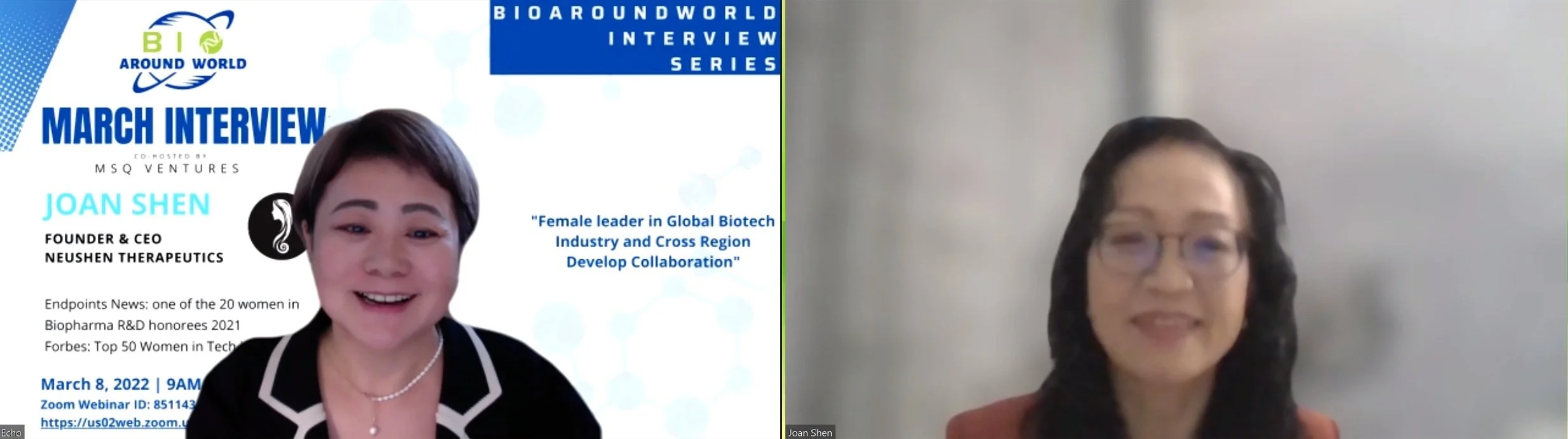
In June 2023, Shen took part in international-cooperation discussions during BIO convention week in Boston. She also moderated a panel at a cross-border summit organized by Jones Day and MSQ Ventures. The participants included academic experts, business leaders and investors. These gatherings show the founder doing the work of connection in person, among people with different roles in the same industry.
A December 2024 webinar account described NeuShen as a company with fewer than twenty experts. That is a dated snapshot, rather than a present-day headcount, but it is an illuminating one. The company was pursuing international partnerships while still operating with a small team. Its reach and the number of people on its payroll were different measures of the business.
Two research centers, one company. The arrangement puts an international organization into the founder’s everyday responsibilities.
The next round of responsibility
On January 28, 2026, NeuShen announced a Series A+ round led by Lilly Asia Ventures. Pivotal bioVenture Partners participated alongside existing investors Shanghai Healthcare Capital, Lapam Capital and TTM Capital. The financing brought new backers into a business that already had an investment history. For a founder, that creates a growing circle of people to whom the next decisions matter.
On September 3, NeuShen announced a Series B round exceeding $80 million. B Capital, Legend Capital, Matrix Partners China, TruMed Investment and SSCI were among the participating institutions. Lilly Asia Ventures increased its stake. The company described the round as oversubscribed and continued to identify Shanghai and Boston as its two research centers.
The amount marks the scale of the company’s latest financing. It also gives the story a new point from which to look back: a founder who began after a public-company tenure now leads a venture with successive rounds of institutional support. Each round extends the undertaking. The work of making decisions, coordinating people and maintaining trust remains with the team.
Shen’s story has room for the academic years, the corporate appointments, the public listing and the new company without turning any one of them into a finish line. The girl interested in the arts became a scientist and executive, then a founder. Music remained part of family life. The career kept moving. Starting again, in her case, came with considerable experience packed for the journey.