In 1999, William J. Golden reached for an unusual explanation of venture capital. Bees. Pittsburgh needed investors to take a closer look, he argued, and a little exposure could attract more of them. Money would arrive, connections would multiply, and a city with research to commercialize might begin to draw a different sort of attention. It was a pleasantly earthy image for a business more comfortable with spreadsheets. The bees, presumably, would do their own due diligence.
Golden was then a managing director of Caduceus Capital. Years later, he would be known as the founder, chairman and chief executive of Noveome Biotherapeutics. But that earlier image offers a useful way into his career. His work has involved assembling the conditions around a company: investors, institutions, managers, facilities and people who know how to turn an ambitious proposal into an operating business.
“It’s a bee-and-pollen type of thing.”
William Golden, 1999
The comparison contains a business argument. Attention can travel. A new investor brings more than money; an institutional partner brings more than a name on a presentation. Each connection makes other connections possible. Read that way, Golden’s remark was a theory of how a region could attract investment, expressed without requiring anyone to sit through forty slides.
The fund before the company
Golden’s route through business included a mechanical engineering degree from the University of Notre Dame, an MBA from Harvard Business School and the Chartered Financial Analyst qualification. He also spent five years directing a venture fund affiliated with Boston University. The combination placed technical education and finance beside experience with the business of universities.
In 1997, he approached UPMC about establishing a venture capital firm with Small Business Administration support. The objective was to encourage a life sciences industry cluster in Pittsburgh. Lancet Capital Health Ventures followed in 1998. Its institutional relationships included UPMC, Highmark, the University of Pittsburgh and Carnegie Mellon University. Golden served as its managing director from 1998 to 2021.
Lancet described its contribution in unusually practical terms. Its offer included senior management for startups, help with operations, business planning, management recruitment and access to expertise. Those are the tasks that rarely occupy the opening paragraph of a founder’s legend. They do, however, tend to occupy the founder’s Monday morning.
Consider the order of operations. A promising idea needs people to develop it. Those people need an organization, and the organization needs a plan that someone will finance. Recruitment and operating knowledge belong in the same conversation as capital. Lancet’s stated approach put these needs together, making the investor a participant in building the business.
Stentor gives the theory a balance sheet
Stentor is a concrete chapter in this history. Golden was a co-founder, seed investor and director of the company. In 1999, it was identified as the first business backed by Caduceus. Its technology originated at the University of Pittsburgh, with work by Paul Chang. Here was the sequence in working form: university research, early investment and a company built around the resulting technology.
The investor group around the fund also stretched beyond Pittsburgh. Alongside local participants Mellon Ventures and PNC Equity Management were Sanderling in California and TVM Techno Venture Management in Munich. Golden’s hoped-for flow of outside attention had an institutional counterpart. The city’s research relationships were part of what he believed made the fund attractive.
In July 2005, Philips announced an agreement to buy Stentor for approximately $280 million in cash, subject to regulatory approval. The acquisition was completed in August. The number belongs to the company’s transaction history, rather than to any calculation of Golden’s personal wealth. It gives the Stentor chapter a measurable outcome without turning a company sale into an imaginary personal payday.
Approximate cash acquisition price announced by Philips. The transaction completed that August.
A founder, a seed investor and a director have different responsibilities. Stentor put Golden in all three roles. That overlap is one of the recurring features of his career: participation at the point where a business begins, followed by a place in its governance. The story crosses the boundary between selecting an investment and taking responsibility for the organization receiving it.
A company needs somewhere to stand
Lancet was the seed investor in the business that became Noveome. Golden founded the company in 2000 and held chairman and chief executive or executive chairman responsibilities from its inception. The link between the fund and the company makes his career more interconnected than a sequence of separate job titles might suggest.
By September 2010, the company, then known as Stemnion, had opened a facility in Clearwater, Florida. Golden held several positions: co-founder, executive chairman, executive vice president and chief financial officer. The list reads like a small organizational chart that has decided to economize on names.
The facility opening brought company officials together with church leaders, including Bishop Robert N. Lynch and Sister Carol Keehan. It was a physical milestone in a business otherwise easy to describe through abstract words such as investment and development. Shelves, storage containers and a new working location put some ordinary objects around those abstractions.
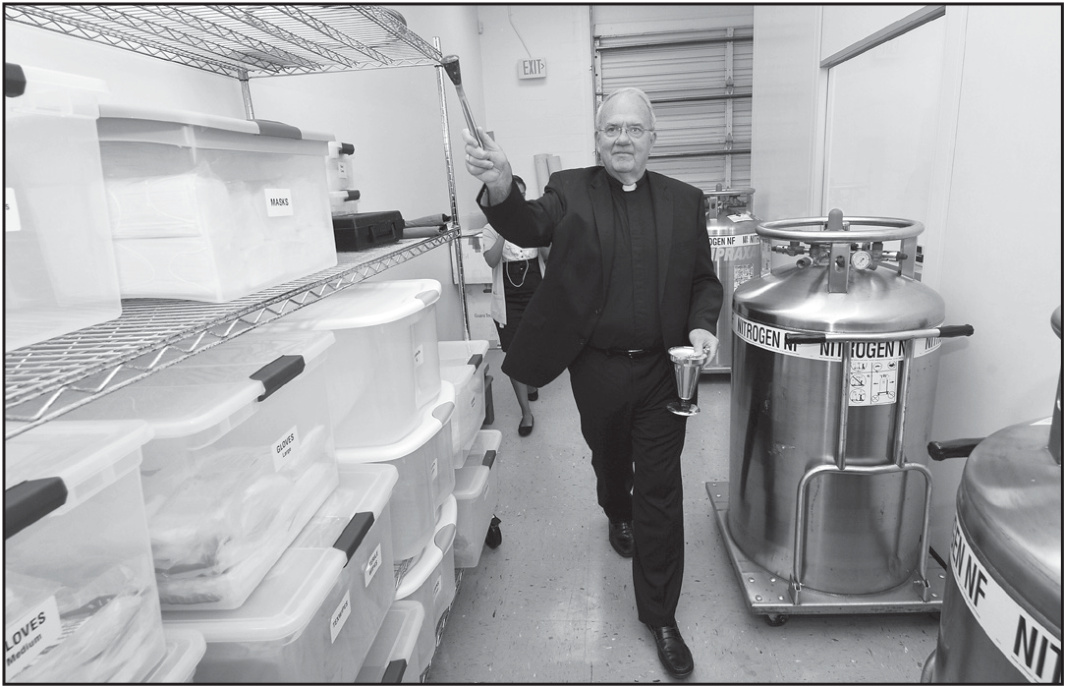
Facilities deserve a place in a business biography because they make commitments visible. An organization has to acquire equipment, establish routines and coordinate people across locations. A new site turns plans into recurring obligations. For an executive also serving as finance chief, the building and the budget sit on the same desk, even if only one of them fits inside a spreadsheet.
- 1998Lancet Capital established
- 2000Noveome’s founding
- 2005Stentor acquired by Philips
- 2021Noveome CEO handoff
The arithmetic of staying in business
On April 9, 2019, Noveome announced that it had closed a $15 million Series D financing. A new institutional investor led the round alongside existing investors. Before that financing, the company said it had raised $144 million through a combination of private equity and non-dilutive capital.
Its named public funding participants included the U.S. Department of Defense, the Commonwealth of Pennsylvania and Allegheny County. These details give texture to Golden’s work as chief executive. The company’s financing involved several constituencies and different forms of capital. A single total would conceal the organizational work required to bring those contributions together.
Private equity and non-dilutive funding have different implications for ownership. Equity financing involves an ownership interest. Non-dilutive funding does not require that same exchange. Keeping the categories visible helps explain the announcement, and it also keeps the financial story honest. The reported capital was funding for the enterprise, with responsibilities attached to its use.
In May 2020, Noveome announced a further $4 million grant from Pennsylvania. Golden’s public thanks singled out Representative Frank Dermody and Senator Jay Costa for helping secure it. The acknowledgment was specific: two named legislators, one named state and a stated amount. For all the talk of entrepreneurial independence, this company’s financial history included public institutions as well as private investors.
Hiring belongs in the founder’s story
Money was one part of building the organization. In October 2019, Noveome appointed Kevin E. McCracken senior vice president of operations. Golden welcomed his experience and described the company’s intention to broaden its leadership team. His comments emphasized operational expertise and manufacturing capacity, giving the appointment a clear business purpose.
McCracken’s background included quality, validation, manufacturing and supply chain work. These are disciplines with their own demands. Bringing them into a leadership team is a way of giving an organization more capabilities than one executive can personally supply. A founder’s calendar has only so many hours; a company’s responsibilities have considerably less respect for that limit.
Board appointments followed. M. Michelle Berrey and Annamaria T. Kausz joined in October 2020. Ronald Poropatich joined in January 2021, and Christopher J. P. Velis in March. The sequence shows the company adding people to its governance as well as its management. Golden’s public role included welcoming those additions.
In 2020, he was also included among Pittsburgh’s Smart 50 honorees. His recognition emphasized the infrastructure he had helped build and his experience at Stentor. The local award connected the company executive back to the regional business story that had occupied him in the 1990s.
May 24, 2021: a different chair
On May 24, 2021, Velis became Noveome’s chief executive. Golden stepped down from that position and remained founder and chairman at the time of the announcement. Velis had joined the board in March, so the transition followed a period in which he already held a governance role.
The distinction between the two chairs matters. A chief executive runs the company; a board chair leads its governance. The announcement separated those responsibilities while retaining Golden’s connection to the organization he had founded. It was a specific change in his working title after a long involvement in the business.
Golden’s career offers several ways to count time: a fund established in 1998, a company founded in 2000, an acquisition in 2005, and a leadership handoff in 2021. The dates describe different kinds of work, from assembling an investment vehicle to helping a company operate and then changing his place within it.
The bees remain a useful image at the end of that sequence. They suggest movement between places and dependence on something outside the individual. Golden’s business history has plenty of both: Boston and Pittsburgh, universities and investors, founding roles and board seats. The work becomes visible in the connections between them, and in the organizations those connections helped establish.
Follow the business trail
Continue with Golden’s professional profile, the firms connected to his career and the dated company announcements.