Ten days into his first trip to sea as a cadet, Michael G. Johnson found himself in a North Atlantic search operation. A bulk carrier was missing. His ship had been sailing through the same winter storm. He later recalled waves of 45 feet. The sea had supplied an unusually brisk introduction to the profession he had chosen.
Johnson went on to become a marine engineer, a Merchant Marine officer, a project manager and an executive in salvage. Years later, he would lead the team that wrote the winning bid to recover the wrecked Costa Concordia. Those experiences put him close to the consequences of decisions made aboard ships. They also gave him a question that would outlast any single job: which parts of operating a vessel should require a person’s continuous attention?
His answer became Sea Machines Robotics. Founded in Boston in 2015, it develops the systems that let vessels steer themselves under human command. Johnson now serves as its President and Chief Technology Officer. The change in title is recent compared with the question. He has spent much of his career looking at boats and asking what their operators could do differently.
A salvage engineer’s view of the future
Johnson is a native Texan with a marine engineering degree from Texas A&M University. Before robots occupied his working day, his career took him through ship repair, shipbuilding, offshore projects and marine transportation. He owned a marine project management company and held senior positions at Crowley Maritime and its affiliate, TITAN Salvage. These were businesses in which a drawing eventually had to survive contact with a ship.
At TITAN and Crowley, he worked on complex projects around the world. The Costa Concordia bid in 2012 brought that experience to a widely watched wreck recovery. His documented part was developing the winning proposal with a team. The distinction matters: a salvage operation involves many specialties, and his contribution was to the plan that secured the work.
The idea for Sea Machines also took shape while he was working on Arctic oil-spill response. There is a practical connection between spill work and the autonomy he later pursued. A boat may need to follow another vessel, maintain a position or repeat a route. Such tasks ask for consistency over time. They offer an engineer something specific to improve, well before the conversation reaches a ship crossing an ocean without anyone aboard.
Johnson’s early experience makes his interest in automation less abstract. His starting point was the job already being done on the water. A useful system would have to earn its place alongside the machinery, procedures and people that operators already knew.
The first office came with a tugboat
In January 2015, Sea Machines consisted of Johnson, a shared office in Cambridge and prototype work with Jaybridge Robotics. The company bought a 25-foot German steel tug and opened a shop at Boston Harbor Shipyard. For a software venture, it was a suitably inconvenient piece of office equipment.
The tug let the team experiment on a working vessel. Wireless remote control came early; an architecture for the SM300 autonomy system followed in May 2017. Along the way, Sea Machines entered MassChallenge in late 2016 and emerged as one of the accelerator’s winners. A concept was becoming something customers could install.
That progression is central to Johnson’s story. He was trying to move an established industry toward a new form of control, using a boat rather than a simulation as the test. The early tug made the engineering tangible. Steering, propulsion and the instructions sent to them had to work together.
“Mariners aren’t usually the type of people that make long-term fixed plans.”
Michael G. Johnson, 2021
The remark is an entertaining admission from someone building technology for planned routes. It also describes a career that accumulated its direction through assignments. Salvage, offshore work and shipyard experience gave Johnson a collection of problems. Sea Machines gave him a way to keep working on them.
Give the captain a different job
A phrase such as autonomous boat can make people picture an empty wheelhouse. Johnson’s approach leaves room for several arrangements. A vessel may carry a crew, operate with fewer people or work without anyone aboard in an appropriate setting. The autonomy system performs control tasks; a human decides what mission to undertake and supervises it.
That division makes the technology easier to understand. An operator can specify a destination or a survey pattern. The onboard system manages the movement needed to carry out the instruction. Remote command adds another possibility: the operator can supervise from somewhere other than the boat.
Monitors progress
Can intervene
Plans and adjusts movement
Controls steering and speed
Command stays with a person. Continuous vessel control can move to the system.
For Johnson, the useful applications include the work he has called “dangerous, dirty, and dull.” The phrase is short enough to fit on a boatyard noticeboard. Surveying an area, tending an oil-spill response operation or maintaining a repetitive course gives automation a defined assignment. The value depends on what happens during the working day.
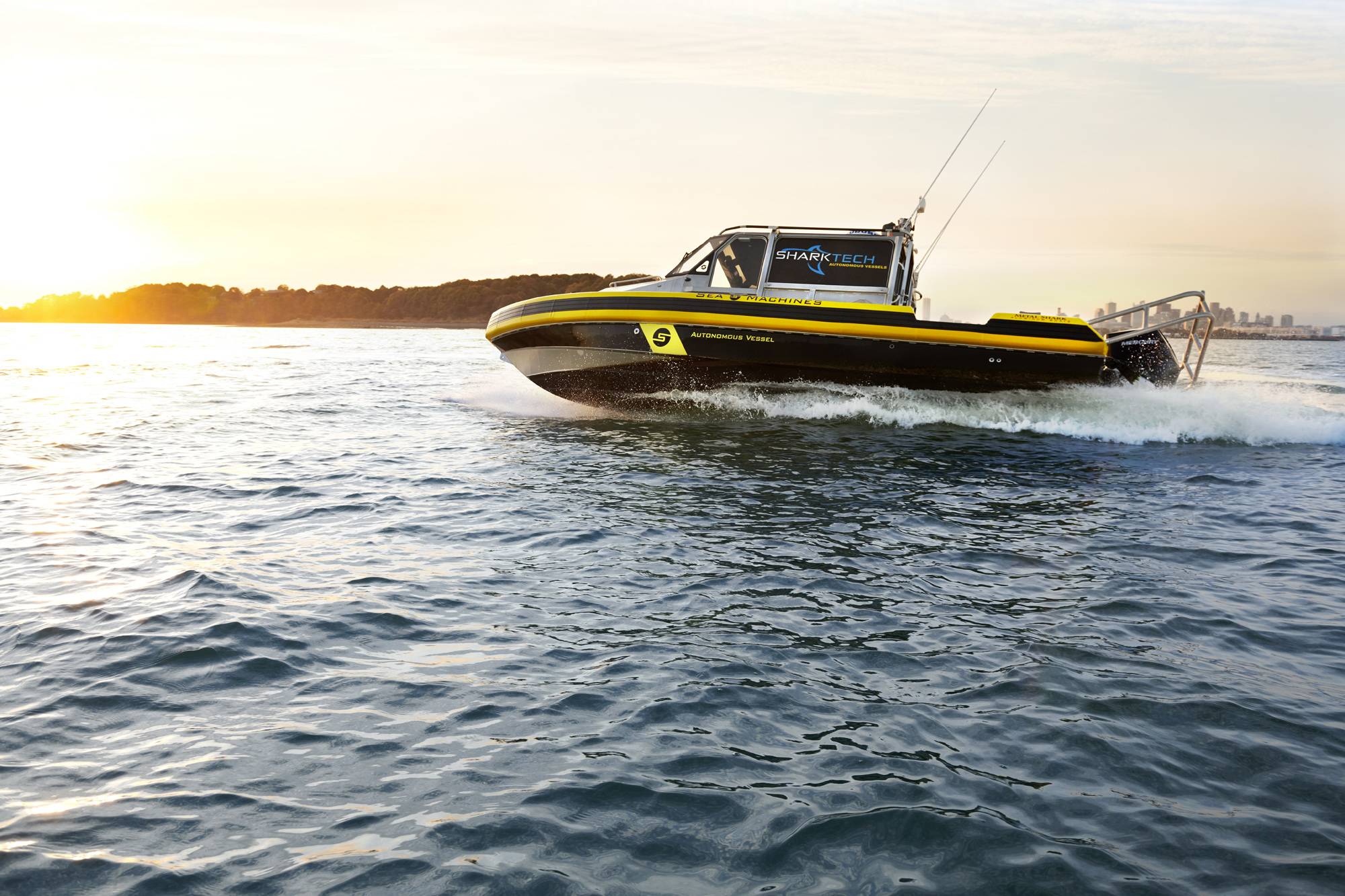
In December 2018, Johnson appeared on a ship-intelligence panel at the International WorkBoat Show in New Orleans alongside Metal Shark CEO Chris Allard. Sea Machines also demonstrated remote command of a workboat in Boston, more than 1,500 miles away. Visitors could watch missions being planned and deployed across the connection. It was a helpful change from a conference presentation in which the boat exists chiefly as a slide.
A thousand miles of ordinary steering
The more sustained demonstration came in 2021. A Damen-built tug named Nellie Bly undertook the Machine Odyssey around Denmark, commanded by licensed mariners stationed in Boston. Its name honoured the journalist known for her journey around the world. A reporter’s name is a pleasant choice for a boat expected to bring back evidence.
Sea Machines reported that the tug covered more than 1,000 nautical miles in 129 operational hours over 13 days. The remote command station was about 3,000 miles away. The voyage generated 3.8 terabytes of operational data. Distance made the demonstration memorable; the hours of operation gave the team something to examine.
Two professional seafarers remained aboard, with observers joining some legs. That arrangement is part of the achievement. It demonstrated extended autonomous vessel control with remote human command and an onboard safety presence. The voyage’s interest lies in that combination, including the people who made it possible.
American Maritime Officers entered into a labour agreement with Sea Machines to support the undertaking. Union-represented, Coast Guard-licensed officers helped command the vessel from Boston. Johnson’s company was working with professional mariners as it tested a different place for them to perform their work.
The distinction between commanding and steering became visible across an ocean. The vessel still had a mission, people responsible for it and machinery responding to changing conditions. Software was taking on a larger share of the continuous control. That is a more useful picture of Johnson’s ambition than an empty captain’s chair.
The boat he decided to postpone
Sea Machines had originally considered building its own autonomous boats. In a 2024 account of the company’s beginnings, Johnson explained why it paused that work. Other companies developing custom craft were spending attention on the reliability of the vessels themselves. Customers wanted capable autonomy that could be fitted to boats.
He chose to concentrate on retrofit systems. The decision narrowed the company’s immediate assignment and let its technology reach different kinds of craft. It also meant that his original boat designs could wait. An engineer’s unfinished drawing can sometimes be a sign that the business has learned something.
By April 2024, Johnson was preparing to introduce SELKIE, an unmanned surface vessel powered by the SM300. The company was returning to complete boats after years of deployments. Some customers wanted a turnkey vessel rather than a system to install on one they already owned. The earlier idea had acquired a different commercial setting.
This is one of the more revealing episodes in his career. The founder who wanted to build autonomous boats first sold the means to automate other people’s boats. He later returned to the complete vessel. The sequence shows a willingness to revise what the company should build next while keeping the underlying engineering purpose.
A new seat at the same company
On September 19, 2023, Johnson testified before the House Subcommittee on Coast Guard and Maritime Transportation at a hearing on autonomous and experimental maritime technologies. His experience had taken him from project work to a public discussion about how the industry might adopt new systems. The testimony gave him a platform to argue for maritime innovation and American participation in it.
In November 2024, David “Chip” Wasson became Sea Machines’ CEO, and Johnson moved to President and CTO. Wasson brought experience as a naval flight officer, an investment banker and an executive at Huntington Ingalls. Johnson’s responsibilities shifted toward the technology roadmap and product development as the company pursued more defence business.
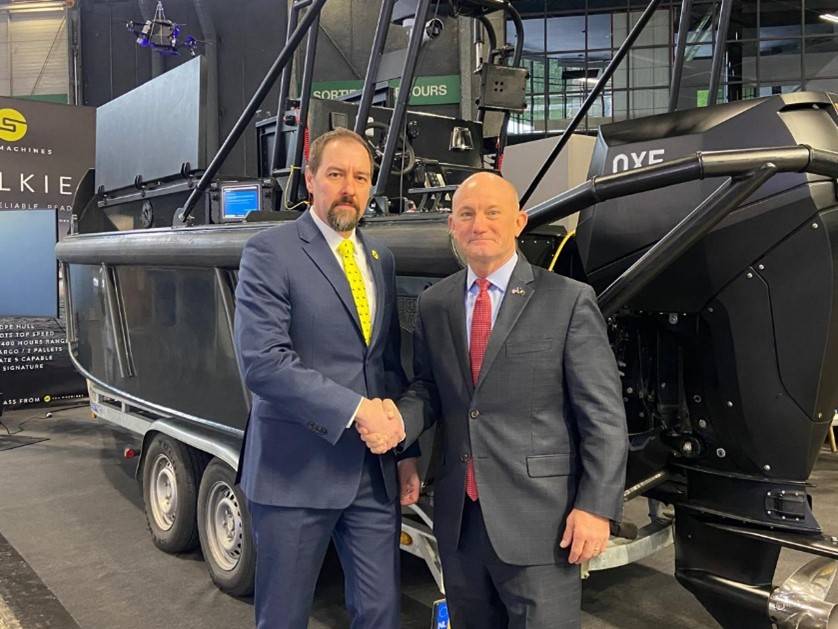
The portfolio continued to expand. In September 2025, Sea Machines announced six products for defence customers, including updated autonomy hardware, software interfaces, a fleet data platform and the eight-metre STORMRUNNER vessel. In April 2026, it appointed Tokyo-based Shintoa Corporation as its authorised value-added reseller in Japan, covering commercial and defence applications.
Johnson’s public biography also describes a conservationist who wants innovation to work alongside the natural world. That concern fits the setting of his career: the ocean is both a workplace and an environment. His aspirations extend beyond getting a boat from one point to another. He wants maritime operations to become more capable, predictable and productive.
For now, his work remains attached to recognisable objects: a tug, a controller, a vessel that needs to hold its course. The first cadet voyage taught him the scale of the sea. The company he founded addresses a smaller, persistent question within it: how much of the next hour’s steering can a machine usefully take on?
Keep a weather eye
Follow Johnson on LinkedIn, visit Sea Machines Robotics, or explore the company profile.
↗ Watch: Delivering the Vision · 2021 interview↗ Watch: Maritime Matters · SELKIE and autonomy, 2024Further reading: Johnson’s 2019 interview · Congressional biography · Japan partnership announcement.