A shipping container is an object of magnificent indifference. It does not care whether it holds shoes, coffee or furniture. A crane lifts it, a ship carries it, and another crane puts it down. Fleetzero’s original insight was to give this familiar box an unfamiliar passenger: the electricity that moves the ship itself.
- Fleetzero builds batteries and propulsion for existing ships as well as new vessels.
- Its early battery-swapping idea treats energy as cargo that ports already know how to handle.
- A $43 million funding round and a 2026 autonomy launch have widened the business beyond electric freight.
Consider the conventional objection to an electric cargo ship. A long voyage requires an enormous battery. That battery occupies space and adds weight. The obvious response is to ask for a better battery. Fleetzero asked a different question: must the ship carry all the energy for the entire journey?
In its early plan, vessels would call at intermediate ports, unload depleted batteries and collect charged ones. The ship could move while its previous batteries charged ashore. Ordinary container-handling equipment would do the lifting. Charging time and sailing time would cease to be the same problem.
The men who knew the engine room
Steven Henderson and Mike Carter grew up together in the mountains of North Carolina, an improbable departure point for a shipping company. Both studied marine engineering at the U.S. Merchant Marine Academy. Henderson later worked aboard a hospital ship in West Africa and in offshore energy. Carter worked in energy before moving into enterprise software.
They founded Fleetzero in 2021. Their expertise concerned the machinery inside a ship, along with the practical business of keeping it running. That distinction matters. A propulsion system has to survive installation, saltwater, maintenance schedules and the judgment of people who would prefer their voyage to remain uneventful.
In a 2022 interview, the founders recalled an insight reached while talking from separate backyards. First-pass calculations made ship electrification look unpromising. Rethinking the operating system around the battery opened another possibility. The memorable change was a calculation, rather than a conversion to environmental virtue.
A crane is already waiting
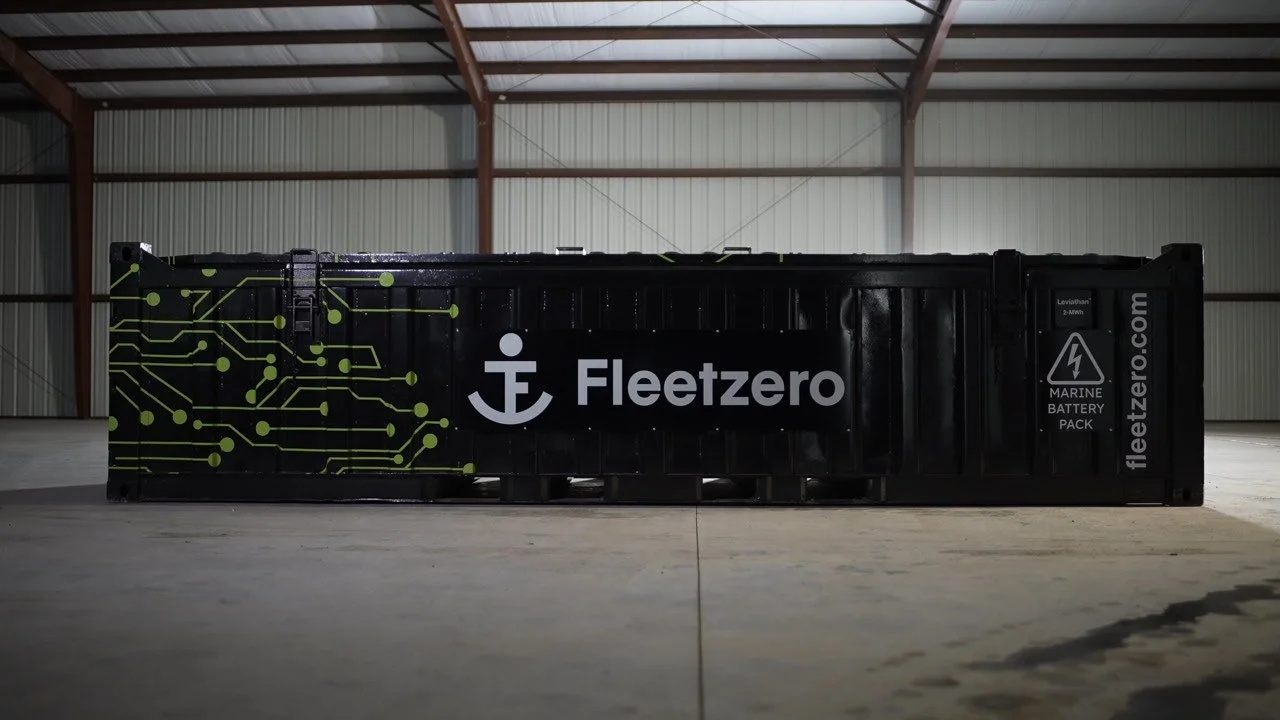
The original swappable packs used a standard 20-foot container format. This was an infrastructure decision as much as a packaging decision. Ports would need electricity and charged inventory, but the battery could travel through a handling system built for something else.
Sharing batteries across ships offered another potential saving. A fleet could coordinate charging and departures instead of treating every vessel as an isolated battery owner. The attractive economics depended on the network: the ports, distances, schedules and availability of another charged pack.
Battery stays ashore
Crane swaps containers
Ship takes the next leg
Energy inventory moves through the fleet. Charging need not immobilize the vessel.
There is a useful lesson here for anyone building expensive hardware. Standardize the interface before asking customers to rebuild their world. A container earns its keep because thousands of other machines already understand it. A clever battery benefits from the same courtesy.
Leviathan must behave itself
Fleetzero’s Leviathan energy-storage system supplies the battery building blocks for its propulsion platform. The company describes configurations starting at 200 kWh and scaling upward, with optional liquid cooling for demanding power applications. Its stated chemistry contains no nickel, manganese or cobalt.
At sea, safety belongs inside the product argument. Fleetzero describes proprietary passive prevention of fire spreading between cells. It also says its systems were designed and tested against several marine classification societies’ rules. Those statements describe its engineering approach; they should not be casually enlarged into universal certification.
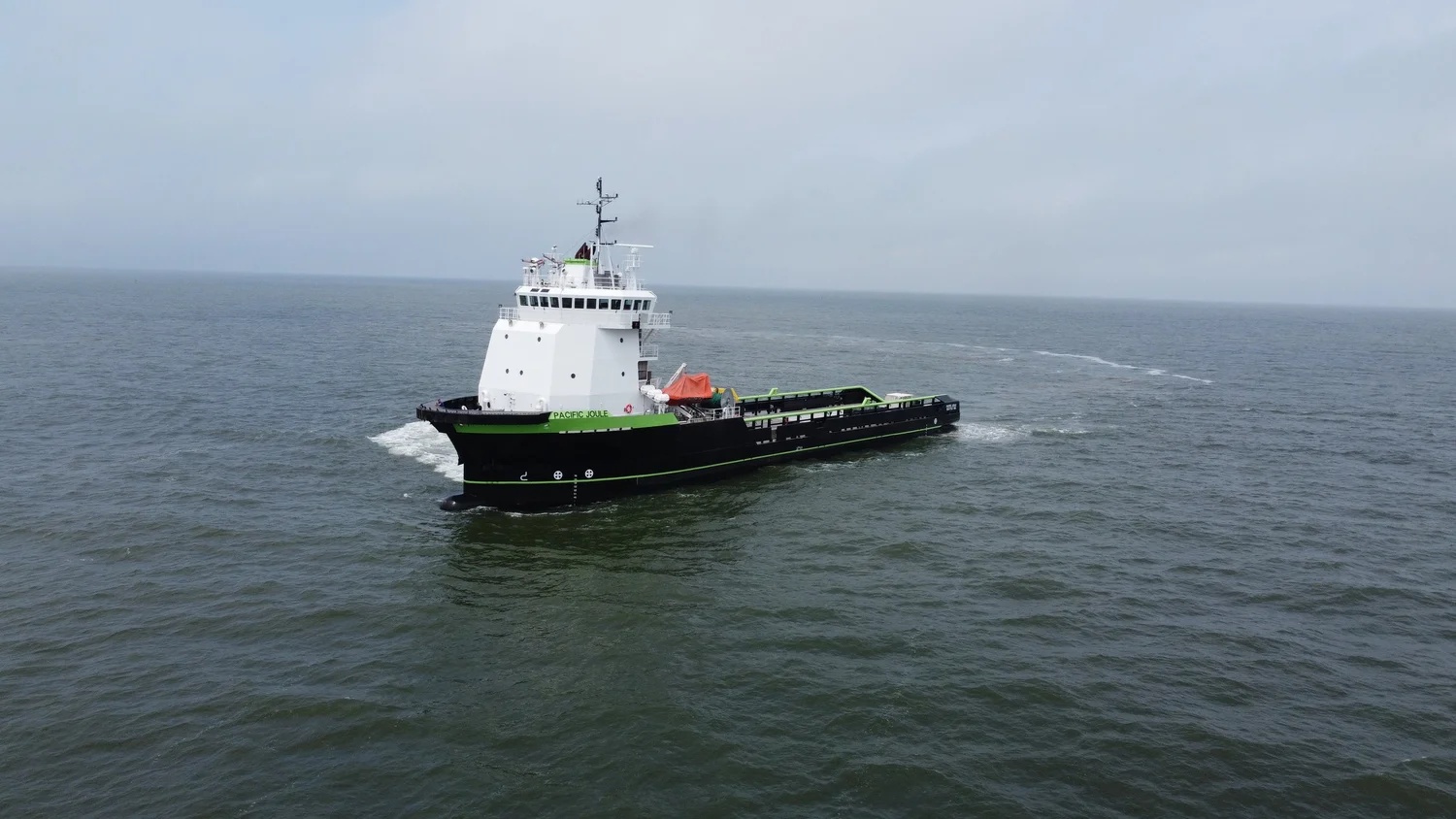
Its test vessel, Pacific Joule, supplied a place to put the components together. Fleetzero reports successful tests of modular propulsion, autonomy and camera vision aboard the ship. The machinery had to meet a vessel, rather than remain a handsome arrangement on a presentation slide.
The customer already owns a boat
Today’s proposition reaches beyond operating an electric cargo network. Fleetzero sells hybrid and electric propulsion systems for new and existing commercial vessels. An owner can therefore consider changing the machinery before replacing the whole ship.
AET provides a concrete example. Its announced project will retrofit a lightering support vessel with plug-in hybrid-electric propulsion. These vessels support transfers of cargo between ships. AET forecasts about 82% lower tank-to-wake greenhouse-gas emissions, subject to operating assumptions. Glosten joined the design work in 2025.
Lower tank-to-wake greenhouse-gas emissions against conventional support vessels. An estimated project outcome, not a measured fleet result.
For the buyer, the cost comparison runs across the vessel’s working life. Batteries and integration require capital up front; the intended payback comes through fuel and maintenance savings. A ship that spends much of its time near a charging point presents a different proposition from one crossing an ocean without stopping. The relevant price is the price of completing the job.
Corvus Energy and EST-Floattech also supply marine batteries; modularity alone does not distinguish Fleetzero. Its particular bet combines energy storage, propulsion integration and increasingly vessel autonomy. Customers are buying an operating system for the boat as well as a place to store electricity.
From engine room to remote cockpit
In January 2026, Fleetzero announced a $43 million Series A led by Obvious Ventures, with Maersk Growth among the participants. Its Houston manufacturing and research headquarters has an announced initial capacity of 300 MWh a year. Capacity is a factory specification, not a sales total.
June brought a collaboration with Thoma-Sea and Glosten on autonomous vessels, followed by the commercial launch of OctoDrive software, the fixed OctoPod command center and portable OctoBox integration package. The intended users include commercial and defense operators.
“Electrification unlocks autonomy at sea.”Mike Carter, co-founder and COO, June 2026
The connection is mechanical: less engine maintenance can reduce the need for intervention aboard. Remote operation still depends on communications, suitable missions and permission to operate. Nor does battery shipping escape geography. Long uninterrupted voyages, inadequate charging or costly electricity can spoil the arithmetic.
The practical starting point for a fleet owner is a route and duty-cycle assessment: energy demand, port access, downtime and integration. Fleetzero’s most transferable idea remains pleasingly mundane. Before demanding a miracle from the battery, examine what the crane can do.