01 / Who they are now
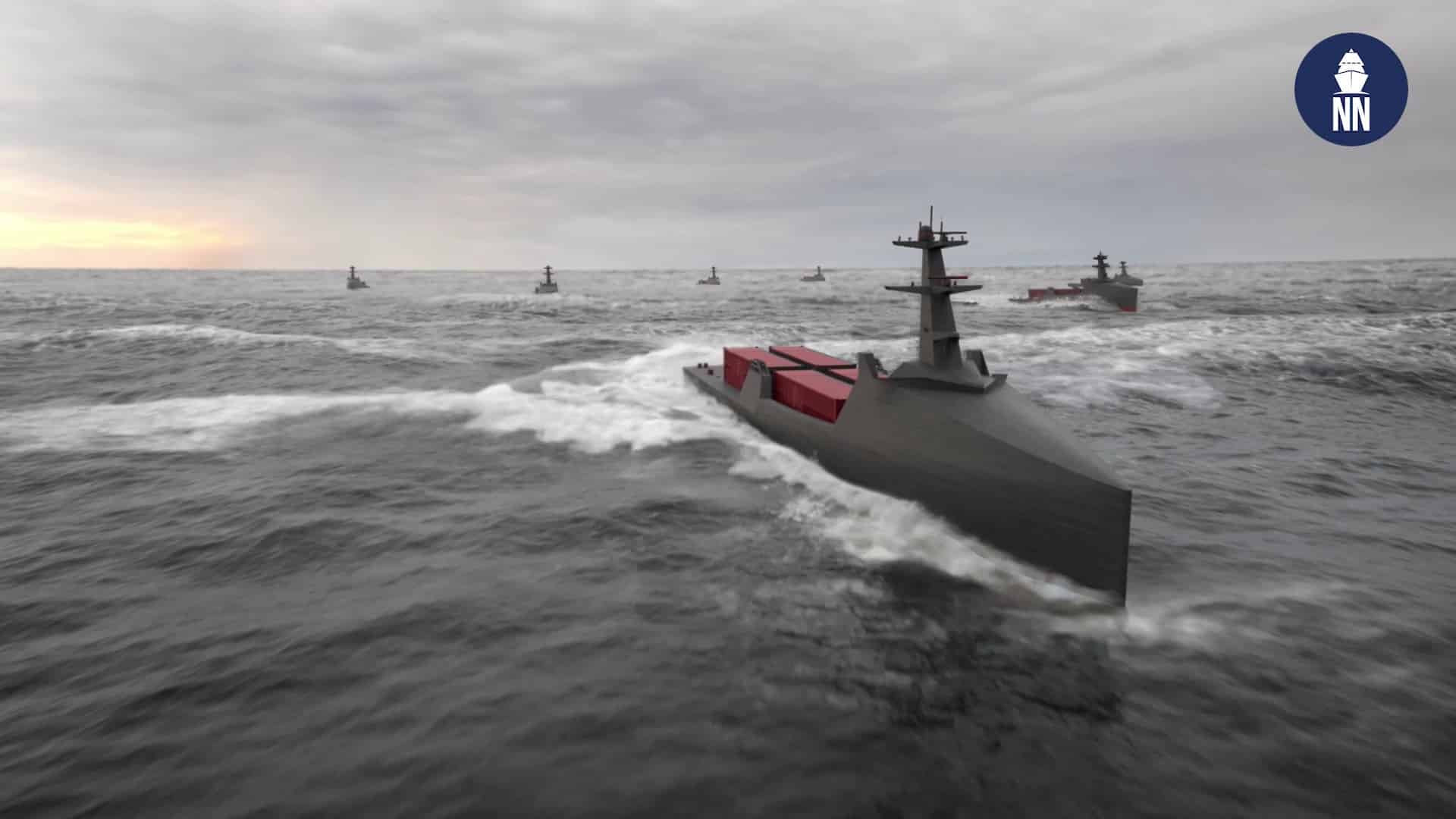
A 190-foot warship is taking shape inside a Louisiana shipyard. It has no bridge worth the name, no berthing, no galley, no crew. That is the point. Blue Water Autonomy builds ships that go to sea so people do not have to.
In February 2026 the company pulled the cover off the Liberty Class - steel hull, axe bow, over 10,000 nautical miles of range, more than 150 metric tons of payload. Construction starts in March at Conrad Shipyard, with a first delivery expected before the year is out. For a company that did not exist before 2024, that is an unusually short distance between idea and keel.
Most defense startups sell a slide deck. Blue Water is building something you can weld.
- The case for ships you can actually point at
Boston is the headquarters. There are now outposts in Washington D.C., Morgan City, and San Diego - the three coordinates of any modern defense company: where the money is decided, where the steel is cut, and where the Navy actually floats. The team is roughly fifty people and growing, drawn from Amazon Robotics, iRobot, the U.S. Navy, and DARPA's crewless ship program.
02 / The problem they saw
The Navy has a math problem
The United States wants a bigger fleet. It also builds ships slowly, expensively, and in shipyards that have thinned out over decades. A modern destroyer takes years and crews of hundreds. Adversaries, meanwhile, are launching cheaper hulls faster. The gap between what the Navy needs and what it can build is the entire premise of this company.
The conventional answer is to build more big crewed ships. The expensive answer. Blue Water's founders looked at the same problem and asked a quieter question: what if the ship did not need a crew at all, and what if you designed it from the first sketch to be built like a product rather than a monument?
A warship that takes five years and a thousand sailors is a beautiful thing. It is also a single point of failure you can see from space.
- The uncomfortable arithmetic of modern naval power
Crew is the constraint that drives almost everything else. Remove the people and you remove the berthing, the life support, the safety margins built around keeping humans alive at sea for months. What is left can be smaller, cheaper, and stranger - and it can stay out far longer than any human deployment would allow.
03 / The founders' bet
Three people who had done this before
Blue Water Autonomy was co-founded in 2024 by three people whose resumes read like a deliberate Venn diagram of the problem.
Started in the U.S. Navy as a surface warfare and engineering officer. Went to Harvard Business School, then to Amazon Robotics, where he helped deploy thousands of warehouse robots. He founded 6 River Systems, an autonomous mobile robot company, and sold it to Shopify for $450 million.
Navy bridge + robotics floor + an exit that proved he can scale hardware.
Scott N. Miller - CTO
An ocean engineer with an MIT master's. Former VP of Engineering at iRobot and founder of Dragon Innovation, a firm built around getting hardware to actually manufacture at volume.
The person who worries about whether the thing can be built, not just designed.
Austin Gray - CSO
Former U.S. Navy intelligence officer who worked on Pentagon technology and supported Ukrainian drone manufacturing - a front-row seat to how cheap, autonomous machines reshape a fight.
The strategist who has seen what asymmetric hardware does in a real war.
The bet is simple to state and hard to execute: pair Silicon Valley's appetite for autonomy and manufacturing with the Navy's appetite for hulls. Investors agreed. The company emerged from stealth in April 2025 with $14M in seed funding from Eclipse, Riot, and Impatient Ventures, then raised a $50M Series A led by GV that August. Total raised: $64M. GV Managing Partner Dave Munichiello - who had backed Hamilton's robotics work before - took a board seat.
This funding gives our team the resources to build long-range autonomous ships from the keel up that will operate on the open ocean for months.
- Rylan Hamilton, CEO & Co-Founder
Milestones
Keel to coverage, fast
2024
Founded
Hamilton, Miller, and Gray start the company in Boston.
Apr 2025
Out of stealth
$14M seed from Eclipse, Riot, and Impatient. Salt-water testing and concept designs already underway.
Aug 2025
$50M Series A
Led by GV. Total raised hits $64M. Team quadruples; D.C. office opens.
Feb 2026
Liberty Class unveiled
190-foot autonomous ship, developed with Damen on a Stan Patrol 6009 hull.
Mar 2026
Construction begins
First hull starts at Conrad Shipyard; first delivery expected later in 2026.
04 / The product
The Liberty Class
The Liberty Class is not a converted patrol boat with a laptop bolted in. It is a fully unmanned ship, built around a full-stack autonomy suite - hardware, software, and AI integrated from the start. The hull borrows a proven design: Damen's Stan Patrol 6009, with an axe bow that slices through waves instead of slamming over them, so the ship stays steady and stays out longer.
The payload bay is deliberately agnostic. Logistics one mission, surveillance the next, munitions after that. The ship is the truck; the cargo is the strategy. And because it was designed for repeat production rather than one-off heroics, the second one should be cheaper and faster than the first - the opposite of how most naval procurement behaves.
The Liberty class reflects our focus on building autonomous ships designed from the start for long-duration operations and repeat production.
- Rylan Hamilton, CEO
05 / The proof
Receipts, not renderings
Defense is a field full of confident renderings. What separates Blue Water is the speed of its physical progress. Within roughly a year of founding it was running on-water engineering tests and had lined up long-lead materials from more than 50 suppliers - the unglamorous tell that a company intends to actually build, not just announce.
The team is the other proof. Alongside the robotics and Navy founders sit shipbuilding veterans with a track record of delivering 30-plus vessels to the U.S. Navy, including destroyers and amphibious ships, plus alumni of DARPA's crewless NOMARS effort. The partnerships line up behind them: Damen for the hull, Conrad Shipyard for construction, GV for capital and credibility.
Funding raised since exiting stealth
Cumulative capital, USD millions. The Series A more than quadrupled the bank.
Sources: PR Newswire, Fortune, GV. Bars scaled to total raised.
There is policy tailwind too. The Pentagon has accelerated plans for medium unmanned surface vessels, with roughly $2.1B in new Congressional funding pointed at exactly the category Blue Water builds. A startup with a program of record and a hull in the water is in a different conversation than one with a pitch deck.
06 / The mission
Revitalizing American shipbuilding
Blue Water frames itself less as a robotics company and more as a shipbuilding company that happens to remove the crew. The stated mission is to revitalize U.S. shipbuilding through designs engineered to scale - to make hulls a country can produce in numbers again, not just admire in ones and twos.
We are forging the future of naval power. We are revitalizing US shipbuilding through designs engineered to scale.
- Blue Water Autonomy, mission statement
It is a tidy bit of irony that the path to a stronger human Navy might run through ships with no humans on them. The crew you save is not eliminated - it is freed to do the things only people should do, while the steel handles the thousand-mile transit and the boring months on station.
07 / Why it matters tomorrow
The fleet, recounted
If the bet pays off, the unit of naval power stops being the single expensive ship and starts being the production line. Quantity becomes a quality the U.S. has lacked at sea for a generation. If it fails, it will be because building ships is genuinely hard and the sea does not grade on ambition.
Either way, the question Blue Water forces is the interesting one. For a century the warship has been the most human machine in any military - hundreds of lives, sealed in steel, sent over the horizon. Back in that Louisiana shipyard, the 190-foot hull is still taking shape. When it slides into the water later this year, no one will climb aboard to take it to sea. It will simply leave. That is the whole idea, and it is a genuinely new picture of what a fleet can be.