Consider a person trying to buy foreign currency before a trip. A map can find the closest bank branch. A chatbot can explain opening hours. Neither answer settles the question that matters: does that branch have the cash? The distance between a plausible answer and a useful one can be a wasted journey across town.
- GlobalTask connects AI to existing business systems.
- Its focus is banks, fintechs, and insurers in Latin America.
- The work includes data, cloud, custom software, and specialist teams.
The branch with the money
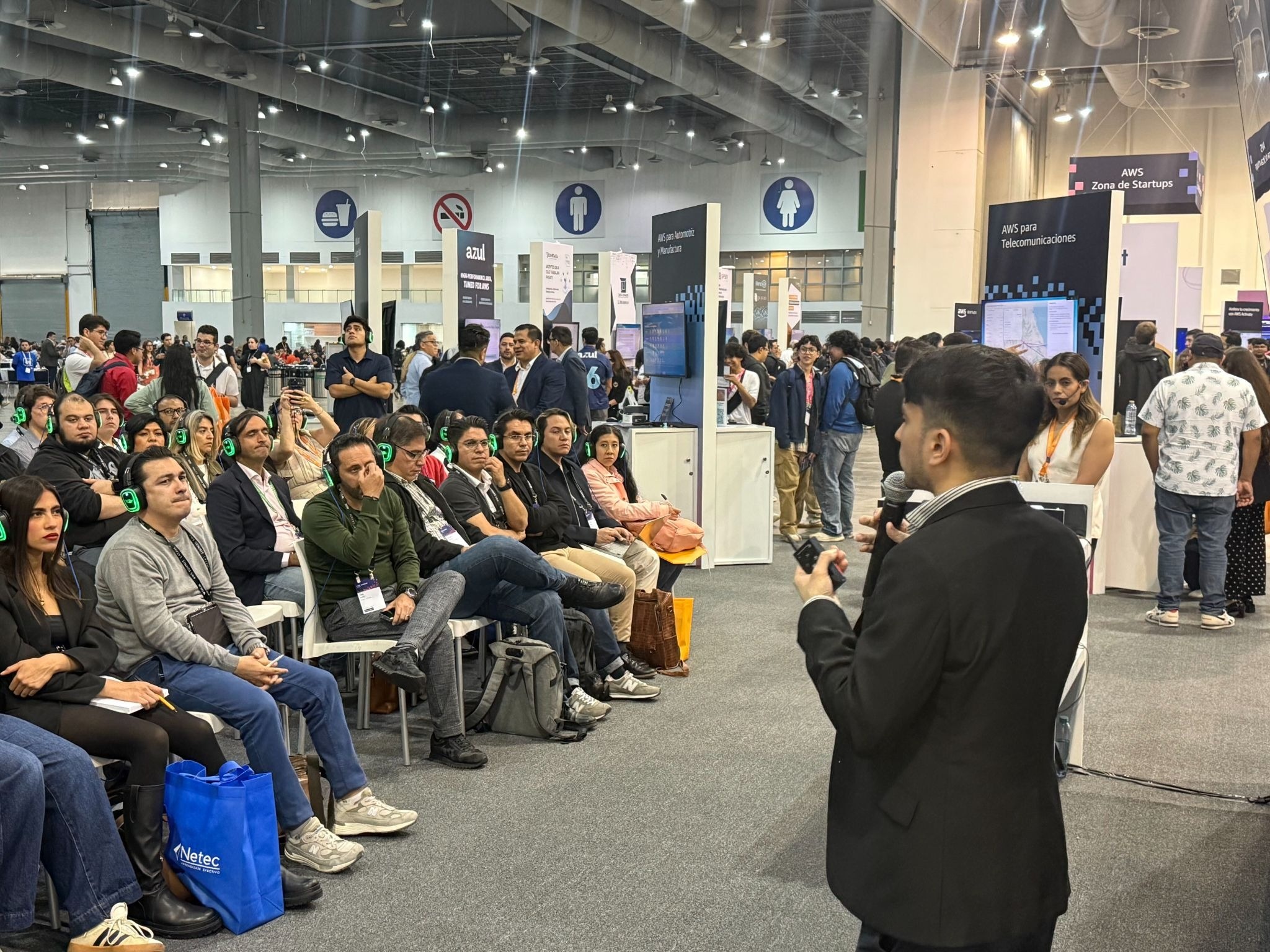
In a September 2026 account of AWS Summit Mexico, GlobalTask described a project presented with Grupo Salinas and AWS. A customer uses WhatsApp to say what currency they need and where they are. The service combines that request with location and inventory information to identify nearby branches with availability. The same operational data can help inform cash redistribution between branches.
The interesting thing is how little of this problem belongs to conversation. Understanding a request is one step. Finding a trustworthy inventory record is another. Connecting the two creates something a customer can act on. For GlobalTask, that connection is the business.
The company sells AI implementation, data strategy, cloud modernization, and engineering capacity, concentrating on financial services and insurance in Latin America. Think of it as a specialist delivery partner for organizations whose new ideas must work with systems already carrying the business. Its proposition combines industry familiarity with the ability to build and integrate software.
For a bank deciding what to buy, this means evaluating a service across several layers. Can the team understand the process? Can it reach the required information? Can it change the software safely? The examples suggest why GlobalTask sells these capabilities together: a useful interface depends on decisions made well below the screen, and often across more than one department.
Three months to make checkout work
An earlier Elektra project makes that proposition concrete. The Mexican retailer wanted cryptocurrency payments within five months. According to GlobalTask’s case study, two months had passed when it joined. Three remained. Accounting decisions around crypto compliance had their own lead times; development needed room to move while those decisions were being made.
GlobalTask describes using independently deployable microservices, its own cloud instances for testing, and a separate payment service designed to absorb transaction peaks. The architectural choice reduced dependencies between workstreams. The case study says the product launched during Buen Fin, Mexico’s discount-shopping season.
Then came documentation, API guidance, and mentoring. GlobalTask says Elektra took ownership shortly after launch. That detail deserves attention: an outside team can deliver quickly and still leave a client dependent on it. Here, the stated goal included an internal team able to keep developing the product.
“Their flexibility is impressive.”
Grupo Elektra reviewer, Clutch · May 2022
The copyable lesson is architectural and organizational. Keep one unresolved decision from blocking every other task. Build room for testing. Treat the handover as work with its own deliverables. A deadline makes those choices visible; it does not make them any less useful after launch.
The goddess in the contact center
For Gigared, an Argentine telecommunications provider, the interface had a name: Atenea, after the Greek goddess of wisdom. GlobalTask’s June 2024 account describes building the assistant with Wisehub, its AI platform, and connecting it through APIs to Gigared’s knowledge base, customer relationship management system, and operational software.
Atenea’s described tasks include explaining bills, helping with online payments, and guiding customers through technical support. The company began with a pilot in Gigared’s customer portal. This is a useful distinction for buyers: a general assistant can discuss what a bill usually means; an integrated service can work with the information and processes of the company that issued it.

The price of getting it connected
GlobalTask’s commercial model is professional services: consulting, software delivery, and dedicated or augmented teams. Buyers are commissioning work, with a scope and a relationship to manage. Its Clutch profile lists hourly rates of $50-$99 and a minimum project size of $25,000. Historical reviews put Elektra’s payment engagement in the $50,000-$199,999 band and Uniclick’s credit-card platform MVP in the $10,000-$49,999 band. Those are reported project ranges, not interchangeable price tags.
The feedback also complicates the sales pitch. Elektra’s reviewer praised flexibility while giving cost a lower rating than quality. A development-augmentation reviewer reported generally strong work with minor issues. Neither observation cancels the positive accounts. Both remind a buyer that adaptability, budget, and code quality are separate things to assess.
The relevant alternatives include hiring internally, using another nearshore developer, or retaining a larger systems integrator. GlobalTask’s chosen position is financial-industry expertise paired with implementation. Its AWS relationship provides another route to market: it has an AWS Marketplace seller profile, and reported receiving Best Practice FSI México recognition in 2025.
The delivery model also puts people inside the product decision. GlobalTask offers specialist teams as well as full projects, so a client can add capacity to an existing operation rather than commission an entire replacement. Its public culture statements emphasize teamwork and quality. The practical question is how those values appear in an engagement: who attends planning, who reviews changes, and who can explain the system when the original developer is away?
Start smaller than your ambition
There is a restraint running through the company’s published AI adoption advice. Start with a defined business problem. Choose suitable technology. Establish usable data. Prove a narrower application before extending it into adjacent processes. Saban’s compact phrase is “Good data, good AI.” It is advice a buyer can use before signing anything.
The prerequisites matter. A currency finder needs current inventory. A billing assistant needs access to the right records. Someone must own the workflow, approve changes, and maintain the connections. My reading of these projects is that an organization unwilling to do that supporting work will struggle to get value from the conversational layer.
GlobalTask’s insurance writing makes the same point through scattered spreadsheets and disconnected systems. Its writing on scaling AI adds the people problem: a technical experiment must reach the rest of the organization. The practical test for a buyer is simple. Choose a task, name its owner, identify the necessary records, and decide how success will be measured. Then ask the consultant to show the route from the customer’s question to a completed job.
Website · LinkedIn · Instagram · Facebook · Company blog · AI Ready Spotlight