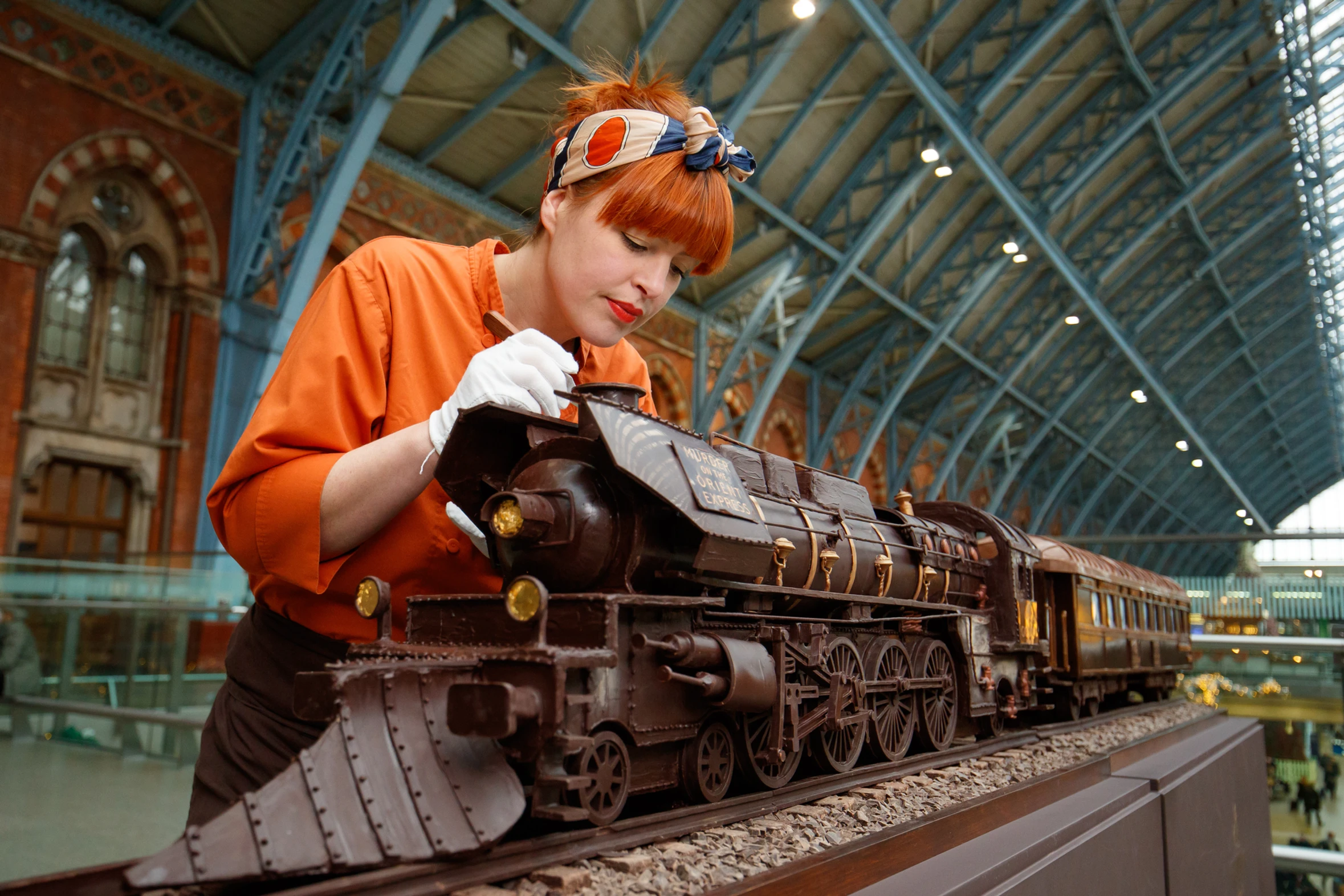
A ten-foot train made from 3,000 chocolate bars is an unusual answer to a marketing brief. It is also an unusually useful introduction to Gina Michnowicz. The train had several jobs: help publicize Murder on the Orient Express, give Godiva something worth sharing, and draw people toward its shop at St. Pancras International. Somewhere between the cinema and the confectionery counter, a business problem acquired wheels.
Michnowicz remembers the project as one of her favorites. The sculpture appeared at the film’s premiere before being displayed at the station. A train belonged in both places, which made the extravagance legible. The chocolate supplied the second half of the connection. Even before anyone reached for a phone, there was something to understand, admire, and talk about.
As founder, CEO and chief creative officer of The Craftsman, Michnowicz works in that space between an objective and an unexpected way to achieve it. Her clients have included Disney, Cisco, Microsoft and Paramount. Her professional history runs through human resources, sales, marketing and management consulting. Her childhood history includes short stories and handmade party invitations. The chocolate train makes a little more sense once those two histories meet.
The girl who drew the invitations
Long before there were clients, there were guests. As a child, Michnowicz wrote stories and drew invitations by hand. She still enjoys throwing themed parties and thinking through the details of the experience. An invitation is a small piece of advance storytelling: it tells someone what kind of occasion to expect and gives them a reason to look forward to arriving.
That interest in the whole occasion survives in her work. A campaign can involve a film, a physical object, a creator’s interpretation and a social post. The pleasure comes from how the parts fit. Her fondness for themes offers a more personal explanation for the agency’s approach than a list of services could. She likes making an idea inhabit a world.
Her first professional training, though, came in human resources, where she worked as an internal consultant. The job developed her ability to collaborate and persuade people to accept change. Those skills became useful when asking a client to support an unfamiliar creative proposal. Someone still has to approve the chocolate train. A charming idea does not arrive with its own purchase order.
When she moved into marketing, she learned through research, listening and doing the work alongside experienced colleagues. Messaging, content, partnerships, events and social media each supplied another way to think about the audience. The breadth matters because her finished campaigns rarely remain inside a single channel.
A consultant’s questions, a maker’s instincts
The move into marketing management consulting widened her range further. She began there as a freelancer working on competitive intelligence, then expanded into messaging and positioning. Work for companies including Microsoft and Cisco helped her build experience as social media became a new professional territory.
Consulting left her with an enduring habit. “Management consultants ask a lot of questions,” she says. For an experiential campaign, questions establish what the client needs, who the audience is and what kind of encounter might make sense. They also give the eventual creative choice something firmer to stand on than the appeal of novelty.
She wanted a business where she could tell immersive brand stories across industries, and where colleagues could develop their own craft. The Craftsman brings together brand strategy, integrated campaigns and experiences, both digital and physical. The services give her room to follow a story across formats rather than forcing every assignment into the same kind of deliverable.
Her entertainment work also informs her technology work. She has described taking inspiration from one industry into another, using the possibilities of film marketing to stretch what a high-tech campaign might do. A technology audience still consists of people with interests, imagination and limited patience. Knowing the product does not require forgetting the person.
“Management consultants ask a lot of questions.”Gina Michnowicz
Couture, now available in chocolate
For Disney’s Cruella home entertainment campaign, fashion supplied an obvious point of interest. The execution required more invention. The creative direction shifted from a life-size chocolate model to miniature chocolate creations based on two of the character’s costumes. The change kept the fascination with the clothes while giving the idea a different form.
The finished pieces went into branded mailers for influencers and media. Disney Eats shared the work on social, and designer Nick Verreos made his own Cruella-inspired design. The objects gave recipients something to photograph; the making of them gave the campaign another story to tell. A dress could have more than one public appearance, even with a rather fragile career in couture.
The agency’s case study lists a dress weight of half a pound and a creation time of 45 minutes. Those details expose the labor inside the spectacle. Someone had to make the shapes convincing at a small scale. Someone also had to make the package part of the experience, so the recipient encountered a coherent idea when opening it.
The integrated campaign won a Clio. That recognition belongs to a larger piece of work, with chocolate among its components. For Michnowicz, the project also demonstrates the value of adjusting a proposal without abandoning its appeal. A smaller object gave the fashion story a way to travel to multiple people.

A good host remembers the outlets
Her work for Booz Allen Hamilton at SXSW in 2019 took a different form. The company wanted to meet people interested in shaping the future. The agency created three activations: custom T-shirt printing at the Startup Crawl, a setting for a Beat Saber tournament, and a room where festival visitors could pause and recharge.
The T-shirts offered six designs with Austin references and a choice of colors. The gaming space used custom signage and neon lighting. The recharge room supplied seating, power outlets, music and coloring postcards. Each answered a different reason someone might stop, whether to make something, play something or finally plug something in.
There is a practical hospitality to this work. Conference visitors have their own plans and their own rapidly declining phone batteries. An activation competes with both. Giving someone a useful or enjoyable moment creates a reason to spend time with a brand, and a better chance of remembering the encounter afterward.
That attention extends beyond event spaces. Michnowicz talks about customer experience as everything from outreach to a website’s ease of use. An elaborate installation cannot do every job for a company. The everyday encounters still shape whether someone wants to return. The party invitation, the welcome and the way home all belong to the same occasion.
- 01 / PremiereGive the film a physical spectacle.
- 02 / StationConnect the train to Godiva’s retail setting.
- 03 / SocialGive people a story to carry onward.
Editorial diagram of the Godiva and film partnership.
When the business partnership ends
Building a business with another person brought Michnowicz a different set of lessons. Before The Craftsman, she co-founded Union+Webster. That co-founding partnership eventually ended. She has since spoken publicly about warning signs she noticed within the first nine months and the importance of thinking carefully about ownership and exit arrangements.
One coincidence became the starting point for a book. Michnowicz and her high-school friend Lynn Julian had gone to different universities, followed separate careers and lived in different states. Both became entrepreneurs, starting businesses with close friends. Both later went through the dissolution of their co-founding relationships.
They signed their respective exit agreements within 24 hours of each other, without knowing at the time what was happening in the other’s company. Supporting one another through those restructurings led them to write Business Bliss or Co-Founder Chaos?, released in January 2024. They interviewed dozens of entrepreneurs across industries and countries, gathering experiences that ranged from successful partnerships to expensive disputes.
The book brings another kind of relationship into her working life: the relationship between people who own a company together. Enthusiasm at the beginning can leave difficult questions unanswered. Who decides? What happens when circumstances change? How does someone leave? Her willingness to examine the breakup gives the founder’s story some useful friction. Creativity still needs agreements.
Making room for the next idea
Michnowicz describes curiosity and the desire to improve as essential to her work. She also identifies time as an obstacle to learning more, using time blocks to protect some of it. It is a recognizable constraint for a leader whose job includes both developing ideas and keeping a company running. The calendar does not expand because the brief is interesting.
Relationships help sustain the business. She says word of mouth is its strongest source of new clients, with existing clients taking the agency into new companies as their own careers change. It is a quieter kind of continuity than a campaign launch, built through repeated work and the confidence to recommend someone.
Her public conversations have continued into 2026, including discussions of brand and demand, experiential campaigns and artificial intelligence. These subjects bring her back to familiar questions about original ideas, customer connection and business results. The tools change; she remains interested in what makes an encounter matter to the person experiencing it.
Asked in 2024 to name her chapter of life, she chose “the magical era.” Asked about advice to her younger self, she wished she had been less hard on herself after mistakes. The combination feels appropriate for someone whose work needs both precision and the freedom to try an unlikely idea. Somewhere on that spectrum sits a ten-foot chocolate train, successfully carrying a brief.
Follow the next thread
The Craftsman’s work · Gina on LinkedIn · Instagram · Twitter/X
Watch: Crafting the Right Marketing Mix
Watch: Creativity in the Age of AI
Watch: Brand, Demand and Experiential Campaigns
Business Bliss or Co-Founder Chaos? · The childhood and career conversation · On Brand conversation · More conversations and articles