The first office was somebody else’s office. Before Tod Martin had a downtown building with an agency inside it, he had a place to work in an accounting practice above a suburban shopping center. It is a useful beginning for a career in advertising: you can have considerable confidence in your ideas while possessing very little real estate.
Martin founded The Martin Group in 2001. Twenty-five years later, the business has become an integrated communications agency, with a reported 108 employees in October 2026. The distance between those facts is easy to express as growth. Look closer, though, and another story appears: a creative director learning how to give other people enough room to do their work.
There are clients in this story, and acquisitions, and a media-company investment. There is also Buffalo. Martin’s ambitions have repeatedly found their expression in its downtown buildings. An address, in his working life, has often become a statement about what might happen next.
The advice that took fifteen years
Martin studied communication design at the University at Buffalo, earning a BFA. His early professional life ran through Buffalo agencies; at Travers Collins & Company he became a partner and creative director. He knew the business from inside an established firm before putting his own name on one.
His decision to become an owner had a long fuse. Recalling an early mentor’s encouragement at a 2015 business roundtable, Martin said fifteen years passed before he made the move. The suggestion had been straightforward: ownership was something he could pursue, too. Advice can sound wonderfully simple when the person delivering it has already survived the consequences.
He started before the September 11 attacks. Looking back in 2024, he acknowledged that the economic uncertainty afterward might have made him hesitate had he still been deciding. That is a revealing admission from someone whose public role involves projecting confidence. The timing mattered. He had already committed when the circumstances became harder to contemplate.
The lesson is modest enough to be believable. A founder can prepare for years and still depend on the moment in which a decision becomes real. Martin had experience and encouragement. Eventually, he also had a desk and a business to keep going.
A client relationship with a wider horizon
New Era became an important part of that business. In 2006, the cap company gave Martin and his team an assignment to introduce its new caps to Major League Baseball. A Buffalo agency was working on something intended to travel far beyond Buffalo. The relationship would continue across the following two decades.
By March 2015, Martin was in Hong Kong, delivering a keynote at a New Era global conference attended by leaders from more than 200 supplier companies. Participants came from manufacturing and commercial markets across several continents. His subject was brand stewardship: the responsibility of keeping New Era’s voice consistent through the creative and production process.
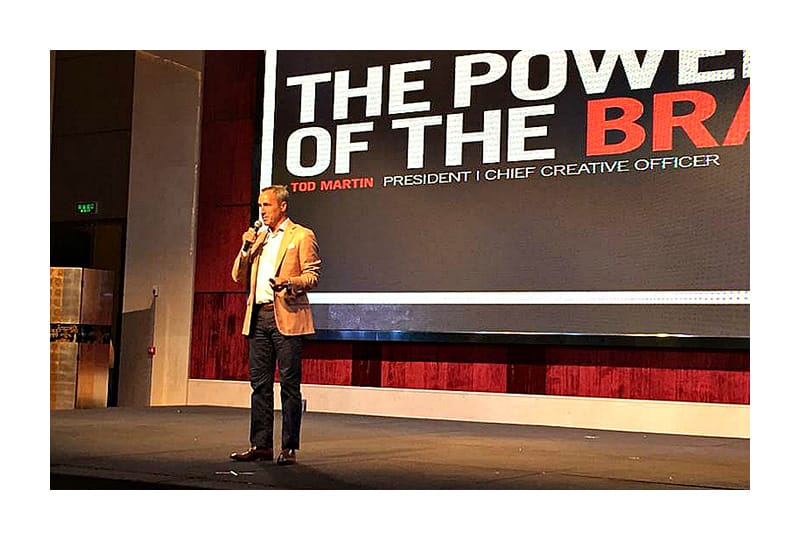
It is an unusually concrete picture of what a branding career can become. A cap passes through many hands before anyone wears it. The idea has to survive all of them. Martin’s place on that stage connected the visual decisions of an agency to the practical decisions of people producing and distributing a physical object.
The setting had changed considerably from a borrowed office. The assignment still required people to agree on what they were making.
Hiring people changes the assignment
One way to follow Martin’s development is through the people who helped build the agency. In January 2014, creative executive Dion Pender returned to the firm after two years at Dixon Schwabl. During Pender’s earlier seven-year stint, the agency had expanded from six people to forty. Martin welcomed someone whose history with the business already included a substantial stretch of its growth.
That return matters because a creative agency’s capabilities reside in people. An account list may attract attention; the people answering the brief determine what the business can actually deliver. Bringing someone back also means recovering a shared vocabulary, a knowledge of clients, and experience that cannot be assembled as quickly as a new presentation.
Lisa Bellacicco joined in 2005 as an account executive and eventually became chief operating officer. Her recollection of asking Martin for a job description is particularly telling. He gave her permission to write her own. In her account, that freedom allowed her to spot gaps and take on responsibilities over time. The position expanded with the person occupying it.
In a separate leadership interview, Lisa Strock identified taking the high road as something Martin had encouraged. Together, those accounts offer a glimpse of his management through colleagues’ experience: initiative had space, and conduct mattered.
The agency becomes more than its founder’s craft
The firm acquired Travers Collins in 2014. For Martin, this carried a personal symmetry: a former employer became part of the company he had started. For the business, it widened the resources available to clients. A career that had once unfolded within another agency now included responsibility for bringing that agency into a different organization.
In 2015, Matt Davison’s AMDG Public Affairs joined the business, forming Martin Davison Public Relations. Davison describes the fit in terms of complementary abilities. Martin’s firm had an established creative practice. Corporate communications, public affairs, public relations, and business strategy made it possible to address a broader set of client problems.
There is a practical change hidden inside the phrase “integrated communications.” A client may arrive needing design and discover that its problem also involves reputation, public policy, or the way its leaders explain a decision. Having those skills together changes the conversation an agency can have. It also changes what its founder has to coordinate.
By August 2015, the business employed more than fifty associates and had been named Western New York’s sixth-fastest-growing company in the Fast Track Awards. Creative work had become the basis for a larger organization. Martin’s responsibility now included making different disciplines useful to one another.
- 2001Founds The Martin Group
- 2014Adds Travers Collins and enters Rochester
- 2015Forms Martin Davison Public Relations
- 2017Moves the agency to 620 Main Street
- 2020Hearst makes an equity investment
- 2026Mr. Smith joins as a distinct division
The building was part of the brief
The agency’s 2013 move to 477 Main Street came with an excellent advertising footnote: the premises had once been a Wendy’s. A building can have several careers, apparently. So can a site that once dispensed lunch.
In 2017, The Martin Group moved to 620 Main Street. This address had its own professional ancestry, having housed the advertising agency Levy, King & White. Martin was taking his expanding firm into a place already connected with Buffalo’s advertising business.
The renovation preserved the marble stairway, plaster cove moldings, and executive office while updating the building’s systems and working spaces. Glass, open areas, and modern equipment joined the older architectural details. Martin’s stated ambition for the surroundings reached toward the kind of space someone might visit in New York, Los Angeles, or Toronto.
Bellacicco’s recollection gives the move its everyday significance. Previously, departments had been separated across annexes. The new headquarters brought people together and allowed room for further expansion. A handsome office may help an agency make an impression. Colleagues being able to find one another is useful on an ordinary Tuesday.
Martin’s investment placed both ambitions at the same address. The business could present itself with confidence and give the people doing its work a more coherent place to do it.
Partners at a different scale
In 2020, Hearst made an equity investment in The Martin Group. Martin and his leadership group retained ownership. The relationship had developed through earlier joint work, including an Excelsior College project, before the formal investment.
For a Buffalo founder, it was another way to extend what the agency could offer. Hearst brought a much wider media and technology network into the relationship. The agency continues to describe itself as independent, with the investment adding access to data, insights, and reach.
Growth continued through specialist additions. The May 2026 acquisition of Mr. Smith brought eight people, including founder Rob Dimmer and partners Chrissy Pyne and Collin Wittman, into the firm. The studio retained its name as a distinct division; existing clients would continue working with their account teams.
Keeping that identity was a meaningful choice. A smaller studio’s name can stand for a particular set of relationships and expectations. In this case, the combination preserved a recognizable point of contact while offering more capabilities around it. The founder’s organization had become large enough to contain another founder’s brand.
What remains after the anniversary
Martin’s public commitments extend into Buffalo’s civic life. His agency biography lists him as a trustee of the Western New York Public Broadcasting Association and identifies board involvement with the BISON Children’s Scholarship Fund and the WNY Law Enforcement Foundation. His working world includes institutions whose purposes reach beyond marketing.
When the agency marked twenty-five years in 2026, his own reflection returned to the people and assignments that had carried it forward. The telling detail was his continuing pleasure in doing the work. Asked by the occasion to look back toward his original intentions, he admitted he could not precisely remember them. He had been occupied with the next job.
“I was too busy doing work that I still love”
Tod Martin, October 2026
For a person paid to help organizations articulate themselves, it is an appealingly unpolished admission. The founding vision had been overtaken by the experience of building the company. Other people had arrived, clients had changed the possibilities, and the rooms had grown larger.
There is still a founder at the center of this story. Around him, increasingly, there are people with their own expertise and responsibilities. Martin’s next assignment is taking shape in their company.