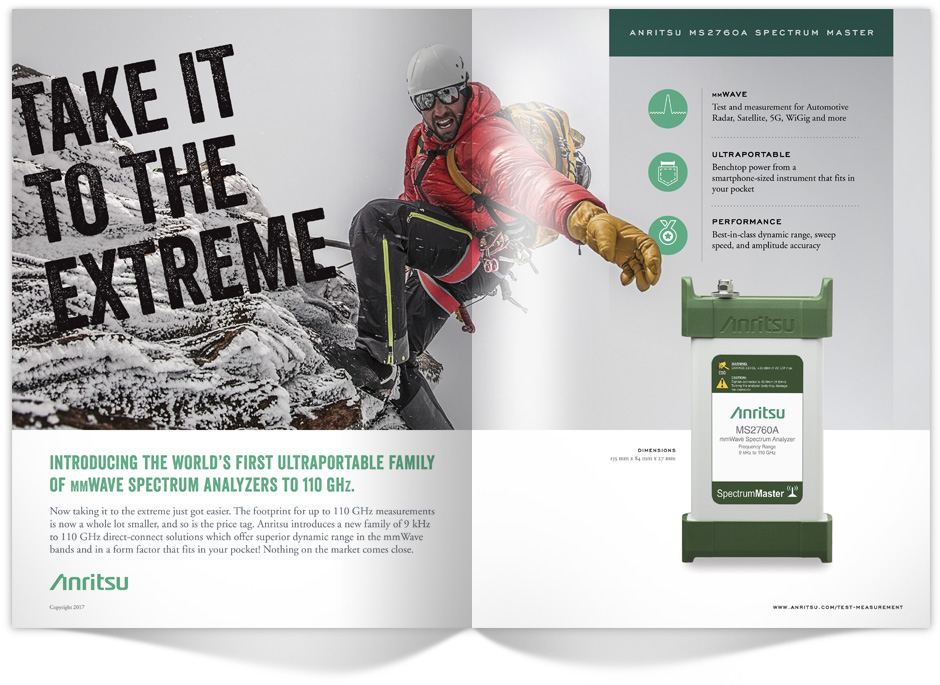
There is a small green machine sitting at the bottom of an advertisement by The Stephenz Group. It is a spectrum analyzer, the sort of instrument whose name can make a civilian's eyes slide toward the nearest exit. On the opposite page, an ice climber hangs off a frozen wall. Across the rock, in block letters, are five words: “Take It to the Extreme.” Suddenly the instrument is not an arrangement of frequencies and acronyms. It is pocket-size. It is rugged. It belongs in the field. You understand the product before you understand the product.
That transformation is the San Jose agency's real line of business. Officially, The Stephenz Group sells branding, communications and digital services. Practically, it helps companies explain complicated things without sanding away the complication that makes them valuable. Its portfolio includes semiconductor components, mmWave test equipment, smart-building systems and pharmaceutical programs. These are products with specifications, committees and buying cycles. They do not sell themselves.
The business of the second sentence
Technology companies are usually good at the first sentence. They can tell you what they built. The trouble arrives with the second: why should anybody care? Anritsu had produced what it called the world's first ultraportable family of mmWave spectrum analyzers. The specifications mattered - up to 110 GHz, a smartphone-size instrument, work in remote conditions - but the specifications were not yet a campaign.
The Stephenz Group found the physical truth hiding inside the technical truth: this serious bench capability could travel. “Take It to the Extreme” made portability visible. The agency then extended the idea into vertical markets with banners and social media aimed at engineers and technicians. One concept did several jobs - product introduction, category education, market expansion and lead generation.
The best idea in a complicated campaign is often the one that survives being moved from a sales call to a banner ad.The Stephenz pattern, in one line
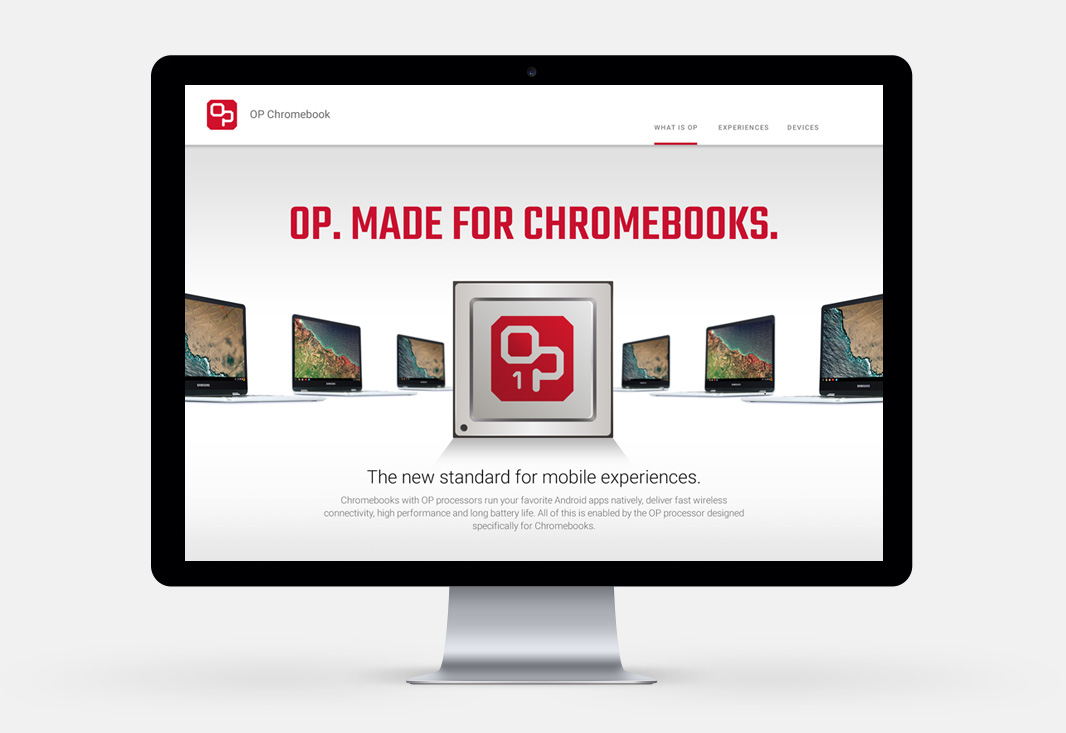
The method repeats elsewhere. ARM needed a separate site to explain an “OP” Chromebook proposition while respecting multiple partners' brands. The agency led with mobile life, real applications and friendly icons, then used a 3D product video to turn processor capability into something a buyer could see. Enlighted needed to distinguish its building technology in a crowded IoT market. The answer was a verbal hinge: “Beyond Smart Buildings. Brilliant Buildings.” The site connected that line to concrete outcomes - savings, sustainability, efficiency and the daily experience of the people inside.
Small enough for PowerPoint, large enough for Samsung
The range is revealing. The Stephenz Group's services page begins with brand strategy, value propositions and positioning. It ends with social media and mobile applications. Its Studio division goes further down the ladder into the work agencies often pretend happens by magic: presentation cleanup, templates, trade-show support, infographics and video. The same organization that can frame a market can also repair the deck for Tuesday's meeting.
That breadth is not an accident. A position is only useful if it survives contact with the materials a company actually uses. Break the work among a brand consultancy, a web shop, a performance agency and a production vendor, and every handoff becomes a chance for the central idea to weaken. The Stephenz model keeps more of that chain together. Clients buy judgment at the top, execution at the bottom and fewer translations in between.
The public numbers are a snapshot, not an audited portrait. The company's site reports a staff of more than 35 and $70 million in billings; current third-party datasets put the headcount lower. The more durable evidence is the client list. The agency says it has worked from startups to the Fortune 100, and its public roster includes HP, Qualcomm, Epson, Gilead, Infinera, Samsung, ARM and Anritsu. Different industries, same recurring problem: somebody inside the client understands the product deeply, while somebody outside still needs a reason to lean in.
What broke first was navigation
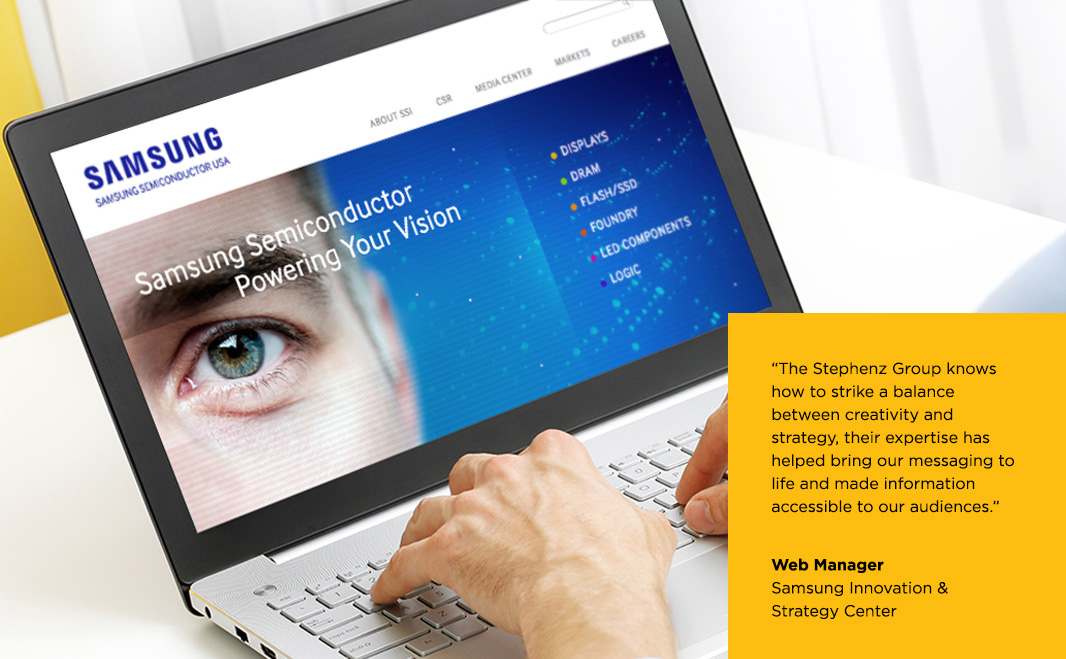
The Samsung Semiconductor assignment offers the least glamorous and most useful lesson. The company had advanced components, multiple markets and plenty to say. Its website needed an interface and architecture that connected products to campaigns and made the catalog easier to navigate. According to the agency's case study, the redesign increased traffic and click-throughs while reducing bounce rates.
This is where creative mythology meets information hygiene. The job was not merely to invent a bright line. It was to organize content, build stronger campaign banners and create routes through a large product range. The agency also developed an internal site for Samsung's research-and-development network, a repository and communication venue for a global organization. One site persuaded. The other helped people work. Both depended on understanding where a user would get lost.
An independent agency with two speeds
Barbara Zenz founded the company in 1981 and remains its president and CEO. The company describes her role in terms of client advocacy, business development and the strategic direction of the agency. Executive creative director Stephanie Paulson leads the creative side, with work across HP, Epson, Qualcomm and Gilead. That is a classic independent-agency pairing: one leader protecting the business problem, another protecting the expression.
The firm has also learned to package its capabilities. While working with security-technology companies, it spotted a neglected market: thousands of independent alarm dealers competing with large cable companies but lacking professional marketing resources. That observation changed the offer. MyStudioPros launched in 2016 with on-demand services and an optional VIP membership priced at $50 a month, providing discounts and access to planning and creative help. Instead of selling an open-ended agency relationship, it offered a clearer vertical bundle: yard signs, flyers, lead generation, websites, social media and SEO. The Studio unit provides the other speed - cost-conscious production for businesses that need the work finished quickly. Strategy may be bespoke; production benefits from a menu.
Where it fits
B2B and enterprise teams with a technical story, several channels and a real need to keep the message coherent from campaign to sales material.
Where it does not
Buyers seeking self-serve software, commodity pricing or a single narrow specialty will find the integrated agency model heavier than necessary.
The part worth copying
Most companies cannot copy a four-decade client history, and they should not try to copy the look of somebody else's campaign. They can copy the sequence. Begin with one distinction rooted in the product. Express it in language short enough to travel. Give it a visual that proves the claim rather than decorating it. Then test whether the idea survives on a website, in an ad, on a sales slide and at a trade show.
The conditions matter. This approach works when the underlying product has a meaningful difference and the company is willing to repeat a clear message. It weakens when every stakeholder adds a qualification, when the product cannot support the promise, or when each channel is run as a separate kingdom. Connected marketing is not the act of appearing everywhere. It is the discipline of remaining recognizable wherever you appear.
That may explain the odd durability of The Stephenz Group. Silicon Valley has changed its favorite vocabulary many times since 1981. Mainframes gave way to personal computers, websites to mobile apps, connected devices to smart buildings. Yet the agency has kept doing a version of the same job. A technical team builds something difficult. A market squints at it. Somewhere in San Jose, somebody looks for the mountain climber.
Continue exploring