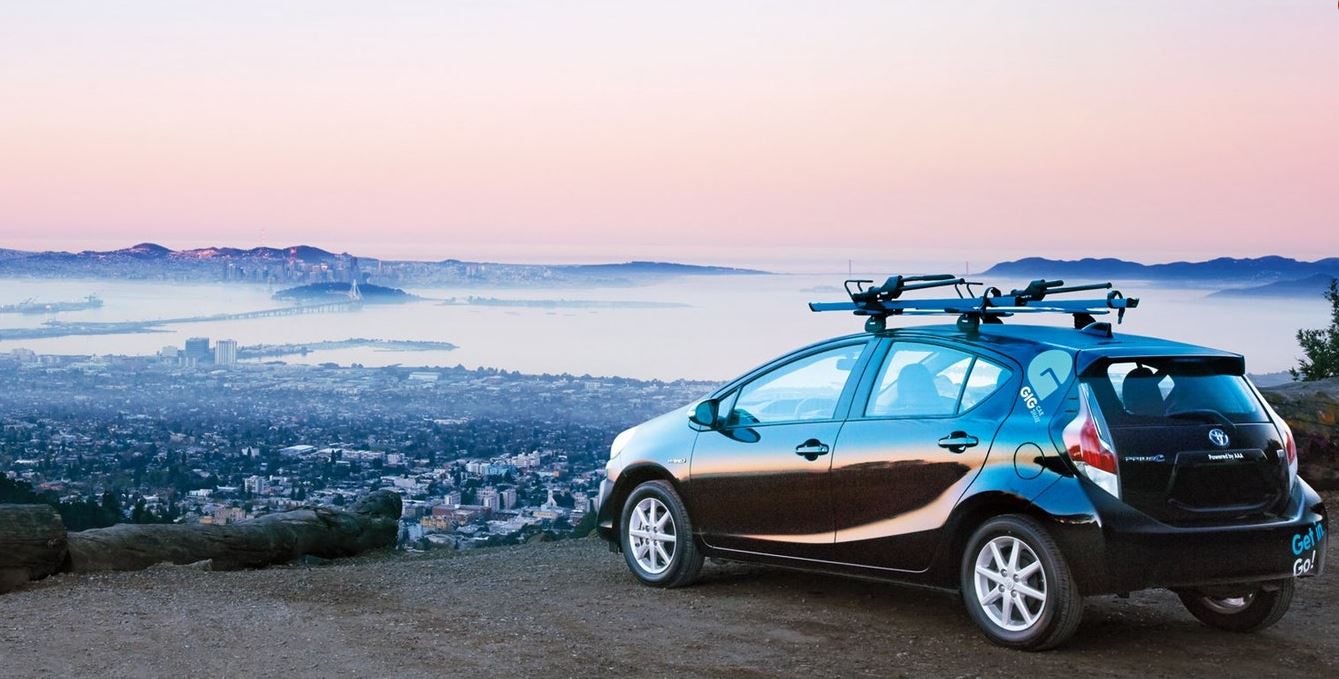
The bicycle racks were the giveaway. On the roof of each little black GIG Prius sat a pair of blue racks, an odd accessory for a company renting cars. They suggested a customer who might arrive on two wheels and leave on four. Here was an automobile service making room for someone who did not organize every journey around an automobile.
- The freedom: find a car, unlock it, leave it at another eligible spot inside the HomeZone.
- The catch: somebody still had to fuel, clean and manage that fleet.
- The ending: AAA closed GIG on December 5, 2024, after citing lower demand and higher costs.
That was the proposition behind GIG Car Share. Launched in Oakland and Berkeley in April 2017, the service came from A3Ventures, the innovation lab of AAA Northern California, Nevada & Utah. An organization associated with helping stranded car owners was trying to serve people who might prefer not to own a car at all.
The parking space was the product
Start with the small inconvenience GIG removed. With a conventional round-trip car share, the return journey comes attached to the outward one. You collect a car from its assigned space and owe that space a car later. GIG let you finish somewhere else within a defined service area, its HomeZone. The return obligation shrank from a particular parking space to a patch of city.
The customer found a vehicle in an app, unlocked it and drove. Eligible parking, fuel and insurance were bundled into the rental, subject to the terms. Drivers could leave the HomeZone during a trip, but ending it required returning to an approved location. You were borrowing a car, not hiring a driver.
That distinction put GIG between several familiar alternatives. A taxi or ride-hailing service carried you; GIG let you carry your own shopping, choose your stops and keep the vehicle. Station-based car sharing offered predictable pickup locations; GIG offered a more flexible ending. Its advantage depended on which inconvenience mattered most to the customer.
Oakland and Berkeley’s parking arrangements helped make that freedom possible. The app could show a car, but city permission determined whether the next driver could leave it near a destination. Treat the curb as an afterthought and the promise becomes much less useful. In GIG’s case, municipal cooperation belonged near the center of the product.
A car for the people on bicycles
GIG began with 250 Toyota Prius C hybrids. Within a year, the fleet had doubled. In 2019, Sacramento added a different experiment: 260 electric Chevrolet Bolts, developed with Electrify America and the city. Seattle followed in June 2020 with 250 Priuses.
The audience was more interesting than the fleet count. In 2018, president Jason Haight described the opportunity as reaching “a younger audience, a new generation of members.” E&E News reported an average GIG user age of 31, against 55 for AAA members. For the parent organization, shared cars offered a way into a different household’s transport habits.
Those habits included the awkward journeys between otherwise workable choices: carrying groceries, reaching a trailhead, taking someone to an appointment. Seattle Bike Blog’s Tom Fucoloro described using GIG to take his car-free family and their bicycles to a wedding near Lake Crescent. The roof racks were doing actual work.
“Gig is member-focused”Jason Haight, GIG president, 2020
Community service was another use. The Gig4Good program announced nearly $200,000 in driving value for Seattle nonprofit partners in June 2020, including Lifelong and Open Arms Perinatal Services. Meanwhile, the company reported one million cumulative trips that July and more than 70,000 members by November. People had found reasons to use it.
What the meter left out
For drivers, GIG translated car access into minutes, hours and days. Sacramento’s early published rates were 40 cents a minute, $15 an hour or $85 a day. The pricing bundled charging, eligible parking and insurance. It made an occasional car trip something a person could weigh against other ways of getting there.
Pay-as-you-go trips added a $1.25 base fee; prepaid rates included it. Taxes, tolls and excess-mile charges could apply.
At closure, the archived hourly rate was $19.99 on weekdays and $24.99 on weekends. Pay-as-you-go daily rates were $129.99 and $139.99 respectively; a prepaid day cost $119.99. The mileage allowance was 100 miles per 24 hours, with a 50-cent charge for each additional mile. Convenience came with a fairly specific rulebook.
Behind the interface, Ridecell supplied reservations, driver verification, payments, vehicle tracking and service workflows. The software helped coordinate a physical operation. Cars needed cleaning, servicing and fuel or charging, including between paid bookings. An idle vehicle could look reassuring on a customer’s map while generating no rental revenue.
Consider the difference between a busy car and a useful one. A driver wants a vehicle nearby exactly when an errand begins. An operator wants that same vehicle earning money for much of the day. Keeping cars available can mean accepting idle time. Keeping them busy can mean a customer opens the app and finds nothing close enough to walk to.
Sacramento was the warning
The electric expansion had support from Electrify America’s broader $44 million Sacramento Green City initiative. That figure covered multiple mobility programs and infrastructure; it was not a GIG funding round. Launching the fleet and sustaining its operation were separate financial questions.
Sacramento answered the second question first. GIG left on February 28, 2023, citing low demand and high operating costs. In July 2024, AAA announced the closure of the remaining Bay Area and Seattle service, pointing to decreased demand, rising operating costs and changing commuting patterns. AAA’s preserved notice records the final shutdown as December 5, 2024.
- 2017East Bay launch
- 2019Sacramento EVs
- 2020Seattle launch
- 2024Service closes
Copy the whole trip
The useful lesson is to design beyond the unlock button. GIG considered where a journey ended, what people needed to carry and how a car could fit beside a bicycle. Builders can copy that attention. They also have to test whether enough paid trips support the work between them. Sparse demand, difficult parking access or expensive fleet care can undo an appealing customer experience.
For a city considering a similar service, that suggests a harder question than how many vehicles to welcome. Where will trips begin and end, and how often? For an operator, it suggests measuring the unpaid intervals as carefully as the booked hours. A launch can fill the streets with cars before the streets fill those cars with customers.
There is a tension here worth keeping: an occasional-use car can be valuable precisely because its customer rarely needs a car. GIG made those exceptions easier. Its disappearance left those trips needing another answer.