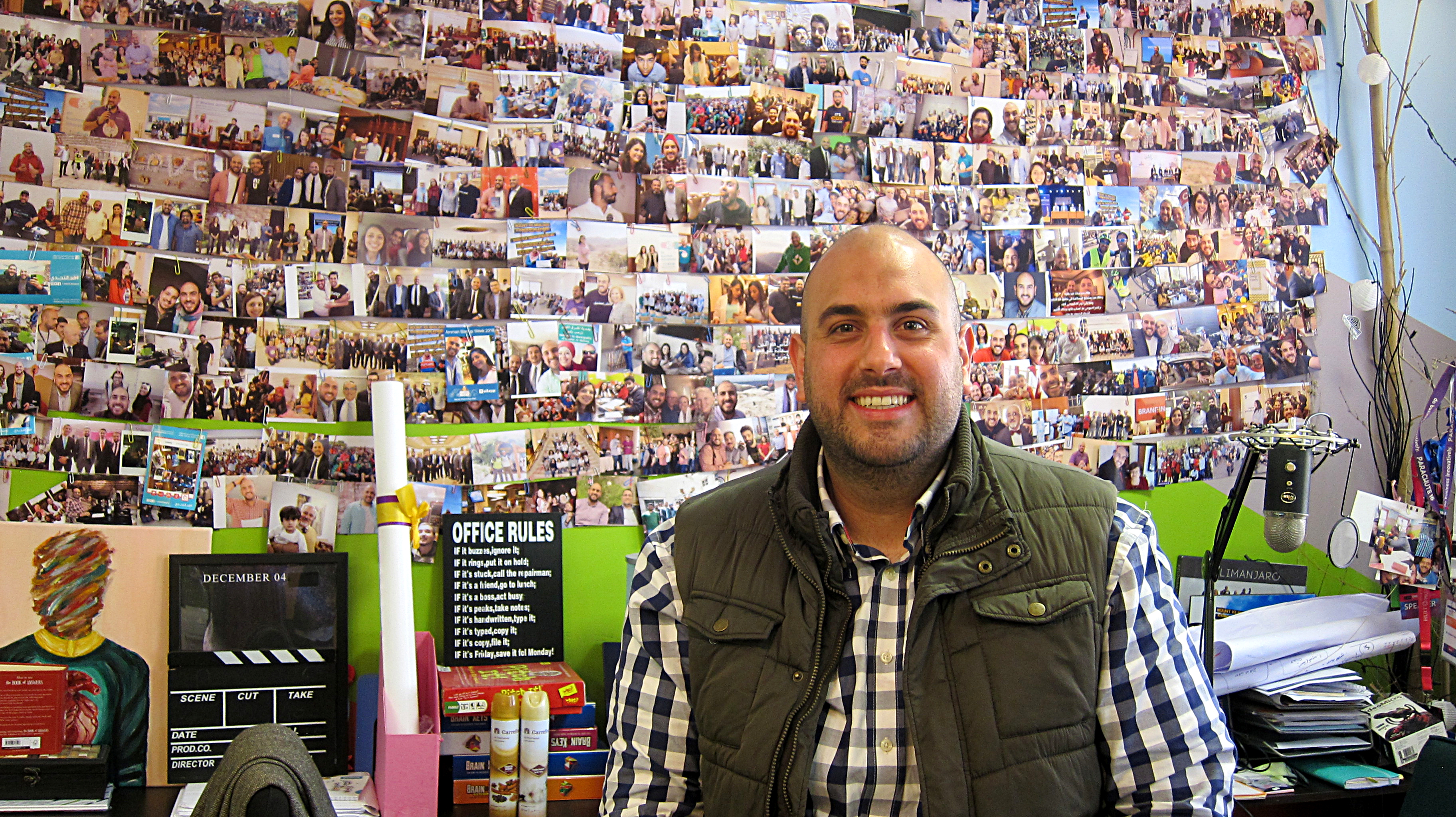
In Ghassan Halawa’s Amman office, the wall was already doing the introductions. Photographs covered it: groups, meetings, faces, people leaning into the frame. A microphone stood nearby. There were books, rolled papers and the cheerful evidence of a room being used. Anyone wishing to reduce entrepreneurship to a solitary genius and a laptop would have had trouble finding wall space for the theory.
The photograph, published in 2020, makes a useful starting point for Halawa’s story. The founder and CEO of parachute16 works in the business of bringing people together: entrepreneurs with mentors, young people with skills, institutions with communities. His working material includes the things a balance sheet has difficulty accommodating - trust, experience and the willingness to answer somebody’s call.
The experience he could put to work
Halawa arrived at this business after ventures that had gone badly. His earlier work crossed media, food, education, training, consultancy and e-learning. That range matters. It gave him repeated encounters with the practical problems of starting something: finding the right expertise, explaining an idea and getting beyond the people who already know you.
When money was scarce, he still had knowledge and relationships. A video by Aramex founder Fadi Ghandour helped him see a possible business in those remaining assets. Ghandour was discussing the need for startups that served other startups. Halawa recognized work he could do.
The idea has a plainspoken explanation. He had wanted help as a founder, so he would organize help for other founders. His own description remains the clearest: “We give the support we didn’t receive.” There is a commercial proposition in that sentence, and a memory of how it feels to need someone useful.
“We give the support we didn’t receive.”
Ghassan Halawa, 2021
Parachute16’s name carries his explanation of beginning an unfamiliar venture: the jump requires willingness, while skills and connections help make it possible. The metaphor is theatrical enough for a company name. The services underneath it are more workmanlike: accelerators, incubators, mentoring, training and introductions. Someone still has to arrange the meeting.
Before the accelerator, a room full of makers
In March 2015, Halawa was hosting a Maker Hackathon at the Zain Innovation Campus in Amman’s King Hussein Business Park. Over three days, participants developed prototypes, received coaching and presented their work. Ideas included an affordable home-security system and a laser-tag game using phones.
His argument then was already about the environment around an idea. Young people had energy and potential; experienced entrepreneurs could help them put those qualities to work. He wanted more creativity in education and more people working together. A competition supplied a deadline, a room and a reason to begin.
That early appearance helps explain the continuity in his career. Bringing a group together, adding expertise and asking it to produce something useful would remain central to his work. The subject might change from a prototype to a startup’s next market. The organizing problem would feel familiar.
That same year, Halawa joined enpact’s international mentoring program. Looking back in its 2020 yearbook, he described relationships that continued long after the fellowship itself: mentors who became friends, participants who remained in touch and contacts who became partners in parachute16.
He singled out exchanges with entrepreneurs and communities in Germany, Egypt, Tunisia and Morocco, as well as elsewhere in Europe. The program had helped his venture, but the continuing relationships were what he emphasized. A fellowship has an end date. Friendship is rather less obedient to the calendar.
It is a revealing account from someone whose later work would depend on assembling networks for others. He had experienced their value from the participant’s chair. Introductions became collaboration because people kept sharing advice, stories and expertise after the formal program was over.
A surprise visitor, and the work already underway
On January 16, 2018, Queen Rania made a surprise visit to companies in the Grow Startups building at King Hussein Business Park. Parachute16 was among them. Halawa’s team explained its plans and introduced projects it supported.
By then, the company’s work already combined consultation, incubator development, interactive learning and opportunities to meet investors and mentors. One initiative, Mesh Mostaheel, invited people across Jordanian society to propose solutions to challenges facing the country. Entrepreneurship here had room for community participation alongside company formation.
The visit offered a public glimpse of a business whose product could be difficult to photograph. Advice, preparation and access rarely sit obligingly on a display table. The people and projects in the room made the activity more tangible: a founder could arrive with a problem and encounter someone equipped to help.
enpact mentoring fellow
parachute16 in Amman
in MilkStraw AI’s round
Ghiras Demo Day, Riyadh
His interest in connections also extended to fellow social entrepreneurs. The International Youth Foundation named him to the YouthActionNet Alumni Council, launched in 2020. Its ten members were drawn from different regions and fellowship cohorts.
The council’s first-term responsibilities included strengthening community and helping fellows exchange knowledge and skills. The wider network had 2,000 members. That was another setting for the work Halawa repeatedly chooses: helping people who have already begun something find one another, learn together and keep moving.
Making the introductions travel
Parachute16’s own history traces its work across Jordan’s twelve governorates and then into Saudi Arabia. Its Saudi programs have included social innovation with the King Khalid Foundation and an accelerator in the dates industry. Dates are a useful reminder that entrepreneurship has customers well beyond the software conference.
The company also describes skills programs with Google Arabia and work preparing freelancers in Jordan. These sit beside its accelerator activity. A young person seeking usable digital skills and a founder seeking a route into a market need different kinds of assistance. Halawa’s company has built programs for both.
That breadth requires other people. The official team includes co-founder Razan Sharia alongside program, communication and project staff. Mentors and consultants add further expertise. The network has to be organized into schedules, learning sessions and follow-up if participants are to get something they can use.
A SPARK speaker biography credits Halawa’s experience with helping accelerate more than 200 startups and entrepreneurs locally and regionally. It lists collaborators including UNDP, GIZ, INJAZ Al-Arab, Monsha’at and Jordan’s Ministry of Digital Economy and Entrepreneurship. Those relationships place him between founders and institutions with very different responsibilities.
For an entrepreneur, that space can be hard to navigate. A ministry, a foundation and a prospective investor will each ask different questions. Helping a founder prepare for those conversations is part of making an introduction useful. A name in an address book is only the beginning of the job.
Coffee, color and a microphone
His colleagues supply a less formal picture. In a 2023 team introduction, they described an exuberantly sociable founder, fond of coffee and bright colors in both the office and his wardrobe. They pictured him scribbling ideas on flip charts and looking for ways to extend the team’s work.
It is an affectionate account, and it gives the organizational language a human face. The office has color. The meeting has coffee. An idea is likely to encounter a flip chart before it acquires a polished slide. His colleagues also emphasized a welcoming culture and his enthusiasm for the people around him.
Conversation became another part of the work through the parachute16 podcast. Its focus is the experience of entrepreneurs and experts in the region, including the journeys behind their decisions. The company’s podcast page features a conversation with Subhi Sallam about large corporations imitating startups.
The microphone offers a different pace from a workshop. A program asks participants to do something; a conversation lets them hear how somebody else approached a decision. Both can make experience available beyond the person who acquired it. Halawa’s interest in storytelling fits that same habit of sharing what people know.
Now he is backing founders, too
His involvement with startups has expanded into investing. In January 2025, he was named among the angel investors in MilkStraw AI’s $600,000 pre-seed round. Flat6Labs led the round, with Angel Spark, Beyond Capital and other angels participating.
MilkStraw AI works on cloud-cost optimization, helping businesses manage infrastructure spending. It is a practical problem for growing technology companies. Halawa’s place in the round puts him alongside other founders and investors backing a company that sells operational help to businesses.
Omla subsequently announced him as an investor and adviser, with parachute16’s backing. He pointed to founders Jovana Jovanovic and Fadi Alzeghan and their experience. In that role, the relationship includes capital and advice as well as the connections that have long been part of his work.
In a November 2025 interview at Biban, he described parachute16’s work helping entrepreneurs and growing companies expand within Saudi Arabia and into other markets. For the founder now based in Riyadh, the question of who can help a business take its next step remains close to the center.
His invitation to the Ghiras Accelerator Demo Day supplied a concrete example for the new year: five startups, January 4, 2026, at The Garage in Riyadh. The program was built with the King Khalid Foundation, and he described months of mentoring and work on market readiness before the presentations.
A stage is the visible part. The preparation takes longer, and the useful relationship may continue after the chairs are put away. Halawa’s career keeps returning to that interval: the work between meeting somebody and being able to help them. In the old Amman office photograph, the wall has made plenty of room for it.