A bank customer sees a payment go through. Mohammed Alhussein’s business concerns the decisions surrounding that small, satisfying moment: who is moving the money, whether the activity makes sense, and which warning deserves a human being’s attention. The visible experience is speed. Behind it sits a growing demand for judgment. A payment app has little room for the leisurely consideration once supplied by a queue.
Alhussein is the co-founder and chief executive of Mozn, the Riyadh enterprise AI company established in 2017. Its work brings together financial-crime prevention and the handling of Arabic-language information. These can sound like separate businesses until one considers what an institution actually needs: to understand the material in front of it, connect it to the right context, and decide what to do next.
His route into that problem passed through computer science, information security, university teaching and patented research. By 2026, the company he leads was pursuing a wider ambition: getting AI out of demonstrations and into the daily operations of banks and public institutions. The difficult part begins when the demonstration ends.
The information hiding in the traffic
Start with an earlier piece of work. In May 2014, a US patent called Website matching based on network traffic was granted. Alhussein appears among its inventors alongside Angelos Stavrou and Brian Sanders. Its subject was the possibility of identifying website traffic through the characteristics of the packets travelling across a network.
The method considered size, order and timing. Even when a message’s contents could not be read, its movement could disclose useful information. Imagine recognising a delivery by the dimensions of the boxes and the rhythm of their arrival. The analogy is imperfect, but it conveys the research question: how much can the surrounding pattern tell you?
The patent belongs to his research record, rather than a description of Mozn’s products. Still, the connection is interesting. His earlier work investigated what could be learned from a stream of activity. His later business would ask institutions to examine patterns in financial activity. Across both, apparently ordinary data could contain something consequential.
Three characteristics examined in the 2014 network-traffic patent. Small details can carry useful information.
His education took him from a computer science bachelor’s degree at King Saud University to a master’s in information security at Royal Holloway, University of London, and a doctorate at George Mason University. He also served as an assistant professor in King Saud University’s College of Computer and Information Sciences. The academic title has a specific history behind it.
Before Mozn, he was part of Elm’s founding team and served on SITE’s founding committee and board. Those positions placed him in Saudi technology organisations as well as academic research. Building software, explaining its workings and helping an organisation take shape are different responsibilities. His career had already included each before enterprise AI became his principal occupation.
A company built around decisions
Mozn began with Alhussein and Khaled Al-Ghoneim; Abdullah Alsaeed and Malik Alyousef later joined as co-founders. The founding group remains visible in its leadership: Alhussein as CEO, Al-Ghoneim as chairman, Alsaeed as chief strategy officer and Alyousef as deputy CEO. The business is a collective undertaking with identifiable people carrying distinct responsibilities.
Raed Ventures invested in 2022. A $10 million Series A, led by Raed with participation from Shorooq Partners, VentureSouq, Sukna Ventures and others, supported the company’s development. Its pitch already linked Arabic natural-language understanding with risk technology. The pairing preceded the present enthusiasm for putting a conversational interface on practically everything that has a power supply.
That choice matters to Alhussein’s story. A company can build a technology and spend years looking for a buyer’s problem. Mozn’s proposition put the institutional decision near the centre: extract information, understand it and use it in a setting where a mistake carries a cost. Research had to become something another organisation could run.
Arabic belongs inside the engineering
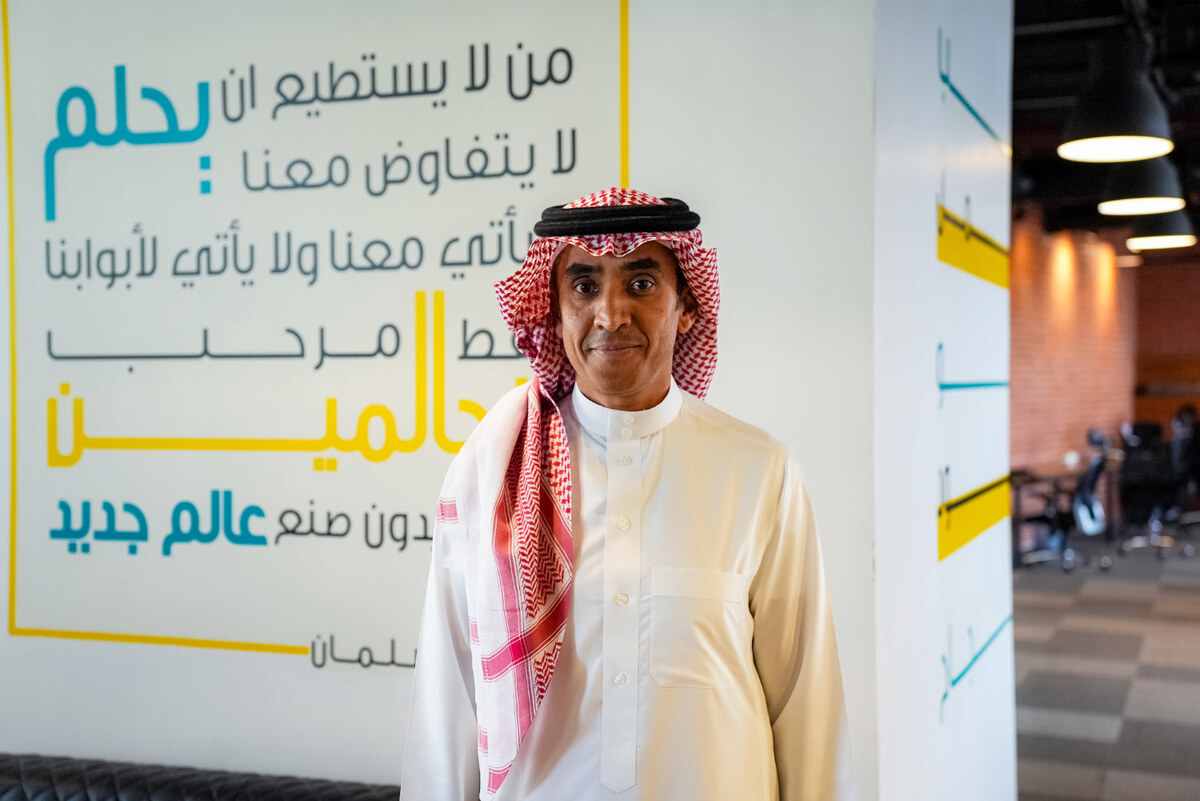
At the Global AI Summit in September 2022, Mozn presented OSOS, its Arabic natural-language understanding technology. The proposed applications included search, question answering and document analysis. Alhussein spoke about understanding the language’s particular complexities. This was a technical brief with a geographical home.
For an organisation whose records are in Arabic, language handling affects the usefulness of the entire system. A search tool must retrieve the right material. A document-analysis tool must identify what matters inside it. A fluent answer is pleasant; an answer connected to the organisation’s actual information is useful. That distinction gives the work a more demanding test than a polished conversation.
Mozn’s subsequent description of OSOS as enterprise knowledge intelligence keeps that institutional setting in view. The user is trying to work with knowledge an organisation already holds. The product’s purpose lies in making that material accessible and usable. The underlying challenge is familiar to anyone who has searched a shared drive whose filing system appears to have been designed during an evacuation.
FOCAL
Financial crime
prevention
OSOS
Enterprise knowledge
intelligence
Different tasks. A shared need for useful context.
The warning is only the beginning
FOCAL addresses financial-crime prevention. Customer screening, transaction monitoring and fraud detection form part of the work described in its industry profile. These functions sit behind services whose customers expect decisions quickly. A warning may be necessary, but somebody must still understand what prompted it and decide how to respond.
The 2026 RegTech100 profile describes capabilities including case investigation, alert triage and decision support, with deployment options spanning software as a service and private cloud. The vocabulary can become dense. The underlying operational question is straightforward: can the institution turn the information it receives into an investigation its staff can use?
Alhussein’s own April 2026 argument focused on that stage after detection. He described analysts piecing together material from disconnected systems and preparing case records. His proposed role for agentic AI was to assist investigators by assembling context and supporting their workflow. In that account, the investigator remains part of the process. Software has work to do before a person reaches a conclusion.
“Everything is digital.”
Mohammed Alhussein, 2024
That short observation captures the pressure on his customers. More activity produces more decisions, and the time available for each can shrink. For a founder selling into this environment, technical capability is only part of the assignment. The product also has to fit the institution’s existing systems and the way its people carry out their jobs.
The handshake and the hard part
On August 3, 2026, HUMAIN announced a strategic investment in Mozn and a partnership to develop enterprise AI together. It was described as HUMAIN’s first investment in a Saudi company. The agreement brought Alhussein’s business into a relationship with the PIF-backed AI company led by Tareq Amin.
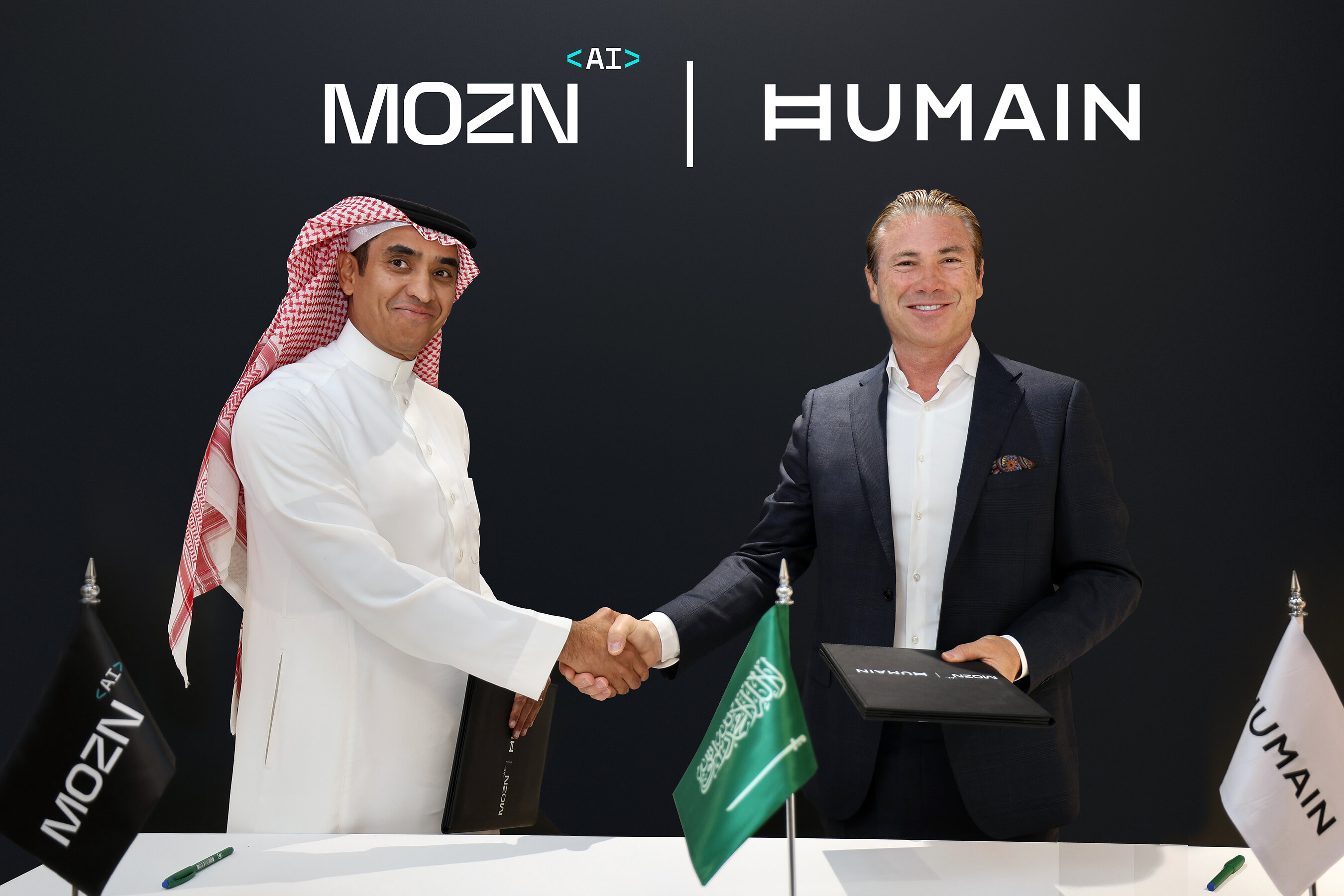
The partnership’s initial priorities included financial-crime prevention, knowledge intelligence and governance, risk and compliance. Jointly developed solutions were intended for the HUMAIN ONE AI Agent Marketplace. The announcement also described engineers working directly within client environments to help design and deploy applications. The intended destination was operating software inside an institution.
For Alhussein, this expands the question of scale beyond finding more customers. A larger distribution route needs products that can survive unfamiliar environments and demanding implementation work. It is easy to photograph a signature. The less photogenic achievement is getting a system to work reliably on an ordinary working day.
Building the route into the building
September brought further partnerships with NourNet, MDS and Ejada. Each covered practical aspects of deploying the Mozn AI Platform, from cloud infrastructure to systems integration and enterprise delivery. Their importance is architectural as well as commercial: AI has to reach an organisation through the infrastructure and relationships that organisation uses.
For a CEO, those agreements extend the work beyond the laboratory and the sales meeting. A customer needs an application installed, connected and supported. Partners can supply parts of that route. Their involvement reflects the breadth of the task facing Alhussein’s company as its product ambitions grow.
On October 7, Mozn announced that it had risen 13 places in the RiskTech100 2027 ranking and received the Middle East award for regional leadership and excellence. These are company recognitions, attached to the work of a team. They give the story a dated marker of progress without settling the questions every customer will ask about its own deployment.
- 2017Mozn established
- 2022$10 million Series A
- Aug 2026HUMAIN investment announced
- Oct 2026RiskTech100 regional award
The sports business that might have been
There is a pleasingly uncorporate answer in Alhussein’s account of his career. Asked what he might have done had he never started Mozn, he did not describe an inevitable destiny in finance. He suggested: “Maybe something on sports, because I love it.” It is a small glimpse of a life with other possible directions.
He had followed a difficult problem into a business. The route now connects a Riyadh company, Arabic information, bank investigations and a widening network of technology partners. His public conversation has followed that practical progression too: a September 2026 podcast appearance concerned trusted AI in institutions and the move from experimentation to adoption.
The split second remains the useful measure. A customer wants the payment completed. An investigator wants enough context to make a sound decision. An employee wants an answer that stands up when opened beside the underlying record. Alhussein’s work sits among those expectations, where the appeal of speed meets the responsibility of deciding what happens next.
Continue the conversation
- Mozn Company website and product information ↗
- Mohammed Alhussein on LinkedIn ↗
- Mohammed Alhussein on X ↗
- Watch: Alhussein on the Zero to One podcast Arabic conversation · September 2026 · YouTube ↗
- Website matching based on network traffic 2014 patent · Inventors and technical description ↗
- Generation Start-up: a conversation with Alhussein The National · May 2023 ↗
- AI and Saudi Arabia’s banking landscape Arab News · October 2024 ↗
- Alhussein on the future of financial-crime prevention Khaleej Times · April 2026 ↗
- The HUMAIN investment and partnership announcement MOZN · August 2026 ↗
- Mozn’s October RiskTech100 update ↗