Seven minutes can seem a generous allowance until you have spent more than sixty-three hours trying to earn them. In June 2014, George Sakellaris’s Shockwave reached Bermuda ahead of Hap Fauth’s Bella Mente. The two boats had spent much of the 635-mile passage within sight of each other. Sakellaris’s elapsed time was 63 hours, 4 minutes and 11 seconds. Fauth arrived 7 minutes and 14 seconds later. An ocean crossing had come down to the length of a coffee break.
On land, Sakellaris has spent decades making a related argument: small differences in how a system works can matter a great deal. A building that wastes less energy gives its owner money to spend elsewhere. Put enough such buildings together and the arithmetic changes for a utility, too. His career began with an ambition to design power plants. It developed around the possibility that some of them could be avoided.
A school trip, then a colder education
The original attraction was machinery. As a schoolboy in Greece, Sakellaris visited a hydroelectric plant and became absorbed by the process of turning one form of energy into another. “From that moment, I knew I wanted to design power plants,” he later recalled. There is something pleasing about the detour that followed: the boy admired the generating station; the grown engineer learned to question whether another one was needed.
He came from Vassara, near Sparta, and left Greece for the United States in 1965. Maine supplied an immediate lesson in geography. He stayed with relatives in Bangor, studied engineering and worked in a variety store and a family restaurant. Summer work could mean sixteen-hour days. The move from a place where snow was unusual to a Maine winter made an impression quite apart from the coursework. America had opportunities. It also had a rather forceful thermostat.
He earned his electrical engineering bachelor’s degree at the University of Maine in 1969, then added graduate study in electrical engineering and business administration at Northeastern. That combination helps explain the career that followed. Understanding the equipment was one requirement. Finding a way for a customer to pay for improvements was another. The second question would occupy almost as much space as the first.
Maine later recognized the career that grew out of that education with an honorary doctorate in 2012. In 2017, its Francis Crowe Society inducted him into its Hall of Fame. Those visits back to the university place the student jobs and the later company in the same frame. The education was followed by decades of work applying it.
When the utility asked for less
At New England Electric, Sakellaris worked on the question of meeting future demand through conservation. During the energy anxieties of the late 1970s, he and three colleagues examined whether encouraging customers to use less could remove the need for proposed generating capacity. The utility put him in charge of a new energy-services subsidiary. Selling restraint was an unusual assignment for a business accustomed to supplying electricity.
The underlying question was practical. If a customer could obtain the same useful service from less energy, why pay to produce the wasted portion? The engineer’s attention shifted from the plant to the customer’s premises. Equipment, controls and operating habits became part of the supply equation. The saving might be hard to photograph, but the difference would appear on a bill.
He eventually bought the business, renamed it NORESCO and sold it to Equitable Resources in 1997. He stayed to lead NORESCO and became a senior vice president at its new parent. The sequence gave him experience on several sides of the same industry: a utility subsidiary, an independent services business and a company operating within a larger energy group.
“Deliver what you say you will.”
George Sakellaris, on starting a business
By May 2008, he was explaining the efficiency business before a congressional committee. The hearing’s title included the term “negawatts”: electricity demand removed through efficiency. His testimony described performance contracting as a way to make improvements and pay for them from the resulting savings. The appeal lay in joining an engineering proposal to a financing mechanism. A promising calculation on its own could leave a customer admiring a project that never got built.
Let the savings help pay the bill.
- 01Find the wasteAssess energy use and equipment.
- 02Make the changesInstall agreed improvements.
- 03Measure the resultVerified savings support project payments.
How energy performance contracting can work. Contract terms and results vary by project.
A fresh start at a restaurant table
Ameresco began in April 2000. Sakellaris’s recollection of its conception places him with a couple of confidantes at Joe’s American Bar & Grill on Route 1 in Dedham, Massachusetts, with a napkin and an idea. After selling a business and spending time under its new ownership, he wanted to build again. A restaurant booth offered sufficient headquarters for the opening discussion.
He wanted customers to be able to see what they were buying. The energy industry’s enthusiasm for combining services and commodities had left room, he believed, for a company approaching the problem from the customer’s perspective. Ameresco would be independent of particular suppliers and products. That independence made room for an engineer to recommend the equipment that fitted the job, rather than starting with a manufacturer’s catalogue and searching for somewhere to put it.
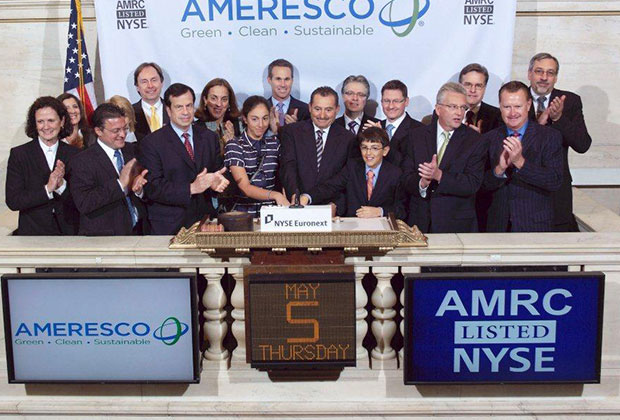
Taking Ameresco public in 2010 brought another set of considerations. Employees had accumulated stock options, and Sakellaris wanted them to have a way to realize some of that value. The company also needed capital for growth. His explanation of the decision was rooted in those two needs: people who had helped build the business, and money to keep building it.
Some of the company’s work has a nicely literal quality. At a South Carolina landfill, Ameresco captured and cleaned methane, then sent it through a ten-mile pipeline to BMW’s manufacturing facility. Turbines that had used natural gas could use the recovered fuel. The arrangement connected an unwanted byproduct at one site to a useful input at another. Sakellaris discussed the project years later with the satisfaction of someone describing a machine whose parts fit.
Tomorrow gets a place on the desk
Sakellaris has said that he still turns to Peter Drucker for management guidance and encourages colleagues to read him. The emphasis he takes from that reading is on what the organization will do tomorrow. In his account of the industry’s development, LED lighting, solar, microgrids and battery storage became economically useful at different points. Keeping a company relevant meant watching those changes closely enough to act.
The questions also widened. A customer might want a lower bill, reduced emissions and a facility that could continue operating during a grid interruption. In 2024, Sakellaris described growing demand for resilience and talked about hiring and training engineers through university relationships. Northeastern’s co-op students were among the recruits. His own passage through engineering and business classrooms had become, in part, a route for bringing other people into the work.
Europe remained an ambition, too. In July 2024, Ameresco’s joint venture with Sunel announced that construction had begun on Lightsource bp’s 560 MWp Enipeas solar project in Greece. Sakellaris emphasized the use of local talent and the benefits to the local economy. For someone who had left a Greek village to study electricity abroad, the project supplied a concrete connection between his starting point and his company’s expansion.
The other performance contract
Then there is the business conducted under sail. In 2016, his Maxi72 Proteus won the RORC Caribbean 600 overall under the IRC handicap rule. He had won the same trophy with Shockwave in 2014. The distinction matters: crossing the finish line first and winning on corrected time are different achievements. Offshore racing gives arithmetic a vote in the prizegiving.
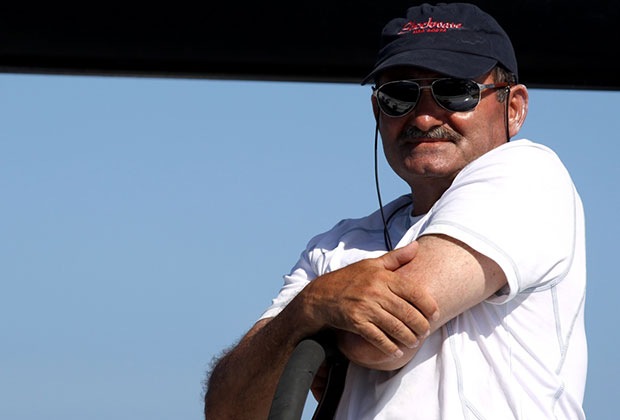
After the 2016 win, Sakellaris congratulated the other competitors and acknowledged the part played by luck. He had a trophy to collect, but his remarks left room for the teams he had beaten. The result followed a race around eleven Caribbean islands, a course that asks crews to keep making decisions as conditions change. A good boat still needs people who can work it.
7m 14s between them after an ocean crossing.
Elapsed time, hours:minutes:seconds. Bars begin at zero; the gap is deliberately small.In October 2023, Sakellaris returned to Greece for a Northeastern gathering of students, graduates and other university community members. His advice began with three words: “Challenge the system.” He connected the determination to pursue work one cares about with the ability to carry on through a business downturn. The setting gave the advice some history. He had left his family’s farm decades earlier; now he was speaking to people considering their own next steps. The route between those moments had included study, employment, ownership and a fresh start. It offered a useful caution against treating a career as a straight line.
The next load on the system
In April 2026, Nicole Bulgarino and Lou Maltezos became Ameresco’s co-presidents, while Sakellaris continued as CEO and chairman. The organization he had started with a handful of people was adding leadership capacity for another phase. Data centers and large energy projects were among the stated priorities.
By the August 2026 earnings call, he was discussing how data-center awards progress toward contracts and construction. He described a possible six-to-twenty-four-month passage from award to contract, followed by implementation. The timetable was a reminder that urgent demand for electricity still meets the measured pace of engineering, procurement and construction. A customer can need power immediately; a complex plant has its own schedule.
That brings Sakellaris back to the question that redirected his early career: how much new supply is required, and how much demand can be avoided? His work now includes building on-site generation as well as improving efficiency. The schoolboy’s fascination with power plants survives alongside the utility engineer’s interest in using less. Between them sits a business, still occupied with getting the parts to work together.
Keep following the current
Conversations, writing and race-day details.
▶ WATCH / YOUTUBESakellaris on data centers and energy infrastructureFox Business · April 2026