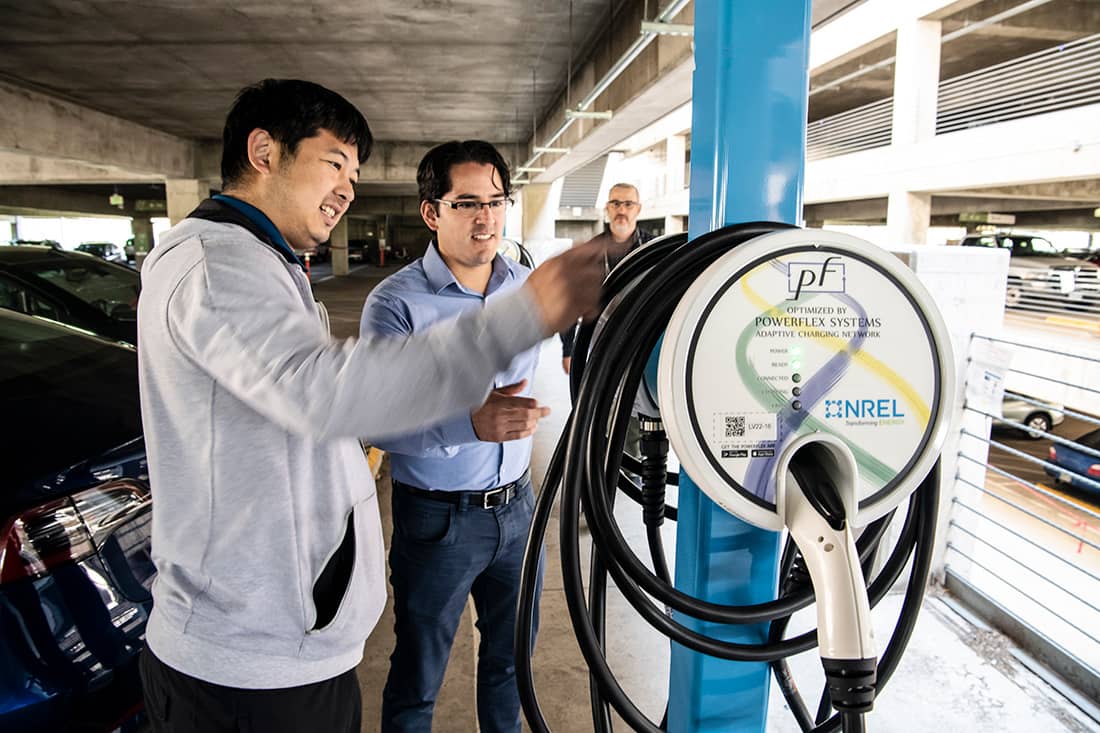
In May 2019, George Lee was applying QR codes to electric vehicle charging equipment in a Colorado parking garage. He was the CEO of PowerFlex Systems. A few months later, EDF Renewables would announce its acquisition of the company. For the moment, there were labels to put on chargers.
The scene has the proportions of a good engineering story: a large ambition, a small task, and an actual piece of equipment between them. Employees at the National Renewable Energy Laboratory could use an app to scan the codes and pay for electricity. The charging system needed algorithms. The person standing beside it needed to know what to do next.
Lee holds a Caltech master’s degree. His earlier affiliations also include FastSoft, another company linked to Caltech professor Steven Low’s research group. The connection places PowerFlex within a longer collaboration between academic work and commercial systems. On his LinkedIn profile, Lee describes his interest in plain terms: “Applying the latest technologies to help solve difficult problems.” The charging projects give that brief statement a physical address.
Lee had helped carry an idea out of Caltech and into installations used by working drivers. His public career keeps returning to that short distance between a system’s design and its everyday use. Follow it far enough and the acquisition gives way to another parking lot, this time at a school near home.
Fifty-four plugs, one shared problem
In 2016, Lee was volunteering in the laboratory of Steven Low, Caltech’s professor of computer science and electrical engineering. Their subject occupied a particularly unromantic research setting: the California Parking Structure. By that April, the campus had 54 charging stations, installed in February and connected through an Adaptive Charging Network.
The obstacle Lee described was economic. Many sites had only a handful of chargers because electrical upgrades and construction were expensive. A network could coordinate charging within the infrastructure already available, making more places to plug in affordable. His stated ambition concerned access: enough stations for people to consider owning an electric car.
“We believe having ample charging stations available is the key to widespread EV adoption.”
George Lee · April 2016
A socket is an invitation. A scarce socket can become a daily negotiation. Who arrived first? Who has finished? Who must interrupt a meeting to move a car? Providing more connections changes that experience, even when the electricity feeding them remains constrained.
Lee’s eventual business would have to make the coordination dependable. The driver’s needs, the building’s demand, and the capacity of the installation all had to fit together. A parking garage offered the research team something less forgiving than a tidy equation: people with departure times.
A plug for the driver.
A schedule for the electricity.
- 01UnderstandDriver energy needs and departure time
- 02CoordinateAvailable capacity and building demand
- 03AdjustCharging power as conditions change
Conceptual guide to adaptive charging. No measured performance data shown.
A laboratory with cars in it
PowerFlex entered the Wells Fargo Innovation Incubator, known as IN2, in 2017. At NREL’s Flatirons Campus, the company could test its equipment alongside the researchers who would help evaluate it. The laboratory also supplied a useful complication: it was a workplace with its own energy requirements.
The distinction matters. A demonstration can prove that equipment responds to commands. A workplace asks whether it can respond while the rest of the building carries on. Through the partnership, PowerFlex used operating data and technical assistance to improve its product. The customer and the experiment shared a parking lot.
NREL subsequently ran an independent procurement and selected PowerFlex for a larger installation at its South Table Mountain campus. Validation had led to a paying customer, with a competitive selection in between.
In May 2019, 108 PowerFlex-supported charging stations were installed at South Table Mountain. Lee later credited NREL with helping develop driver pricing, including individual requests and load management. His description of the collaboration was practical: the research reached into what customers would pay and how they would use the system.
“NREL helped develop the pricing structure for drivers”
George Lee · IN2, October 2019
That is a revealing place for research to land. A price appears on a screen. Behind it sit decisions about demand, timing, and the building. The campus project brought those decisions into the same conversation.
The city gets a vote
At San Leandro Tech Campus in the Bay Area, the problem had a different shape. Electrical conduits were already built into the garage, but chargers had not been installed when the campus opened. Tenants began asking for them. Infrastructure can be prepared for a future that still needs someone to arrange its arrival.
PowerFlex handled the layout and permitting for an installation of 39 chargers. Lee, identified as a senior vice president in the project’s case study, described the municipal approval with a detail any project manager would appreciate: “We had the permit within two weeks”.
There is little glamour in that sentence. There is considerable relief. A charging system has to pass through drawings, an owner’s approval, construction, and the questions of people responsible for the property. An algorithm cannot submit its own plans to the city.
The San Leandro episode widens the picture of Lee’s work. He was helping sell a functioning installation, with the electrical design and institutional patience that required. The garage would ultimately be judged by whether drivers could charge their cars. All the preceding negotiations had to disappear into that ordinary result.
Lee’s stated time to obtain the San Leandro permit. One project’s experience, rather than a promised installation timeline.
September 2019: the system gets bigger
On September 3, 2019, EDF Renewables North America announced the PowerFlex Systems acquisition. Lee was CEO. The Los Altos company brought managed charging technology developed from Low’s Caltech research into a business with solar, storage, and energy-management capabilities.
Lee’s argument at the time extended beyond getting more chargers into the ground. He advocated low-cost workplace charging during the day, when electric cars could make use of solar production. Vehicles would become a flexible demand that could be coordinated with a variable supply.
It was a different way of looking at the employee parking lot. The car sitting there through the working day had time available. The building had electrical limits. Solar generation followed its own pattern. Connecting those facts created a job for software and a reason for charging to belong in a larger energy business.
By November 2021, Lee was speaking as PowerFlex’s chief product officer about a planned installation at LAX Economy Parking: 500 Level 2 chargers and eight fast chargers. The setting had grown from a campus garage to an airport facility. The coordination problem remained recognizable: many vehicles, individual needs, and an electrical service that had to be shared.
The parking lot goes back to class
Commercial deployment did not end Lee’s connection to research. He co-authored Adaptive Charging Networks: A Framework for Smart Electric Vehicle Charging, published in IEEE Transactions on Smart Grid in 2021. The paper described the architecture and algorithms behind the network, including the awkward behavior that real equipment brings to an otherwise elegant plan.
Electrical phases can be unbalanced. Charging behavior can depart from ideal models. Control signals come with practical restrictions. Those are useful subjects for someone whose work had to survive an occupied garage. The paper treated the messiness as part of the engineering.
Lee and Low also appear as co-inventors on a charging-network patent granted in November 2021. Their shared work continued into a Stanford seminar scheduled for February 9, 2023, covering system design, deployment data, and the difficulties of getting clean technology startups off the ground.
The seminar’s scope joined business experience to technical detail. It also included open research tools built around Caltech’s network, allowing other researchers to work with charging data and simulation. A system installed for drivers could keep teaching people who were designing the next one.
Back to the neighborhood
In February 2026, Lee appeared in a Los Altos High School community announcement as founder and CEO of OPF Energy. He had donated and installed additional campus charging stations at no cost to the school. They were in the auxiliary lot beside the track, supplementing the existing faculty-lot chargers.
The arrangement made the equipment useful beyond the school day. Community members could charge outside school hours, including weekends and holidays. Another institution’s parking spaces had acquired a second purpose.
OPF’s business addresses electrical constraints through real-time coordination of building loads and EV charging. The company’s focus connects with the problem Lee was working on at Caltech a decade earlier: fitting new electrical demand into a facility that has other things to do.
At OPF Energy, the facility is the starting point. When building demand rises, the platform adjusts flexible loads, including EV charging, to stay within electrical limits. That puts the charger in a relationship with other equipment instead of treating it as an isolated appliance. For the person managing a property, the desired result is deliberately uneventful: the building continues operating, and charging is coordinated around what the site can support.
Then came a smaller update. On March 27, the school credited Lee with completing a breaker upgrade the previous weekend. Regular chargers could now operate at their full rated speed, up to 48 amps, or 11 kilowatts.
A founder’s career can be measured in an acquisition, a patent, or the size of an installation. Lee’s also contains QR labels and a weekend electrical upgrade. These details give the larger milestones their human scale. Someone has to make the connection work. Years after the Colorado parking garage, he was still attending to that end of the cable.
Follow the current
Continue with George Lee’s work and the projects along the way.