The revealing detail in Shopify’s move to mobile office badges is that the first version made getting inside more complicated. A booking application sat in the access flow. Adoption was low. The company simplified the process, then rolled out Apple Wallet credentials in 2023. The useful innovation was partly subtraction: fewer things to do while standing at a door.
THE SHORT VERSION
- Genea connects building access, visitors, cooling requests and tenant utility billing.
- Its security pitch combines compatible hardware, identity integrations and live support.
- The practical lesson: remove administrative steps before adding another interface.
The badge was not the bottleneck
Genea occupies the unglamorous territory between an intention and a building doing what someone needs. An employee joins. A contractor arrives. A tenant works late. Somewhere, somebody must translate that event into permission, a schedule or an invoice. Multiply those translations across offices and the receptionist’s small interruption becomes the security team’s permanent workload.
The company supplies cloud software for physical access control, visitor management, on-demand HVAC and submeter billing. Its buyers include enterprise IT and security departments, property managers and building engineers. Adyen’s published deployment spans 28 offices in 18 countries. Those numbers make the problem tangible: a local door can belong to a very international administrative system.
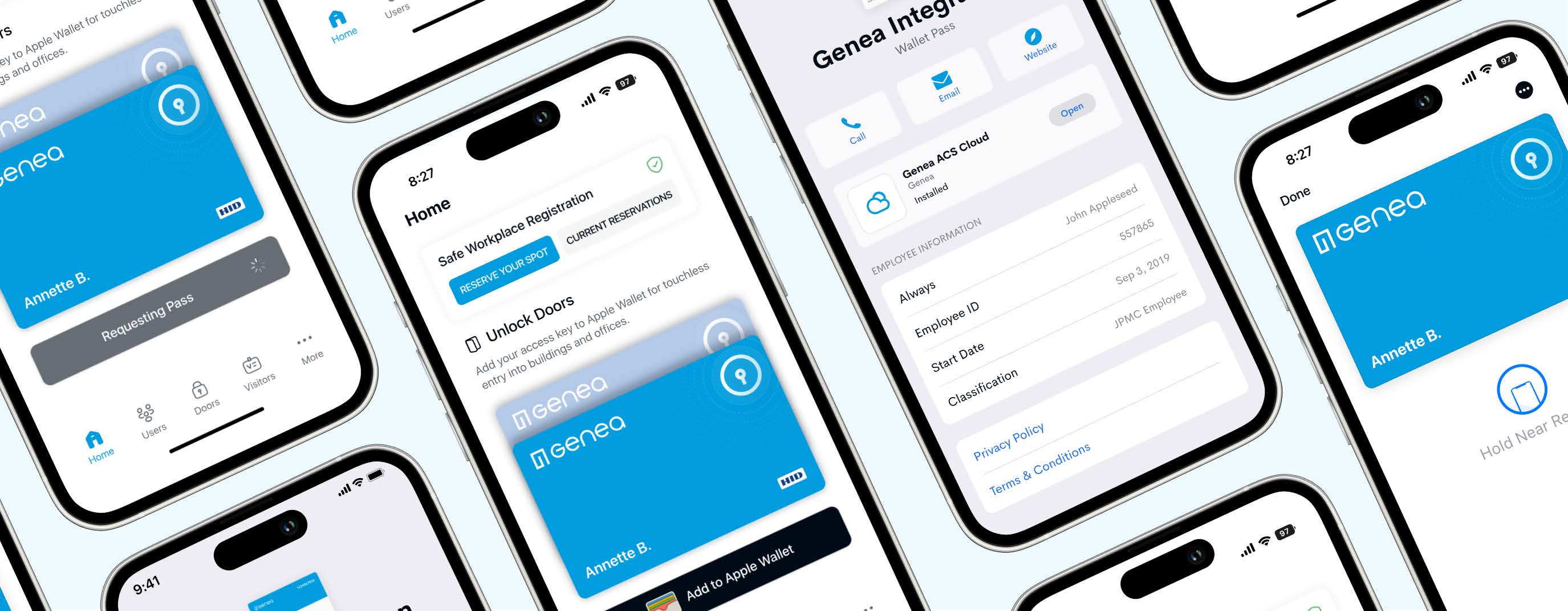
Shopify’s physical security lead, Chris Lafrance, offered a wonderfully short assessment: “Apple Wallet changed everything.” The company’s experience suggests a useful distinction. Putting a credential on a phone is a technical accomplishment. Making it convenient enough for people to use is a separate piece of work.
First came the air conditioning
Genea’s route to the office door ran through heating and cooling. In a published podcast transcript, CEO Michael Wong describes a predecessor called ACS, the After Hours Control System. Tenants could request extra service through a touch-tone telephone. A server in the building connected those requests to its controls. Even the future once required pressing a number on a keypad.
Then, around 2006 or 2007, the Irvine Company wanted the system across its portfolio, Wong recalled, with one condition: it did not want servers scattered through its buildings. Maintaining and upgrading them would become another property-team chore. That customer request helped push the application toward hosted software. The appealing feature was the removal of maintenance work.
Wong came from private equity. In his account, Genea was struggling after the financial crisis when the board asked him to invest and become CEO in 2011. Recurring monthly revenue helped persuade him. His operating philosophy was incremental: make the next investment after earning the capacity to fund it. This was building software with a cash-flow conscience.
ONE REQUEST, THREE JOBS
Illustrative On-Demand HVAC workflow. Manual intervention can remain part of fulfillment.
Keep the hardware. Fix the handoffs.
Genea announced its acquisition of cloud access company Sequr in February 2020. Wong said existing HVAC and billing customers had been asking for access-control help. The logic was adjacent rather than mysterious: the same property teams already trusted Genea with another operational problem. Security added a new set of doors to an established customer relationship.
In a market that includes Brivo, Avigilon Alta and Verkada, a cloud dashboard alone offers little distinction. Genea emphasizes non-proprietary Mercury hardware, integrations and direct end-user support. Compatible equipment can stay in service. Identity tools such as Okta and Microsoft Entra ID can connect personnel changes with physical access. Camera integrations can place door events beside video.
The awkward work still matters. In Genea’s Sage Realty case study, integrator Grid Squared Systems surveyed existing panels and wiring. A three-door office pilot preceded wider implementation. Duplicate user records needed cleaning, too. Copy that sequence: inspect the equipment, clean the identities, prove the workflow on a small installation, then expand. A new dashboard cannot tidy a database by looking attractive.
A local door can belong to a very international administrative system.
The commercial model pairs recurring software with the realities of installation and service. Buyers should price the subscription, compatible controllers and readers, credentials, integrator labor and migration together. Genea advertises no setup fees for Submeter Billing; that specific offer should not be stretched into a promise of free security installation. Hardware reuse can reduce a bill without making it disappear.
Visitors introduce a different clock. An employee may need standing access; a guest needs a specific visit. Genea’s visitor tools connect invitations and check-in with access administration. For a property team, the attraction is fewer disconnected records to reconcile. For the person arriving, the test is simpler: does the front desk know who is expected?
The meter still needs reading
The billing product reveals Genea’s practical streak. Networked meters can send readings through the building management system. For meters without that connection, the workflow uses a QR code and a smartphone photograph. Someone still walks to the meter. The improvement comes afterward, as readings become organized records and tenant invoices, with unusual values flagged for attention.

There is a concrete economic example. Genea reported that a 700,000-square-foot South Florida building added $45,000 in after-hours HVAC revenue over twelve months. The explanation included easier requests and more complete billing. Treat that as one reported building’s result. Lease terms, occupancy and existing billing discipline determine whether another property has similar money to recover.
Nor does automation erase building constraints. Genea’s HVAC materials describe cases in which engineers must retain manual control. Access projects require compatible hardware and a plan for credential migration. A buyer’s useful question is therefore specific: which repeated task disappears, and which person still owns the exception?
That exception is where the support promise becomes consequential. Genea offers live help around the clock, including to end users. Building operations do not politely stop at the end of the software team’s day. A weekend access problem is still somebody’s problem, and the service model determines whose.
The next interface is a sentence
Genea’s newer MCP connection lets supported AI assistants handle access-administration requests in ordinary language. Existing permissions carry over, and actions enter the audit log. The guide says it is included for customers at no extra cost. Genea also has a product reveal scheduled for October 29, 2026. Whatever arrives next, Shopify’s lesson remains a good test: count the steps between wanting to enter and getting through the door.