A boxing game is a curious place to begin a career in financial technology. It does, however, teach an audience something about buttons. Before Gaspard de Dreuzy co-founded Pager, before the brokerage connections and the crypto apps, he worked in video-game production. His credits included the Ready 2 Rumble Boxing franchise. Years later, he would help put a stock portfolio inside an interface built around dragging and dropping. The distance between those two screens is smaller than the distance between their industries suggests.
Games ask people to enter an unfamiliar world and start doing things. Financial software often asks them to understand the world first. De Dreuzy’s ventures offer a running experiment in changing that order. At Kapitall, the invitation was visual and playful. At TradeIt, it was a connection to an existing brokerage account. At Ulys, it has become a conversation. Each approach addresses the awkward interval between wanting to do something and knowing how.
The boxing game before the brokerage
His early working life crossed entertainment businesses that knew a good deal about attracting attention. He advised Warner Music and produced video-game software, working with publishers including Atari, THQ and Mattel. He co-founded three game production, development and consulting companies. His experience covered PC and console titles, a professional background with rather more controllers than the usual founder biography.
There was a financial education, too: he studied at Université Paris Dauphine. The combination matters. The eventual move into investing brought an entertainment producer’s experience into a field he had also encountered academically. His career would repeatedly join people who understood financial systems with people who understood how consumers behaved around a screen.
For the purposes of understanding his work, the interesting object is the interface itself. A controller gives a player a limited set of actions inside a complicated system. An investing screen also translates an underlying system into choices someone can make. Borrowing ideas from one field for the other can make an entrance more inviting. It also leaves a serious question about what the person has understood when they step through it.
Two school friends, one unfamiliar market
Kapitall had a more personal beginning than a meeting assembled around a business plan. De Dreuzy and Serge Kreiker had met at school in Paris. By the time they were profiled together in 2011, the friendship stretched back roughly twenty years. Kreiker had worked at Bloomberg in New York. De Dreuzy had been building game-production businesses in Paris, then moved to New York in 2006.
They wanted to build a company together. In 2008, Kapitall gave that ambition a name. Their respective backgrounds were useful ingredients: financial technology on one side, games on the other. The business brought a visual approach to an activity more commonly presented through rows of numbers. It is an appealing origin story partly because the partnership preceded the pitch. They already knew each other before they needed to explain a market.
At its 2009 Finovate presentation, Kapitall described an investing environment modeled on video games. Users could explore investments, research companies, collaborate and track their progress. Drag-and-drop interaction was central. The proposition included a way to begin without first opening a brokerage account. Learning and participation could start before the paperwork became the main event.
An editorial comparison of product approaches, not a performance ranking.
Wall Street gets a happy hour
Some of Kapitall’s choices were cheerfully literal. In May 2012, it offered a week of commission-free trading around Facebook’s IPO, subject to the promotion’s limits. The following month came a daily Happy Hour: a commission-free window whose start time would be announced on Twitter five minutes beforehand. Brokerage marketing had acquired the scheduling habits of a neighborhood bar.
The promotion makes the games background tangible. It offered a reason to return, a clock to watch and an event to share. Those are recognizable tools for building participation. They also make clear that an interface extends beyond the arrangement of buttons. The message that brings someone back to the screen is part of the experience, too.
By September 2012, Kapitall reported more than 100,000 registered users. In 2014, its announced membership exceeded 200,000. These were company-reported membership figures, rather than a count of profitable investors or evidence of investment results. They nevertheless show that the experiment had attracted an audience. An unusual idea about the appearance of investing had become a working business with people returning to it.
From the corner office to the product desk
In September 2012, Kapitall appointed Jarrett Lilien, the former E*TRADE president and chief operating officer, as chairman and CEO. De Dreuzy continued as chief innovation officer and head of product. The change put a brokerage veteran in the chief executive’s seat while leaving the founding CEO with a role close to what customers actually touched.
That division of work is a revealing detail in a career often compressed into a string of co-founder titles. Companies need different kinds of attention as they develop. In this case, the formal handover kept a place for product work alongside the incoming executive’s responsibility for growth and the business. De Dreuzy’s next public demonstrations continued to concern the experience of using the software.
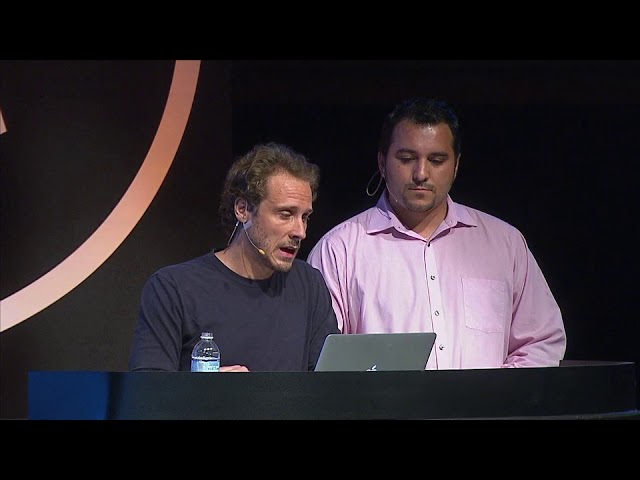
At FinovateFall 2014, he appeared with Antonio Reyes, Kapitall’s head of development, to present Tournament & Pocket. The product brought practice portfolios, tournaments and live brokerage access to iOS. The desktop experiment was moving into a pocket, with the same interest in giving people different ways to participate.
That year, he also co-founded Pager, where he served as CEO. A 2017 interview identified him as president and co-founder. His comments about building products were refreshingly provisional: “We take nothing for granted.” He described releasing imperfect things, listening to feedback and continuing to test. It is a working method with room for correction, an essential allowance when a product meets actual people.
“We want to stick to our fundamentals but also test new things.”
Gaspard de Dreuzy, 2017
The trade that follows you
TradeIt approached investing from a different direction. Co-founded by de Dreuzy, Nathan Richardson and Serge Kreiker, it connected brokerage accounts with outside websites and apps. Someone encountering financial information could act through an existing account from that environment. The company was working on the gap between the place where an idea occurred and the place where a trade could happen.
The distinction from Kapitall is useful. Kapitall built a destination and tried to make it inviting. TradeIt supplied connections that other destinations could use. A founder associated with a visibly playful product was now involved in infrastructure that could work behind another company’s interface. The common concern was the amount of effort demanded from the user.
On April 9, 2019, TradingView announced that it had acquired TradeIt. The buyer said the deal would help it add brokers faster and expand through partnerships. That is a concrete commercial outcome for a business built around connecting existing systems. The value sat partly in making those systems easier to bring together, even when the customer might never learn the connector’s name.
An interface cannot carry the whole business
Voyager introduced a more difficult chapter. De Dreuzy co-founded the crypto brokerage alongside Stephen Ehrlich, Philip Eytan and Oscar Salazar. It was built around retail access to cryptocurrency markets. Its subsequent court disclosure described a platform that had reached a peak of 3.5 million users and held more than $5.9 billion in cryptocurrency assets.
On July 1, 2022, Voyager suspended trading, deposits and withdrawals. It filed for Chapter 11 on July 5 and announced the process the following day. Those events belong alongside the growth figures. The business had attracted a large audience; its customers then faced the consequences of its failure.
For anyone reading de Dreuzy’s career as a story about accessibility, Voyager changes the weight of the word. Making a financial product easier to enter creates obligations that continue long after entry. An interface can organize choices and explain actions. The company behind it still has to withstand demands that a well-designed screen cannot settle. Product appeal and business durability deserve separate examination.
Back to the opening move
A September 2025 prospectus identified de Dreuzy as co-founder and CEO of Ulys, and named him an advisor to FutureCrest upon the start of its NYSE trading. In a July 19, 2026 launch announcement, Ulys described a U.S. iOS app for on-chain finance built around conversational interaction. Users could research assets and prepare transactions, then review and confirm before execution.
The progression is striking without requiring a tidy redemption story. Kapitall offered objects to move. TradeIt connected the account a person already used. Ulys lets the person begin with words. These are different answers to a recurring design problem, rather than proof that one answer has finally resolved it.
De Dreuzy’s working life has moved through several kinds of software, several business models and very different outcomes. The old game-production detail remains useful because it points back to the moment before participation: someone is looking at a screen, deciding whether they understand enough to continue. A great deal of work has gone into making that first move feel possible. What follows the click is where the promise has to hold.
Follow the next move
Public profiles, product demonstrations and further reading.